Year 4 – Week 35 (April 28 – May 4, 2024 – Holy Week)

Day 1 (Monday)

Daniel 3:46-96 (Song of the Three Youths)

Last time we saw the Three Servants of the Lord (Azariah, Hananiah, and Mishael, or Shadrach, Meshach, and Abed-Nego) refuse to worship the statue set up by King Nebuchadnezzar, and therefore be thrown into the fiery furnace. As they went in, Azariah prayed a prayer of repentance and faith, asking for mercy and deliverance for them, and for all their people. This time, we will see what comes of this.

The Song of the Three Servants

46 Now the king’s servants who threw them in kept stoking the furnace with naphtha, pitch, tow, and brushwood. 47 And the flames poured out above the furnace forty-nine cubits, 48 and spread out and burned those Chaldeans who were caught near the furnace. 49 But the angel of the Lord came down into the furnace to be with Azariah and his companions, and drove the fiery flame out of the furnace, 50 and made the inside of the furnace as though a moist wind were whistling through it. The fire did not touch them at all and caused them no pain or distress.

51 Then the three with one voice praised and glorified and blessed God in the furnace:

52 “Blessed are you, O Lord, God of our fathers,
and to be praised and highly exalted forever;
And blessed is your glorious, holy name,
and to be highly praised and highly exalted forever.
53 Blessed are you in the temple of your holy glory,
and to be extolled and highly glorified forever.
54 Blessed are you who look into the depths from your throne on the cherubim,
and to be praised and highly exalted forever.
55 Blessed are you on the throne of your kingdom,
and to be extolled and highly exalted forever.
56 Blessed are you in the firmament of heaven,
and to be sung and glorified forever.

57 “Bless the Lord, all you works of the Lord;
sing praise to him and highly exalt him forever.
58 Bless the Lord, you heavens;
sing praise to him and highly exalt him forever.
59 Bless the Lord, you angels of the Lord;
sing praise to him and highly exalt him forever.
60 Bless the Lord, all you waters above the heavens;
sing praise to him and highly exalt him forever.
61 Bless the Lord, all you powers of the Lord;
sing praise to him and highly exalt him forever.
62 Bless the Lord, sun and moon;
sing praise to him and highly exalt him forever.
63 Bless the Lord, stars of heaven;
sing praise to him and highly exalt him forever.

64 “Bless the Lord, all rain and dew;
sing praise to him and highly exalt him forever.
65 Bless the Lord, all you winds;
sing praise to him and highly exalt him forever.
66 Bless the Lord, fire and heat;
sing praise to him and highly exalt him forever.
67 Bless the Lord, winter cold and summer heat;
sing praise to him and highly exalt him forever.
68 Bless the Lord, dews and falling snow;
sing praise to him and highly exalt him forever.
69 Bless the Lord, ice and cold;
sing praise to him and highly exalt him forever.
70 Bless the Lord, frosts and snows;
sing praise to him and highly exalt him forever.

71 Bless the Lord, nights and days;
sing praise to him and highly exalt him forever.
72 Bless the Lord, light and darkness;
sing praise to him and highly exalt him forever.
73 Bless the Lord, lightnings and clouds;
sing praise to him and highly exalt him forever.
74 “Let the earth bless the Lord;
let it sing praise to him and highly exalt him forever.
75 Bless the Lord, mountains and hills;
sing praise to him and highly exalt him forever.
76 Bless the Lord, all that grows in the ground;
sing praise to him and highly exalt him forever.

77 Bless the Lord, you springs;
sing praise to him and highly exalt him forever.
78 Bless the Lord, seas and rivers;
sing praise to him and highly exalt him forever.
79 Bless the Lord, you whales and all that swim in the waters;
sing praise to him and highly exalt him forever.
80 Bless the Lord, all birds of the air;
sing praise to him and highly exalt him forever.
81 Bless the Lord, all wild animals and cattle;
sing praise to him and highly exalt him forever.

82 “Bless the Lord, all people on earth;
sing praise to him and highly exalt him forever.
83 Bless the Lord, O Israel;
sing praise to him and highly exalt him forever.
84 Bless the Lord, you priests of the Lord;
sing praise to him and highly exalt him forever.
85 Bless the Lord, you servants of the Lord;
sing praise to him and highly exalt him forever.
86 Bless the Lord, spirits and souls of the righteous;
sing praise to him and highly exalt him forever.
87 Bless the Lord, you who are holy and humble in heart;
sing praise to him and highly exalt him forever.

88 “Bless the Lord, Hananiah, Azariah, and Mishael;
sing praise to him and highly exalt him forever.
For he has rescued us from Hades and saved us from the power[f] of death,
and delivered us from the midst of the burning fiery furnace;
from the midst of the fire he has delivered us.
89 Give thanks to the Lord, for he is good,
for his mercy endures forever.
90 All who worship the Lord, bless the God of gods,
sing praise to him and give thanks to him,
for his mercy endures forever.”

91 Hearing them sing, and amazed at seeing them alive, King Nebuchadnezzar rose up quickly. He said to his counselors, “Was it not three men that we threw bound into the fire?” They answered the king, “True, O king.” 92 He replied, “But I see four men unbound, walking in the middle of the fire, and they are not hurt; and the fourth has the appearance of a god.” 93 Nebuchadnezzar then approached the door of the furnace of blazing fire and said, “Shadrach, Meshach, and Abednego, servants of the Most High God, come out! Come here!” So Shadrach, Meshach, and Abednego came out from the fire. 94 And the satraps, the prefects, the governors, and the king’s counselors gathered together and saw that the fire had not had any power over the bodies of those men; the hair of their heads was not singed, their tunics were not harmed, and not even the smell of fire came from them.

95 Nebuchadnezzar said, “Blessed be the God of Shadrach, Meshach, and Abednego, who has sent his angel and delivered his servants who trusted in him. They disobeyed the king’s command and yielded up their bodies rather than serve and worship any god except their own God. 96 Therefore I make a decree: Any people, nation, or language that utters blasphemy against the God of Shadrach, Meshach, and Abednego shall be torn limb from limb, and their houses laid in ruins; for there is no other god who is able to deliver in this way.” 97 Then the king promoted Shadrach, Meshach, and Abednego in the province of Babylon.

Discussion questions:

1) What did you notice in today’s reading? What surprised you or what was memorable to you? (The Leader should note that this hymn of the Three Young Men/Three Servants/Three Youths is sung, not in asking the Lord for deliverance, but rather is sung IN HIS PRESENCE WITHIN THE FIRE as He stands there, delivering them. In the presence of Almighty God, His faithful servants make the interior of the furnace itself into a Temple of the Most-High God. And in the same way, when the Lord descends into Hades, filling even death itself with His glory, the saints of all ages do the same thing, and make the prison of death into a space for praising the mighty works of the Lord.)

2) What do we learn about God in this reading?

3) What do we learn about human beings in this reading?

4) What do you find difficult about this reading? Is there anything confusing about it, or anything that you dislike? (This is an open question, as always. )

5) Does this reading make you think that you need to change anything in your life?

Day 2 (Wednesday)

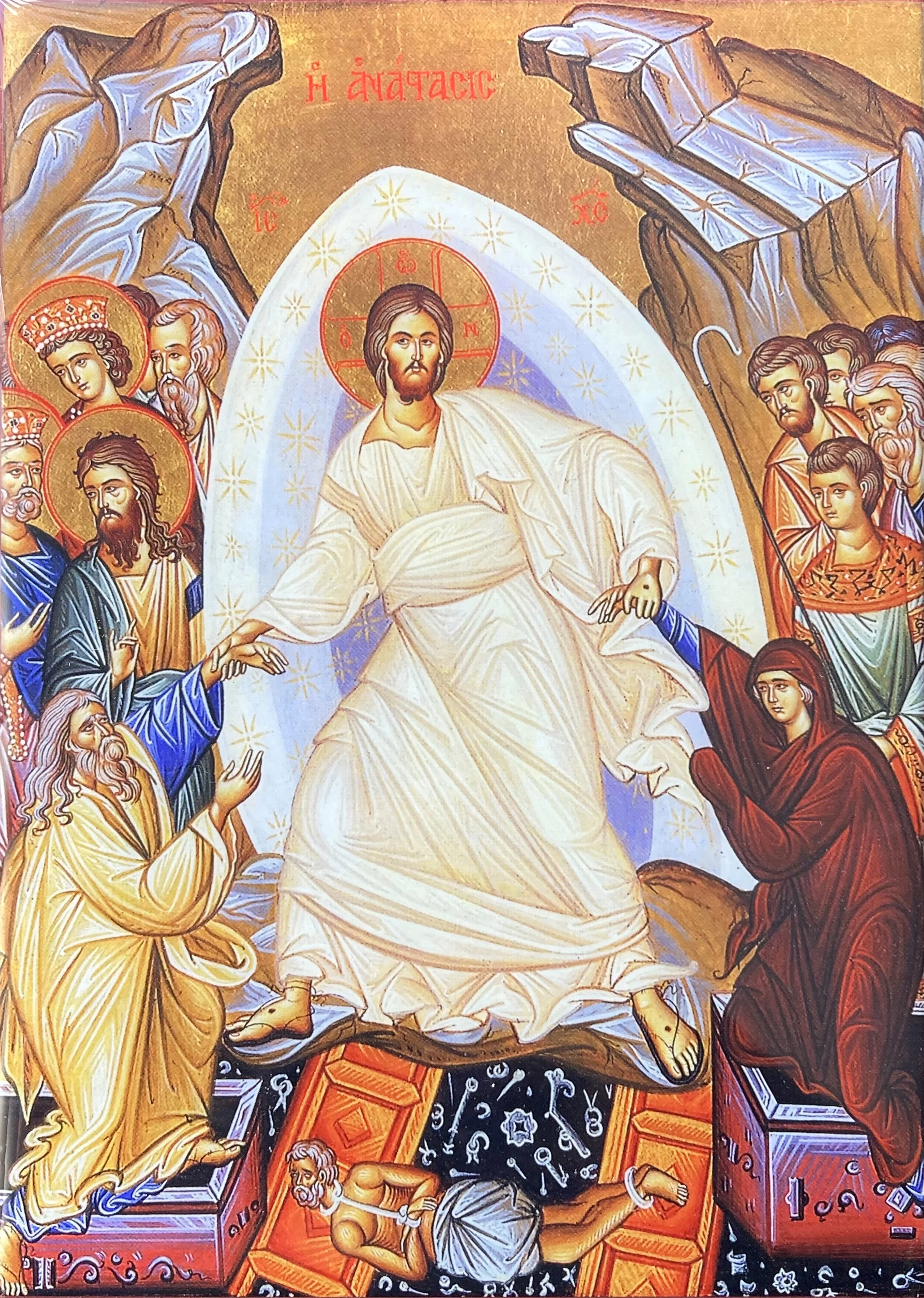
Gospel of Nicodemus – 4 of 5

Last time we saw the Lord’s arrival in Hades, as He, the King of glory, trampled on death, seized Satan, delivered him to the power of Hades (even though just a moment before Satan had been bossing Hades around), and drew Adam to His brightness. In this Holy Week reading, we will see Hades remonstrate with Satan, and then turn to the Lord’s deliverance of His Faithful.

Reading 4

CHAP. 7 (23)—Then Hades, receiving Prince Satan, said to him, with vehement revilings: “O prince of perdition, and leader of extermination, Beelzebub, derision of angels, to be spit upon by the just, why didst thou wish to do this? Didst thou wish to crucify the King of glory, in whose death thou didst promise us so great spoils? Like a fool, thou didst not know what thou wast doing.”

“For, behold, that Jesus by the splendour of His divinity is putting to flight all the darkness of death, and He has broken into the strong lowest depths of our dungeons, and has brought out the captives, and released those who were bound. And all who used to groan under our torments insult us, and by their prayers our dominions are taken by storm, and our realms conquered, and no race of men has now any respect for us. Moreover, also, we are grievously threatened by the dead, who have never been haughty to us, and who have not at any time been joyful as captives.”

“O Prince Satan, father of all impious wretches and renegades, why didst thou wish to do this? Of those who from the beginning, even until now, have despaired of salvation and life, no bellowing after the usual fashion is now heard here; and no groaning of theirs resounds, nor in any of their faces is a trace of tears found. O Prince Satan, possessor of the keys of the lower regions, all thy riches which thou hadst acquired by the tree of transgression and the loss of paradise, thou hast now lost by the tree of the cross, and all thy joy has perished. When thou didst hang up that Christ Jesus the King of glory, thou wast acting against thyself and against me.”

“Henceforth thou shalt know what eternal torments and infinite punishments thou art to endure in my everlasting keeping. O Prince Satan, author of death, and source of all pride, thou oughtest first to have inquired into the bad cause of that Jesus. Him in whom thou perceivedst no fault, why, without reason, didst thou dare unjustly to crucify? and why hast thou brought to our regions one innocent and just, and lost the guilty, the impious, and the unjust of the whole world?”

And when Hades had thus spoken to Prince Satan, then the King of glory said to Hades:” Satan the prince will be in thy power for ever, in place of Adam and his sons, my just ones.”

CHAP. 8 (24)—And the Lord stretched out His hand, and said: “Come to me, all my saints, who have my image and likeness. Do you, who have been condemned through the tree and the devil and death, now see the devil and death condemned through the tree.” Immediately all the saints were brought together under the hand of the Lord. And the Lord, holding Adam by the right hand, said to him: “Peace be to thee, with all thy children, my righteous ones!”

And Adam fell down at the knees of the Lord, and with tearful entreaty praying, said with a loud voice: “I will extol Thee, O Lord; for Thou hast lifted me up, and hast not made my foes to rejoice over me. O Lord God, I cried unto Thee, and Thou hast healed me. O Lord, Thou hast brought out my soul from the powers below; Thou hast saved me from them that go down into the pit. Sing praises to the Lord, all His saints, and confess to the memory of His holiness; since there is anger in but for a moment, and His favor is for a lifetime.” (Psalm 30:1-5a)

In like manner also all the saints of God, falling on their knees at the feet of the Lord, said with one voice: “Thou hast come, O Redeemer of the world: as Thou hast foretold by the law and Thy prophets, so hast Thou fulfilled by Thy deeds. Thou hast redeemed the living by Thy cross; and by the death of the cross Thou hast come down to us, to rescue us from the powers below, and from death, by Thy majesty. O Lord, as Thou hast set the title of Thy glory in heaven, and hast erected as the title of redemption Thy cross upon earth, so, O Lord, set in Hades the sign of the victory of Thy cross, that death may no more have dominion.”

And the Lord, stretching forth His hand, made the sign of the cross upon Adam and upon all His saints; and holding Adam by the right hand, went up from the powers below: and all the saints followed Him. Then holy David cried out aloud, saying: “Sing unto the Lord a new song, for He hath done wonderful things; His right hand and His holy arm have brought salvation to Himself. The Lord hath made known His salvation; His righteousness hath He revealed in the sight of the heathen.” And all the multitude of the saints answered, saying: “This is glory to all His saints. Amen, alleluia.”

And after this the prophet Habacuc cried out, saying: “Thou wentest forth for the salvation of Thy people, to deliver Thine elect.” And all the saints answered, saying: “Blessed is He who cometh in the name of the Lord; God is the Lord, and He hath shone upon us. Amen, alleluia”. In like manner after this the prophet Michæas also cried out, saying: “Who is a God like unto thee, O Lord, taking away iniquities and passing by sins? And now Thou dost withhold Thine anger for a testimony against us, because Thou delightest in mercy. And Thou turnest again, and hast compassion upon us, and pardonest all our iniquities; and all our sins hast Thou sunk in the multitude of death, as Thou hast sworn unto our fathers in the days of old.”

3 And all the saints answered, saying: “This is our God to eternity, and for ever and ever; and He will direct us for evermore. Amen, alleluia.” So also all the prophets, quoting the sacred writings concerning His praises, and all the saints crying, “Amen, alleluia,” followed the Lord.

Alexander Roberts, James Donaldson, and A. Cleveland Coxe, eds., “The Gospel of Nicodemus,” in The Ante-Nicene Fathers: Fathers of the Third and Fourth Centuries: The Twelve Patriarchs, Excerpts and Epistles, the Clementina, Apocrypha, Decretals, Memoirs of Edessa and Syriac Documents, Remains of the First Ages, trans. Alexander Walker, vol. 8 (Buffalo, NY: Christian Literature Company, 1886), 448–453.

Pascha

Discussion questions:

1) What did you notice in today’s reading? What surprised you or what was memorable to you? (The Leader should point out how this text, although it is not Scripture, nonetheless illustrates for us how the Church has always understood the Old Testament as prophesying not just the general coming of the Lord (His birth, preaching, healing, death, and resurrection), but even His descent into Hades and bringing joy and life and salvation to those who had been bound in death. The anonymous author of this text did not know what was actually said by the Saints in Hades when the Lord came to them, but had ample material from the Psalms and the Prophecies. This text, then, is also an invitation to us to go and look at the passages referenced, from Psalms, and Habakkuk, and Micah.)

2) Where do we see Christ in this text; what is He saying or doing here?

3) Do we see ourselves and the Church in this text; what does it say about us?

4) What do you find difficult about this reading? Is there anything confusing about it, or anything that you dislike? (This is an open question, as always. )

5) Does this reading make you think that you need to change anything in your life?
Day 3 (Friday)

John 19:38-42; 20:1-18 (Burial of Jesus, Resurrection of Jesus, Jesus Appears to Mary Magdalene)

Last time, we saw Jesus die on the Cross, giving up His spirit willingly, and saw His side pierced by the soldiers who came to ensure that those who were crucified were dead before the sun set, so that they could be buried, and would not remain on the Cross during the Holy Day of Passover. We noted how the passage dealing with His piercing is repeated every Liturgy during the Preparation, when the Lamb (Amnos) on the Diskos is pierced, and then the wine and water are poured into the Chalice. This time, we will see the Lord buried, and then what follows very soon afterward.

The Burial of Jesus

38 After these things, Joseph of Arimathea, who was a disciple of Jesus, though a secret one because of his fear of the Jews, asked Pilate to let him take away the body of Jesus. Pilate gave him permission; so he came and removed his body. 39 Nicodemus, who had at first come to Jesus by night, also came, bringing a mixture of myrrh and aloes, weighing about a hundred pounds. 40 They took the body of Jesus and wrapped it with the spices in linen cloths, according to the burial custom of the Jews. 41 Now there was a garden in the place where he was crucified, and in the garden there was a new tomb in which no one had ever been laid. 42 And so, because it was the Jewish day of Preparation, and the tomb was nearby, they laid Jesus there.

The Resurrection of Jesus

20 Early on the first day of the week, while it was still dark, Mary Magdalene came to the tomb and saw that the stone had been removed from the tomb. 2 So she ran and went to Simon Peter and the other disciple, the one whom Jesus loved, and said to them, “They have taken the Lord out of the tomb, and we do not know where they have laid him.” 3 Then Peter and the other disciple set out and went toward the tomb. 4 The two were running together, but the other disciple outran Peter and reached the tomb first.

5 He bent down to look in and saw the linen wrappings lying there, but he did not go in. 6 Then Simon Peter came, following him, and went into the tomb. He saw the linen wrappings lying there, 7 and the cloth that had been on Jesus’ head, not lying with the linen wrappings but rolled up in a place by itself. 8 Then the other disciple, who reached the tomb first, also went in, and he saw and believed; 9 for as yet they did not understand the scripture, that he must rise from the dead. 10 Then the disciples returned to their homes.

Jesus Appears to Mary Magdalene

11 But Mary stood weeping outside the tomb. As she wept, she bent over to look into the tomb; 12 and she saw two angels in white, sitting where the body of Jesus had been lying, one at the head and the other at the feet. 13 They said to her, “Woman, why are you weeping?” She said to them, “They have taken away my Lord, and I do not know where they have laid him.” 14 When she had said this, she turned around and saw Jesus standing there, but she did not know that it was Jesus.

15 Jesus said to her, “Woman, why are you weeping? Whom are you looking for?” Supposing him to be the gardener, she said to him, “Sir, if you have carried him away, tell me where you have laid him, and I will take him away.” 16 Jesus said to her, “Mary!” She turned and said to him in Hebrew, “Rabbouni!” (which means Teacher). 17 Jesus said to her, “Do not hold on to me, because I have not yet ascended to the Father. But go to my brothers and say to them, ‘I am ascending to my Father and your Father, to my God and your God.’” 18 Mary Magdalene went and announced to the disciples, “I have seen the Lord”; and she told them that he had said these things to her.

Discussion questions:

1) What did you notice in today’s reading? What surprised you or what was memorable to you? (The Leader should point out how St. John is entirely silent about what happened between the end of the day of Preparation (Friday) and the beginning of the First Day of the week (Sunday/the Lord’s Day). This is notable and appropriate, as this is the great day of Rest, and by saying nothing about it at all, he emphasizes that this is the fulfillment of the prophecy of the Sabbath. Before, he shows us Jesus saying that “His Father is still working, and that He too is still working” (John 5:17), when He was confronted about healing on the Sabbath. But now, on the great Sabbath, He shows us Jesus doing nothing, resting indeed. We can also notice the profound faithfulness and courage shown by Joseph of Arimathea and Nicodemus, and the deep and abiding love exhibited by Mary Magdalene.)

2) Where do we see Christ in this text; what is He saying or doing here?

3) Do we see ourselves and the Church in this text; what does it say about us?

4) What do you find difficult about this reading? Is there anything confusing about it, or anything that you dislike? (This is an open question, as always. )

5) Does this reading make you think that you need to change anything in your life?

Year 4 – Week 34 (April 21 – 27, 2024)

Day 1 (Monday)

Daniel 3:1-45 (The Golden Image & Fiery Furnace)

Since January, we have been reading about King David, from his anointing as the Messiah of Yahweh (the Anointed of the Lord) by Samuel, through his defeat of Goliath, his meteoric rise in the ranks of King Saul’s army, through Saul’s jealousy of him and attempts to kill him, through his wandering in the wilderness, through the death of Saul, David’s crowning as king first of Judah, and then of all Israel, and finally his bringing of the Ark of God into Jerusalem. We will read somewhat more of David’s life, of his great fall into sin, of the consequences that follow that, in a few weeks, but as we approach Pascha, we will pause and instead continue with the story of Daniel, David’s descendant, and of his three friends, Ananias, Azarias, and Misael (sometimes better known by their Babylonian names: Shadrach, Meshach, and Abed-Nego). When we left Daniel, he had just both told and interpreted the dream that King Nebuchadnezzar had had, of a great image with a gold head, silver chest, bronze mid-section, and iron legs, and of the Rock Not Cut with Hands which destroyed it and grew into a mountain and filled the entire earth. Upon this success, the king promoted him and his friends…but whether the king actually learned anything, we will see in the coming story.

The Golden Image

3 King Nebuchadnezzar made a golden statue whose height was sixty cubits and whose width was six cubits; he set it up on the plain of Dura in the province of Babylon. 2 Then King Nebuchadnezzar sent for the satraps, the prefects, and the governors, the counselors, the treasurers, the justices, the magistrates, and all the officials of the provinces, to assemble and come to the dedication of the statue that King Nebuchadnezzar had set up. 3 So the satraps, the prefects, and the governors, the counselors, the treasurers, the justices, the magistrates, and all the officials of the provinces, assembled for the dedication of the statue that King Nebuchadnezzar had set up.

When they were standing before the statue that Nebuchadnezzar had set up, 4 the herald proclaimed aloud, “You are commanded, O peoples, nations, and languages, 5 that when you hear the sound of the horn, pipe, lyre, trigon, harp, drum, and entire musical ensemble, you are to fall down and worship the golden statue that King Nebuchadnezzar has set up. 6 Whoever does not fall down and worship shall immediately be thrown into a furnace of blazing fire.” 7 Therefore, as soon as all the peoples heard the sound of the horn, pipe, lyre, trigon, harp, drum, and entire musical ensemble, all the peoples, nations, and languages fell down and worshiped the golden statue that King Nebuchadnezzar had set up.

8 Accordingly, at this time certain Chaldeans came forward and denounced the Jews. 9 They said to King Nebuchadnezzar, “O king, live forever! 10 You, O king, have made a decree, that everyone who hears the sound of the horn, pipe, lyre, trigon, harp, drum, and entire musical ensemble, shall fall down and worship the golden statue, 11 and whoever does not fall down and worship shall be thrown into a furnace of blazing fire. 12 There are certain Jews whom you have appointed over the affairs of the province of Babylon: Shadrach, Meshach, and Abednego. These pay no heed to you, O king. They do not serve your gods and they do not worship the golden statue that you have set up.”

13 Then Nebuchadnezzar in furious rage commanded that Shadrach, Meshach, and Abednego be brought in; so they brought those men before the king. 14 Nebuchadnezzar said to them, “Is it true, O Shadrach, Meshach, and Abednego, that you do not serve my gods and you do not worship the golden statue that I have set up? 15 Now if you are ready when you hear the sound of the horn, pipe, lyre, trigon, harp, drum, and entire musical ensemble to fall down and worship the statue that I have made, well and good. But if you do not worship, you shall immediately be thrown into a furnace of blazing fire, and who is the god that will deliver you out of my hands?”

16 Shadrach, Meshach, and Abednego answered the king, “O Nebuchadnezzar, we have no need to present a defense to you in this matter. 17 If our God whom we serve is able to deliver us from the furnace of blazing fire and out of your hand, O king, let him deliver us. 18 But if not, be it known to you, O king, that we will not serve your gods and we will not worship the golden statue that you have set up.”

The Fiery Furnace

19 Then Nebuchadnezzar was so filled with rage against Shadrach, Meshach, and Abednego that his face was distorted. He ordered the furnace heated up seven times more than was customary, 20 and ordered some of the strongest guards in his army to bind Shadrach, Meshach, and Abednego and to throw them into the furnace of blazing fire. 21 So the men were bound, still wearing their tunics, their trousers, their hats, and their other garments, and they were thrown into the furnace of blazing fire. 22 Because the king’s command was urgent and the furnace was so overheated, the raging flames killed the men who lifted Shadrach, Meshach, and Abednego. 23 But the three men, Shadrach, Meshach, and Abednego, fell down, bound, into the furnace of blazing fire.

The Prayer of Azariah in the Furnace

24 They walked around in the midst of the flames, singing hymns to God and blessing the Lord. 25 Then Azariah stood still in the fire and prayed aloud:

26 “Blessed are you, O Lord, God of our ancestors, and worthy of praise;
and glorious is your name forever!
27 For you are just in all you have done;
all your works are true and your ways right,
and all your judgments are true.
28 You have executed true judgments in all you have brought upon us
and upon Jerusalem, the holy city of our ancestors;
by a true judgment you have brought all this upon us because of our sins.

29 For we have sinned and broken your law in turning away from you;
in all matters we have sinned grievously.
30 We have not obeyed your commandments,
we have not kept them or done what you have commanded us for our own good.
31 So all that you have brought upon us,
and all that you have done to us,
you have done by a true judgment.
32 You have handed us over to our enemies, lawless and hateful rebels,
and to an unjust king, the most wicked in all the world.
33 And now we cannot open our mouths;
we, your servants who worship you, have become a shame and a reproach.

34 For your name’s sake do not give us up forever,
and do not annul your covenant.
35 Do not withdraw your mercy from us,
for the sake of Abraham your beloved
and for the sake of your servant Isaac
and Israel your holy one,
36 to whom you promised
to multiply their descendants like the stars of heaven
and like the sand on the shore of the sea.

37 For we, O Lord, have become fewer than any other nation,
and are brought low this day in all the world because of our sins.
38 In our day we have no ruler, or prophet, or leader,
no burnt offering, or sacrifice, or oblation, or incense,
no place to make an offering before you and to find mercy.
39 Yet with a contrite heart and a humble spirit may we be accepted,
40 as though it were with burnt offerings of rams and bulls,
or with tens of thousands of fat lambs;
such may our sacrifice be in your sight today,
and may we unreservedly follow you,
for no shame will come to those who trust in you.

41 And now with all our heart we follow you;
we fear you and seek your presence.
42 Do not put us to shame,
but deal with us in your patience
and in your abundant mercy.
43 Deliver us in accordance with your marvelous works,
and bring glory to your name, O Lord.
44 Let all who do harm to your servants be put to shame;
let them be disgraced and deprived of all power,
and let their strength be broken.
45 Let them know that you alone are the Lord God,
glorious over the whole world.”

Discussion questions:

1) What did you notice in today’s reading? What surprised you or what was memorable to you? (The Leader should point out that the three Young Men, also called the Three Servants (of God), do not tell the king that God WILL save them. They say that He is able to do so, or rather, they say that if He is able, let Him do so (which is to say, even when they talk to the king, they are actually asking God for His help), but whether He saves them or not, they refuse to be unfaithful to Him. This is the most perfect picture of what Faith actually looks like; trusting God’s will, regardless of the outcome, and holding fast to Him whatever comes. Second, we should note how Azariah prays, because we have seen this before. First, he confesses that God is righteous and holy, and then he confesses his sins, both his own, and the sins of all the people. Then, finally, he asks for mercy, first for his people, and then for himself and his friends.)

2) Where do we see Christ in this text; what is He saying or doing here?

3) Do we see ourselves and the Church in this text; what does it say about us?

4) What do you find difficult about this reading? Is there anything confusing about it, or anything that you dislike? (This is an open question, as always. )

5) Does this reading make you think that you need to change anything in your life?

Day 2 (Wednesday)

Gospel of Nicodemus – 3 of 5

Last time we saw Seth speak of the prophecy he had received from the Archangel Michael, about the One Who would be baptized in the Jordan being the one to bring the oil of mercy from the Tree of Life, to restore Adam and all his race. We also saw Satan and Hades speaking to one another about the imminent coming of Jesus to Hades, with Satan gleefully rejoicing in the defeat of his enemy, while Hades was speaking in incredulous fear of the arrival of this One Who had called so many of the dead out of Hades by His own authority. He had begged Satan not to bring Jesus to Hades, telling him that if Jesus came to Hades, then He would not only be free among the dead Himself, but would lead all those bound there into freedom. We will continue from that point.

Reading 3

CHAP. 5 (21)—And as Prince Satan and Hades were thus speaking to each other in turn, suddenly there was a voice as of thunders, and a shouting of spirits: “Lift up your gates, ye princes; and be ye lifted up, ye everlasting gates; and the King of glory shall come in.” Hades hearing this, said to Prince Satan: “Retire from me, and go outside of my realms: if thou art a powerful warrior, fight against the King of glory. But what hast thou to do with Him?” And Hades thrust Satan outside of his realms. And Hades said to his impious officers: “Shut the cruel gates of brass, and put up the bars of iron, and resist bravely, that we, holding captivity, may not take Him captive.”

And all the multitude of the saints, hearing this, said to Hades, with the voice of reproach: “Open thy gates, that the King of glory may come in.” And David cried out, saying: “Did I not, when I was alive upon earth, prophesy to you: Let them confess to the Lord His tender mercies and His wonderful works to the children of men: for He has shattered the brazen gates, and burst the iron bars; He has taken them up out of the way of their iniquity?”

And after this, in like manner, Esaias said: “Did not I, when I was alive upon earth, prophesy to you: ‘The dead shall rise up, and those who are in their tombs shall rise again, and those who are upon earth shall exult; because the dew, which is from the Lord, is their health?’4 And again I said, ‘Where, O Death, is thy sting? where, O Hades, is thy victory?’”

And when all the saints heard this from Esaias, they said to Hades: “Open thy gates. Since thou art now conquered, thou wilt be weak and powerless.” And there was a great voice, as of thunders, saying: “Lift up your gates, ye princes; and be ye lifted up, ye infernal gates; and the King of glory shall come in.” Hades, seeing that they had twice shouted out this, says, as if not knowing: “Who is the king of glory?”

David says, in answer to Hades: “I recognise those words of the shout, since I prophesied the same by His Spirit. And now, what I have said above I say to thee, ‘The Lord strong and mighty, the Lord mighty in battle; He is the King of glory.’ And the Lord Himself hath looked down from heaven upon earth, to hear the groans of the prisoners, and to release the sons of the slain.7 And now, most filthy and most foul Hades, open thy gates, that the King of glory may come in.”

While David was thus speaking, there came to Hades, in the form of a man, the Lord of majesty, and lighted up the eternal darkness, and burst asunder the indissoluble chains; and the aid of unconquered power visited us, sitting in the profound darkness of transgressions, and in the shadow of death of sins.

CHAP. 6 (22)—When this was seen by Hades and Death, and their impious officers, along with their cruel servants, they trembled at perceiving in their own dominions the clearness of so great a light, when they saw Christ suddenly in their abodes; and they cried out, saying: “We have been overcome by thee. Who art thou, that to the Lord directest our confusion? Who art thou, that, undestroyed by corruption, the uncorrupted proof of thy majesty, with fury condemnest our power?Who art thou, so great and little, lowly and exalted, soldier and commander, wonderful warrior in the form of a slave, and the king of glory dead and alive, whom slain the cross has carried?”

“Thou, who didst lie dead in the sepulchre, hast come down to us alive; and in thy death every creature trembled, and the stars in a body were moved; and now thou hast been made free among the dead, and disturbest our legions. Who art thou, that settest free those who art held captive, bound by original sin, and recallest them to their former liberty? Who art thou, who sheddest a divine, and splendid, and illuminating light upon those who have been blinded by the darkness of their sins?”

In like manner, also, all the legions of the demons, terror-stricken with like fear from their fearful overthrow, cried out, saying: “Whence art thou, O Jesus, a man so powerful and splendid in majesty, so excellent, without spot, and free from guilt? For that world of earth which has been subject to us always until now, which used to pay tribute for our uses, has never sent us such a dead man, has never destined such gifts for the powers below.”

“Who therefore art thou, that hast so intrepidly entered our bounds, and who hast not only no fear of our punishments, but, moreover, attemptest to take all away from our chains? Perhaps thou art that Jesus of whom our prince Satan said, that by thy death of the cross thou wast destined to receive the dominion of the whole world.”

Then the King of glory, trampling on death by His majesty, and seizing Prince Satan, delivered him to the power of Hades, and drew Adam to His brightness.

Alexander Roberts, James Donaldson, and A. Cleveland Coxe, eds., “The Gospel of Nicodemus,” in The Ante-Nicene Fathers: Fathers of the Third and Fourth Centuries: The Twelve Patriarchs, Excerpts and Epistles, the Clementina, Apocrypha, Decretals, Memoirs of Edessa and Syriac Documents, Remains of the First Ages, trans. Alexander Walker, vol. 8 (Buffalo, NY: Christian Literature Company, 1886), 448–453.

IMG_7694

Discussion questions:

1) What did you notice in today’s reading? What surprised you or what was memorable to you? (The Leader should point out that the words that the Lord says outside the gates of Hades are the words of Psalm 23/24, which are often repeated during Holy Week either Holy Friday evening or Holy Saturday, when the Faithful are re-entering the Church from outside. They are also used during the Consecration of a Church, during the opening of the doors (Thyranyxia). In all of these, we are celebrating the Lord’s entrance and purification and dominion in the place that is being opened, and we must comprehend in all this the marvel that Death itself is being filled with the presence of Almighty God.)

2) Where do we see Christ in this text; what is He saying or doing here?

3) Do we see ourselves and the Church in this text; what does it say about us?

4) What do you find difficult about this reading? Is there anything confusing about it, or anything that you dislike? (This is an open question, as always. )

5) Does this reading make you think that you need to change anything in your life?

Day 3 (Friday)

John 19:25b-37 (Jesus on the Cross)

Last time, we saw Jesus crucified, and saw the description of the soldiers dividing His garments among them, and casting lots for His tunic. We noted that the inclusion of this detail functions something like a tag, confirming and cross-referencing the accounts of the other Evangelists, who all emphasize this or other elements prophesied in Psalms 21/22. This time, we will see what else happens while Jesus is on the Cross, and what His final words are.

Jesus on the Cross

Meanwhile, standing near the cross of Jesus were his mother, and his mother’s sister, Mary the wife of Clopas, and Mary Magdalene. 26 When Jesus saw his mother and the disciple whom he loved standing beside her, he said to his mother, “Woman, here is your son.” 27 Then he said to the disciple, “Here is your mother.” And from that hour the disciple took her into his own home.

28 After this, when Jesus knew that all was now finished, he said (in order to fulfill the scripture), “I am thirsty.” 29 A jar full of sour wine was standing there. So they put a sponge full of the wine on a branch of hyssop and held it to his mouth. 30 When Jesus had received the wine, he said, “It is finished.” Then he bowed his head and gave up his spirit.

Jesus’ Side Is Pierced

31 Since it was the day of Preparation, the Jews did not want the bodies left on the cross during the sabbath, especially because that sabbath was a day of great solemnity. So they asked Pilate to have the legs of the crucified men broken and the bodies removed. 32 Then the soldiers came and broke the legs of the first and of the other who had been crucified with him. 33 But when they came to Jesus and saw that he was already dead, they did not break his legs.

34 Instead, one of the soldiers pierced his side with a spear, and at once blood and water came out. 35 (He who saw this has testified so that you also may believe. His testimony is true, and he knows[g] that he tells the truth.) 36 These things occurred so that the scripture might be fulfilled, “None of his bones shall be broken.” 37 And again another passage of scripture says, “They will look on the one whom they have pierced.”

Discussion questions:

1) What did you notice in today’s reading? What surprised you or what was memorable to you? (The Leader should point out two things. First, the Church recognizes a strong connection between the Lord’s final words on the Cross “It is finished,” and the words of completion in the Genesis account of Creation, that “Behold, it was very good.” It is significant that on both occasions, God speaks these words at the end of the 6th Day, and on both occasions, He rests on the 7th Day. Sometimes we go so far as to say that these are not two separate occasions, but descriptions of the same reality from different perspectives. Second, the final paragraph, about the soldier piercing the Lord’s side with the lance, is what is read every Liturgy during the Preparation of the Gifts, as the Lamb, the portion of the Bread that will be consecrated, is pierced with a lance, and then the wine and water that will be consecrated are poured into the Chalice as the Priest recites: “and immediately there came out blood and water.”)

2) Where do we see Christ in this text; what is He saying or doing here?

3) Do we see ourselves and the Church in this text; what does it say about us?

4) What do you find difficult about this reading? Is there anything confusing about it, or anything that you dislike? (This is an open question, as always. )

5) Does this reading make you think that you need to change anything in your life?

Year 4 – Week 33 (April 14 – 20, 2024)

Day 1 (Monday)

Psalm 79 (80 in Protestant/Catholic Bibles) – O Shepherd of Israel

As we pause from our readings about David, it is good that we should remember how we began, with Psalm 77/78, which recounts the entire history of the people of Israel, and ends with a hopeful and triumphant note about how God “chose David his servant, and took him from the sheepfolds. He brought him from following the ewes great with young, to shepherd Jacob his servant, and Israel his inheritance. And he shepherded them in the integrity of his heart, and guided them by the skillfulness of his hands.” We have seen enough of David to understand that, however hard David has tried, he simply is not the “good shepherd” that the earlier Psalmist longs for and foretells. We are therefore reading two Psalms later this week, which speaks not of David, but of his descendant, the seed of the woman, the son of promise longed for by Abraham, Isaac, and Jacob, the true Good Shepherd we have read about previously in John’s Gospel.

Psalm 79

For the end, concerning the things that shall be changed, a testimony of Asaph, a psalm concerning the Assyrian

Give ear, O Shepherd of Israel, you who lead Joseph like a flock; O you who are seated upon the Cherubim, show yourself. Before Ephraim, and Benjamin, and Manasseh, stir up your strength, and come and save us. Turn us, O God, and reveal your face, and we shall be saved.

O Lord God of hosts, how long will you be angry with the prayer of your servants? How long will you feed us with the bread of tears, and give us tears to drink in full measure? You have made us a strife to our neighbors, and our enemies have mocked us. Turn us, O Lord God of hosts, and reveal your face, and we shall be saved.

Diapsalm.
You brought a vine out of Egypt; you cast out the nations, and planted it. You made a way before it, and caused it to take deep root; and it filled the land. Its shade covered the mountains, and its tendrils the cedars of God. She stretched out her branches to the sea, and her offshoots to the rivers. Why have you broken down her hedge, so that all who pass by the way pluck her?

The boar of the forest has laid it waste, and the solitary beast has devoured it. Turn about, we beseech you, O God of hosts, and look down from heaven, and see, and visit this vine, And restore that which your right hand has planted; and look upon the son of man, whom you took for yourself. It has been burned with fire, and uprooted; they shall perish at the rebuke of your countenance.

Let your hand be upon the man of your right hand, and upon the son of man, whom you took for yourself. And let us never depart from you; you will give us life, and we will call upon your name. Turn us, O Lord God of hosts, and reveal your face, and we shall be saved.

Roumas, Nicholas. The Psalter of David the Prophet and King with the Nine Odes (pp. 106-107). Great Light Publishing Co.. Kindle Edition.

Discussion questions:

1) What did you notice in today’s reading? What surprised you or what was memorable to you? (The Leader should note that this is clearly no longer talking about David as the shepherd of Israel; rather the addressee is manifestly God Himself. In this passage, which the superscription indicates has to do with the captivity of Israel, the tribes of Ephraim & Manasseh, by the Assyrians, and asking the Lord to restore them. Here we see the phrase “the son of man,” the “man of your right hand,” and begin to understand the Messianic yearning of God’s people after the failure of David’s line to maintain peace and faithfulness, and the deportation into captivity of faithless Israel, as the Psalmist asks the Lord to visit the vine that His right hand has planted. We should note, as well, that this phrase is used uniquely by the Bishop in the Orthodox tradition as he prays during the final repetitions of the Trisagion Prayer during the Divine Liturgy.)

2) What do we learn about God in this reading?

3) What do we learn about human beings in this reading?

4) What do you find difficult about this reading? Is there anything confusing about it, or anything that you dislike? (This is an open question, as always. )

5) Does this reading make you think that you need to change anything in your life?

Day 2 (Wednesday)

Gospel of Nicodemus – 2 of 5

Last time we read the frame narrative for this account of the Lord’s descent into Hades, as we were presented with the two sons of the righteous Symeon, who had been raised and were dwelling in Arimathea, and then were brought to the chief priests to bear witness of what they had seen. They told of how they were assembled with the righteous of the Old Testament, and saw a bright and royal light shining, and heard first Adam, then Isaiah and Symeon their father, and finally John the Baptist, bear witness that this was the Lord coming for their deliverance, and especially speaking of the Lord being baptized in the Jordan River. We will pick up the story there.

Reading 2

CHAP. 3 (19)—And when the first created, father Adam, had heard this, that Jesus was baptized in Jordan, he cried out to his son Seth: Tell thy sons, the patriarchs and the prophets, all that thou heardest from Michael the archangel when I sent thee to the gates of paradise to implore God that he might send thee His angel to give thee oil from the tree of mercy, with which to anoint my body when I was sick.

Then Seth, coming near to the holy patriarchs and prophets, said: When I, Seth, was praying to the Lord at the gates of paradise, behold Michael, the angel of the Lord, appeared to me, saying, I have been sent to thee by the Lord. I am set over the human race. And to thee, Seth, I say, do not labour with tears in prayers and supplications on account of the oil of the tree of mercy to anoint thy father Adam for the pain of his body, because in no wise shalt thou receive of it, except in the last days and times, except when five thousand and five hundred years have been fulfilled:”

“Then will come upon the earth the most beloved Son of God, to raise up again the body of Adam, and the bodies of the dead; and He, when He comes, will be baptized in Jordan. And when he shall have come out of the water of Jordan, then with the oil of His mercy shall He anoint all that believe on Him; and that oil of mercy shall be for the generation of those who shall be born out of water and the Holy Spirit into life eternal. Then, descending upon earth, Christ Jesus, the most beloved Son of God, will lead our father Adam into paradise to the tree of mercy.
And when they heard all these things from Seth, all the patriarchs and prophets exulted with great exultation.

CHAP. 4 (20)— And when all the saints were exulting, lo, Satan, the prince and leader of death, said to Hades: Make thyself ready to receive Jesus, who boasts himself to be the Son of God, and is a man fearing death, and saying, My soul is sorrowful, even unto death. And he has withstood me much, doing me evil; and many whom I made blind, lame, deaf, leprous, and demoniac, he has healed with a word; and those whom I have brought to thee dead, he has dragged away from thee.

Hades, answering, said to Prince Satan: “Who is he that is so powerful, when he is a man in fear of death? For all the powerful of the earth are kept in subjection by my power, whom thou hast brought into subjection by thy power. If then, thou art powerful, what is that man Jesus like, who, though fearing death, withstands thy power? If he is so powerful in humanity, verily I say unto thee, he is all-powerful in divinity, and his power can no one resist. And when he says that he fears death, he wishes to lay hold on thee, and woe will be to thee to the ages of eternity.”

And Satan, prince of Tartarus, answered and said: “Why hast thou doubted, and feared to receive this Jesus, thy adversary and mine? For I have tempted him, and I have roused up my ancient people the Jews with hatred and anger against him; I have sharpened a lance to strike him; I have mixed gall and vinegar to give him to drink; and I have prepared wood to crucify him, and nails to pierce him, and his death is near at hand, that I may bring him to thee, subject to thee and me.”

Tartarus answered and said: “Thou hast told me that it is he himself who has dragged away the dead from me. Now there are many who are here kept by me, who, while they lived on earth, took the dead from me, not by their own powers, but by godly prayers, and their almighty God dragged them away from me. Who is that Jesus, who by his word has withdrawn the dead from me without prayers? Perhaps he is the same who, by the word of his command, brought alive Lazarus, after he had been four days in stench and corruption, whom I kept dead.”

Satan prince of death, answered and said: “That Jesus is the same. And when Hades heard this, he said to him: I adjure thee by thy powers and mine, do not bring him to me. For I at that time, when I heard the command of his word, trembled with terror and dismay, and all my officers at the same time were confounded along with me. Nor could we keep that Lazarus; but, shaking himself like an eagle, he sprang out, and went forth from us with all activity and speed, and the same ground which held the dead body of Lazarus immediately gave him forth alive.”

“So now, I know that that man who could do these things is God, strong in authority, powerful in humanity, and He is the Saviour of the human race. But if thou bring Him to me, all who are here shut up in the cruelty of the prison, and bound by their sins in chains that cannot be loosened, He will let loose, and will bring to the life of His divinity for ever.”

Alexander Roberts, James Donaldson, and A. Cleveland Coxe, eds., “The Gospel of Nicodemus,” in The Ante-Nicene Fathers: Fathers of the Third and Fourth Centuries: The Twelve Patriarchs, Excerpts and Epistles, the Clementina, Apocrypha, Decretals, Memoirs of Edessa and Syriac Documents, Remains of the First Ages, trans. Alexander Walker, vol. 8 (Buffalo, NY: Christian Literature Company, 1886), 448–453.

image from s3.amazonaws.com

From the following website:

https://hum54-15.omeka.fas.harvard.edu/exhibits/show/chora-church/anastasis

Discussion questions:

1) What did you notice in today’s reading? What surprised you or what was memorable to you? (The Leader should point out two things here: the first is that the story that Seth relates is found in a text called “The Life of Adam and Eve,” an apocryphal text of the Old Testament from around the 1st century A.D., which describes Adam’s last illness, and the effort to save his life with oil from the Tree of Life. The prophecy about the Son of God coming and bringing baptism and oil is connecting this event with the Oil of Gladness with which new Christians are anointed immediately before their Baptism. The second thing is the dialogue between Satan and Hades, in which Satan is described as the lord of Hades and death, but distinct from Hades/Tartarus/death. In this, Satan is viewed as the agent who brought about Jesus’ death on the Cross, but also as the ignorant one and the fool, who, as St. John Chrysostom says in his Paschal homily, “It took a body, and, lo, it discovered God. It took earth and, behold! It encountered Heaven. It took what it saw, and was overcome by what it could not see.”

2) Where do we see Christ in this text; what is He saying or doing here?

3) Do we see ourselves and the Church in this text; what does it say about us?

4) What do you find difficult about this reading? Is there anything confusing about it, or anything that you dislike? (This is an open question, as always. )

5) Does this reading make you think that you need to change anything in your life?

Day 3 (Friday)

John 19:8-25a (Jesus Condemned, Crucifixion of Jesus)

Last time, we saw Pilate have Jesus beaten and mocked, and then bring Jesus out to the chief priests and the others accusing Him, saying, “Behold the man,” and that he found no fault in Him, but nonetheless delivering Him to them to crucify Him. Those accusing Jesus replied that the crime Jesus had committed, which required death, was that He had claimed to be the Son of God. This, as we will see, causes Pilate no little anxiety, and he will come back to speak with Jesus once more here.

Condemnation of Jesus

8 Now when Pilate heard this, he was more afraid than ever. 9 He entered his headquarters again and asked Jesus, “Where are you from?” But Jesus gave him no answer. 10 Pilate therefore said to him, “Do you refuse to speak to me? Do you not know that I have power to release you, and power to crucify you?” 11 Jesus answered him, “You would have no power over me unless it had been given you from above; therefore the one who handed me over to you is guilty of a greater sin.” 12 From then on Pilate tried to release him, but the Jews cried out, “If you release this man, you are no friend of the emperor. Everyone who claims to be a king sets himself against the emperor.”

13 When Pilate heard these words, he brought Jesus outside and sat on the judge’s bench at a place called The Stone Pavement, or in Hebrew Gabbatha. 14 Now it was the day of Preparation for the Passover; and it was about noon. He said to the Jews, “Here is your King!” 15 They cried out, “Away with him! Away with him! Crucify him!” Pilate asked them, “Shall I crucify your King?” The chief priests answered, “We have no king but the emperor.” 16 Then he handed him over to them to be crucified.

The Crucifixion of Jesus

So they took Jesus; 17 and carrying the cross by himself, he went out to what is called The Place of the Skull, which in Hebrew is called Golgotha. 18 There they crucified him, and with him two others, one on either side, with Jesus between them. 19 Pilate also had an inscription written and put on the cross. It read, “Jesus of Nazareth, the King of the Jews.” 20 Many of the Jews read this inscription, because the place where Jesus was crucified was near the city; and it was written in Hebrew, in Latin, and in Greek.

21 Then the chief priests of the Jews said to Pilate, “Do not write, ‘The King of the Jews,’ but, ‘This man said, I am King of the Jews.’” 22 Pilate answered, “What I have written I have written.” 23 When the soldiers had crucified Jesus, they took his clothes and divided them into four parts, one for each soldier. They also took his tunic; now the tunic was seamless, woven in one piece from the top. 24 So they said to one another, “Let us not tear it, but cast lots for it to see who will get it.” This was to fulfill what the scripture says,

“They divided my clothes among themselves,
and for my clothing they cast lots.”
25 And that is what the soldiers did.

Discussion questions:

1) What did you notice in today’s reading? What surprised you or what was memorable to you? (The Leader should point out that John’s Gospel is not generally filled with statements about how what happens to Jesus fulfills prophecy, but he includes the point about the soldiers casting lots here. This is from Psalm 21/22, which begins “My god, my god, why have you forsaken me,” and it is perhaps this statement of the Lord on the Cross that John is alluding to here, although he does not give Jesus saying this, as the other evangelists (Matthew & Mark) have already provided it. It is important to note that Jesus quotes this Psalm as a statement that He is fulfilling what was prophesied, and not as a statement that the Father has forsaken Him. He is indeed the King of the Jews, the Messiah of Yahweh, the Anointed One, the true and Good Shepherd of the people of God, and as king, He fulfills and completes what David had foretold long before, responding to that prayer with His own presence in our midst, in our darkest and deepest degradation.)

2) Where do we see Christ in this text; what is He saying or doing here?

3) Do we see ourselves and the Church in this text; what does it say about us?

4) What do you find difficult about this reading? Is there anything confusing about it, or anything that you dislike? (This is an open question, as always. )

5) Does this reading make you think that you need to change anything in your life?

Sunday, April 14th (Sunday of St. John Climacus)

Lead Chanter: John Brakatselos

Current status/assignments:

Readings: Photini/Tom

Responses: Photini

Evlogitaria: Rita, Demetri, Photini, Kathy

Rita: for the next while, will be working on prepping the first of the Exaposteilaria in Greek.

Rebecca: will be working on one of the Praises

Kathy: one of the Kathisma hymns

If possible, anyone that wants to prepare a particular hymn for next week should speak with Fr. Anthony after the Liturgy to reserve that hymn. Fr. Anthony is happy to meet after Coffee Hour concludes to help practice, and can provide recordings for practice during the week as well.

Responses (throughout) – 3

Photini
Readings – 1 Tom/Photini/Justin/Demetri
God is the Lord Verses – 4 Demetri/Photini/Rita/Kathy
God is the Lord Tune – 6 Proto first to set the tone, then others (Photini will prep one repetition of this refrain)
Apolytikia – 7 Chanters unless otherwise assigned
Kathismata – 7 Chanters unless otherwise assigned (Kathy will do the Glory hymn of the 1st Kathisma, By Your voluntary will…; Demetri will do the Glory hymn of the 2nd Kathisma, From exalted heights…)
Evlogitaria – 5 Rita/Justin/Demetri/Photini/Kathy
Anavathmoi – 9 Chanters
Kontakion/Oikos – 2 Tom/Photini/Rita
Synaxarion – 2 Tom/Photini/Rita (unless the names in the Synaxarion are over-complicated, in which case they should be read by one of the Chanters)
Katavasies – 9 Chanters (for now, only one chanter at a time; others should try to follow along silently with the music being sung by the Chanter, in preparation for eventually singing this oloi mazi)
Let everything that breathes/Pre & Post Gospel elements – 5 Photini/Justin/Demetri/Rita
Psalm 50 – 6 Chanters start and set tone, and then Photini/Rita/Justin/Demetri can join in
Psalm 50 final hymns – 6 Chanters (during Triodion, there is an opportunity for those who can practice to sing softly along with the chanters, to build a choir approach to these. Those who sing along should watch the chanter for a cutoff signal in case the extra voices are throwing them off.)
Megalynarion/Ode 9 of Canon – 9 Chanters (refrain sung by everyone all together; everyone should sing softly, carefully listening to one another and matching the Proto/lead chanter)
Holy is the Lord – 6 Chanters start, Rita/Photini/Justin/Demetri continue, Chanters finish
Exaposteilaria – 7 Chanters unless otherwise assigned (Rita will prep the 1st Exaposteilarion, Τοῖς Μαθηταῖς συνέλθωμεν…)
Praises – 8 Chanters unless otherwise assigned (Rita is prepping Lauds 3 – Τῷ σῷ Σταυρῷ Χριστὲ…,  Rebecca is prepping Lauds 4 – Never parting from the Father’s bosom…, Justin is prepping Lauds 6 – Holy father John, as one devout…)
Doxastikon – 10 Chanters
Both now – 10 Chanters
Doxology – 9 Chanters (Justin will stay to help for a little while before joining the choir)
Liturgy – Antiphon Verses – 4 Photini/Justin/Demetri
Epistle Reading Assigned for this week to Darija Lackovich. She may need the lavalier microphone to help her be heard (although she has been practicing projecting her voice)
Communion hymn Chanters
Psalm 33 (after the 3rd "Blessed be the name of the Lord") Read by whatever reader is present, or chanted by a small Byzantine choir

Year 4 – Week 32 (April 7 – 13, 2024)

Day 1 (Monday)

2 Kingdoms 6:1-23; 7:1-29 (David Brings the Ark to Jerusalem, God’s Covenant with David)

Last time, we saw David take up the kingship over all Israel and set up his new capital in Jerusalem. We also saw the many things that were troubled about his young reign, with the violence, betrayal, and murder that attended the final fall of the kingdom of Saul’s son Ish-baal, and David’s own slow fall into the polygamy of the pagan nations, as he took many wives and fathered many children by them. This time, we will see what seems to be the high point of David’s reign, as he moves toward establishing the worship of Yahweh, the God of Israel, in Jerusalem.

David Brings the Ark to Jerusalem

6 David again gathered all the chosen men of Israel, thirty thousand. 2 David and all the people with him set out and went from Baale-judah, to bring up from there the ark of God, which is called by the name of the Lord of hosts who is enthroned on the cherubim. 3 They carried the ark of God on a new cart, and brought it out of the house of Abinadab, which was on the hill. Uzzah and Ahio, the sons of Abinadab, were driving the new cart 4 with the ark of God; and Ahio went in front of the ark. 5 David and all the house of Israel were dancing before the Lord with all their might, with songs and lyres and harps and tambourines and castanets and cymbals.

6 When they came to the threshing floor of Nacon, Uzzah reached out his hand to the ark of God and took hold of it, for the oxen shook it. 7 The anger of the Lord was kindled against Uzzah; and God struck him there because he reached out his hand to the ark; and he died there beside the ark of God. 8 David was angry because the Lord had burst forth with an outburst upon Uzzah; so that place is called Perez-uzzah, to this day. 9 David was afraid of the Lord that day; he said, “How can the ark of the Lord come into my care?” 10 So David was unwilling to take the ark of the Lord into his care in the city of David; instead David took it to the house of Obed-edom the Gittite. 11 The ark of the Lord remained in the house of Obed-edom the Gittite three months; and the Lord blessed Obed-edom and all his household.

12 It was told King David, “The Lord has blessed the household of Obed-edom and all that belongs to him, because of the ark of God.” So David went and brought up the ark of God from the house of Obed-edom to the city of David with rejoicing…

For the sake of time, we will skip over this journey; David had the Ark carried, as it ought to be transported, this time, and made sacrifices to the Lord and danced before the Lord as he brought it to Jerusalem and into the tent he had prepared for it, and then distributed food to all the people before they went home.

God’s Covenant with David

7 Now when the king was settled in his house, and the Lord had given him rest from all his enemies around him, 2 the king said to the prophet Nathan, “See now, I am living in a house of cedar, but the ark of God stays in a tent.” 3 Nathan said to the king, “Go, do all that you have in mind; for the Lord is with you.”

4 But that same night the word of the Lord came to Nathan: 5 Go and tell my servant David: Thus says the Lord: Are you the one to build me a house to live in? 6 I have not lived in a house since the day I brought up the people of Israel from Egypt to this day, but I have been moving about in a tent and a tabernacle. 7 Wherever I have moved about among all the people of Israel, did I ever speak a word with any of the tribal leaders of Israel, whom I commanded to shepherd my people Israel, saying, “Why have you not built me a house of cedar?”

8 Now therefore thus you shall say to my servant David: Thus says the Lord of hosts: I took you from the pasture, from following the sheep to be prince over my people Israel; 9 and I have been with you wherever you went, and have cut off all your enemies from before you; and I will make for you a great name, like the name of the great ones of the earth. 10 And I will appoint a place for my people Israel and will plant them, so that they may live in their own place, and be disturbed no more; and evildoers shall afflict them no more, as formerly, 11 from the time that I appointed judges over my people Israel; and I will give you rest from all your enemies. Moreover the Lord declares to you that the Lord will make you a house.

12 When your days are fulfilled and you lie down with your ancestors, I will raise up your offspring after you, who shall come forth from your body, and I will establish his kingdom. 13 He shall build a house for my name, and I will establish the throne of his kingdom forever. 14 I will be a father to him, and he shall be a son to me. When he commits iniquity, I will punish him with a rod such as mortals use, with blows inflicted by human beings. 15 But I will not take my steadfast love from him, as I took it from Saul, whom I put away from before you. 16 Your house and your kingdom shall be made sure forever before me; your throne shall be established forever. 17 In accordance with all these words and with all this vision, Nathan spoke to David.

David’s Prayer

18 Then King David went in and sat before the Lord, and said, “Who am I, O Lord God, and what is my house, that you have brought me thus far? 19 And yet this was a small thing in your eyes, O Lord God; you have spoken also of your servant’s house for a great while to come. May this be instruction for the people, O Lord God! 20 And what more can David say to you? For you know your servant, O Lord God! 21 Because of your promise, and according to your own heart, you have wrought all this greatness, so that your servant may know it. 22 Therefore you are great, O Lord God; for there is no one like you, and there is no God besides you, according to all that we have heard with our ears.

23 Who is like your people, like Israel? Is there another nation on earth whose God went to redeem it as a people, and to make a name for himself, doing great and awesome things for them, by driving out before his people nations and their gods? 24 And you established your people Israel for yourself to be your people forever; and you, O Lord, became their God. 25 And now, O Lord God, as for the word that you have spoken concerning your servant and concerning his house, confirm it forever; do as you have promised. 26 Thus your name will be magnified forever in the saying, ‘The Lord of hosts is God over Israel’; and the house of your servant David will be established before you.

27 For you, O Lord of hosts, the God of Israel, have made this revelation to your servant, saying, ‘I will build you a house’; therefore your servant has found courage to pray this prayer to you. 28 And now, O Lord God, you are God, and your words are true, and you have promised this good thing to your servant; 29 now therefore may it please you to bless the house of your servant, so that it may continue forever before you; for you, O Lord God, have spoken, and with your blessing shall the house of your servant be blessed forever.”

Discussion questions:

1) What did you notice in today’s reading? What surprised you or what was memorable to you? (The Leader should point out that David first falls into the trap of viewing the Ark as some totem to be possessed, transporting it on an ox-cart as some common piece of luggage. This carelessness with the Presence of God is met with a “breaking out” of God’s holiness, which destroys the unworthy and careless Uzzah. When David returns to finish the journey, he seems to have the Ark carried as God commanded in the Torah, but there is still an element of impropriety here. We should note that, while David has inquired of God about what he should do many times, he does not ask God if he should bring the Ark to Jerusalem. Even the prophet is caught up in the spirit of establishing a strong principle for the kingdom on a religious basis as well as a military basis; he approves David’s plan in God’s name, but without asking the Lord. With that said, we should note that David accepts the correction, and the Lord renews His promise to David at this point, as we have seen Him do with Abraham, Isaac, and Jacob previously. David’s prayer, however, reflects something of a misunderstanding of Israel’s role in the world; they were not simply God’s chosen people, preferred by God over all the other nations. Israel is rather God’s instrument to reconcile all the nations to Himself…David is missing this at the moment, and seems to be thinking only in terms of his own kingdom, as we can see by his acting in the role of both priest and king, offering sacrifices himself along the way, as it seems, a thing which is not permitted to a ruler of Israel, and which we saw Saul punished for doing. This triumph of bringing the Ark into Jerusalem is therefore both a positive sign anticipating the day when the Lord will set up a Temple that will never be destroyed in Jerusalem, and a sinister foreshadowing of the trouble that is about to come to David and his household. We will return to David’s story after Pascha, however; for the next few weeks, we will read the story of Jonah.)

2) Where do we see Christ in this text; what is He saying or doing here?

3) Do we see ourselves and the Church in this text; what does it say about us?

4) What do you find difficult about this reading? Is there anything confusing about it, or anything that you dislike? (This is an open question, as always. )

5) Does this reading make you think that you need to change anything in your life?

Day 2 (Wednesday)

Gospel of Nicodemus – 1 of 5

The Gospel of Nicodemus is a text whose precise date and author is unknown. It is certainly not of Apostolic dating and origin, but reflects rather the mindset and understanding of the Gospel accounts and of the thinking of the Church about the matters of the Lord’s Passion, Death, and Resurrection, at the time of writing. It appears in the corpus around the 4th century, in a number of different versions in both Greek and Latin, and then, translated from the Latin, in a great many languages throughout Western Europe, including even in Old English. It does not seem to have been as popular in the East, but despite this, you will no doubt recognize the scene described in the next few weeks’ readings from the iconography of the Church.

THE GOSPEL OF NICODEMUS

PART II.—CHRIST’S DESCENT INTO HELL

LATIN. FIRST VERSION

Reading 1

CHAP. 1 (17)—And Joseph (of Arimathea) rose up and said to Annas and Caiaphas: Truly and well do you wonder, since you have heard that Jesus has been seen alive from the dead, ascending up into heaven. But it is more to be wondered at that he is not the only one who has risen from the dead; but he has raised up alive out of their tombs many others of the dead, and they have been seen by many in Jerusalem. And hear me now, that we all know the blessed Simeon, the great priest, who took up with his hands Jesus, when an infant, in the temple.

And Simeon himself had two sons, full brothers; and we all were at their filling asleep, and at their burial. Go, therefore, and see their tombs: for they are open, because they have risen; and, behold, they are in the city of Arimathæa, living together in prayers. And, indeed, they are heard crying out, but speaking with nobody, and they are silent as the dead. But come, let us go to them; let us conduct them to us with all honour and respect. And if we adjure them, perhaps they will speak to us of the mystery of their resurrection.

At hearing this they all rejoiced. And Annas and Caiaphas, Nicodemus, and Joseph, and Gamaliel, went, and did not find them in their sepulchres; but, walking into the city of Arimathea, they found them there, on their bended knees, and spending their time in prayer. And kissing them, they conducted them to Jerusalem, into the synagogue, with all veneration and fear of God. And shutting the doors, and lifting up the law of the Lord, they put it in their hands, adjuring them by the God Adonai, and the God of Israel, who by the law and the prophets spoke to our fathers, saying: Do you believe that it was Jesus who raised you from the dead? Tell us how you have risen from the dead.

Karinus and Leucius, hearing this adjuration, trembled in their body, and groaned, being disturbed in heart. And together they looked towards heaven, and with their fingers made the sign of the cross on their tongues, and immediately they spoke together, saying: Give each of us sheets of paper, and let us write what we have seen and heard. And they gave it to them. And they sat down, and each of them wrote, saying:—

CHAP. 2 (18)—O Lord Jesus Christ, the resurrection and the life of the dead, permit us to speak mysteries through the death of Thy cross, because we have been adjured by Thee. For Thou didst order Thy servants to relate to no one the secrets of Thy divine majesty which Thou didst in Hades. And when we were, along with all our fathers, lying in the deep, in the blackness of darkness, suddenly there appeared a golden heat of the sun, and a purple royal light shining upon us.

And immediately the father of all the human race, with all the patriarchs and prophets, exulted, saying: That light is the source of eternal light, which hath promised to transmit to us co-eternal light. And Esaias cried out, and said: This is the light of the Father, the Son of God, as I predicted when I was alive upon earth: The land of Zabulon and the land of Nephthalim across Jordan, Galilee of the nations, the people who sat in darkness, have seen a great light; and light was shining among those who are in the region of the shadow of death. And now it has come and shone upon us sitting in death.

And when we were all exulting in the light which shone over us, there came up to us our father Simeon; and he said, exulting: Glorify the Lord Jesus Christ, the Son of God; because I took Him up when born, an infant, in my hands in the temple; and instigated by the Holy Spirit, I said to Him, confessing: Now mine eyes have seen Thy salvation, which Thou hast prepared in the sight of all peoples, a light for the revealing of the nations, and the glory of Thy people Israel. When they heard this, all the multitude of the saints exulted more.

And after this there comes up, as it were, a dweller in the desert; and he is asked by all: Who art thou? To whom he says in answer: I am John, the voice and prophet of the Most High, going before the face of His coming to prepare His ways, to give the knowledge of salvation to His people for the remission of their sins. And seeing Him coming to me, instigated by the Holy Spirit, I said: Behold the Lamb of God! behold Him who taketh away the sins of the world! And I baptized Him in the river of Jordan, and I saw the Holy Spirit descending upon Him in the form of a dove; and I heard a voice from the heavens saying, This is my beloved Son, in whom I am well pleased. And now I have gone before His face, and have descended to announce to you that the rising Son of God is close at hand to visit us, coming from on high to us sitting in darkness and the shadow of death.

Alexander Roberts, James Donaldson, and A. Cleveland Coxe, eds., “The Gospel of Nicodemus,” in The Ante-Nicene Fathers: Fathers of the Third and Fourth Centuries: The Twelve Patriarchs, Excerpts and Epistles, the Clementina, Apocrypha, Decretals, Memoirs of Edessa and Syriac Documents, Remains of the First Ages, trans. Alexander Walker, vol. 8 (Buffalo, NY: Christian Literature Company, 1886), 448–453.

image from images.squarespace-cdn.com

Icon from the link below:
https://www.instituteofsacredarts.com/illuminations/2021/5/14/john-capones-the-anastasis-icon-a-homily

Discussion questions:

1) What did you notice in today’s reading? What surprised you or what was memorable to you? (The Leader should point out how, while this scene is not intended to be read as entirely historical, the frame narrative involving Joseph of Arimathea, the high priests, and the sons of the righteous Symeon is intended to provide us with a lens through which to see what we know happened when the Lord gave up His spirit on the Cross, that He, as St. Peter bears witness in his 1st general Epistle, “went and proclaimed to the spirits” (1 Peter 3:19), and as St. Paul says, that He triumphed over the enemy, and “disarmed the rules and authorities and put them to open shame, by triumphing over them in the Cross” (Colossians 2:15). In short, we are given by this frame narrative a glimpse into Hades, where all the righteous were imprisoned, as the light of the Lord coming to overthrow the power of death begins to dawn upon them. It is especially important that here we see St. John the Baptist speaking first, as what is described here is what we hear of in his apolytikion as well, that: “The memory of the just is observed with hymns of praise; for you suffices the testimony of the Lord, O Forerunner. You have proved to be truly more ven'rable than the Prophets, since you were granted to baptize in the river the One whom they proclaimed. Therefore, when for the truth you had contested, rejoicing, to those in Hades you preached the Gospel, that God was manifested in the flesh, and takes away the sin of the world, and grants to us the great mercy.” And, of course, we see the Forerunner pointing toward the Lord in the icon that we link above.)

2) Where do we see Christ in this text; what is He saying or doing here?

3) Do we see ourselves and the Church in this text; what does it say about us?

4) What do you find difficult about this reading? Is there anything confusing about it, or anything that you dislike? (This is an open question, as always. )

5) Does this reading make you think that you need to change anything in your life?

Day 3 (Friday)

John 18:38b-40; 19:1-7 (Jesus Sentenced to Death)

Last week we saw the chief priests bring Jesus to Pilate, and although the governor tried to avoid dealing with Jesus at all, telling them to manage the matter themselves, they pushed back hard, insisting that Jesus was worthy of death. When Pilate examined Jesus specifically about the question of whether He claimed to be a king, and found himself confused, as Jesus did not claim to be a king, but to have come into the world to proclaim the truth. Pilate professes doubt about whether there is any truth that can be known, and then goes out to speak to those accusing Jesus. We pick up the story there.

Jesus Sentenced to Death

After he had said this, he went out to the Jews again and told them, “I find no case against him. 39 But you have a custom that I release someone for you at the Passover. Do you want me to release for you the King of the Jews?” 40 They shouted in reply, “Not this man, but Barabbas!” Now Barabbas was a bandit.

19 Then Pilate took Jesus and had him flogged. 2 And the soldiers wove a crown of thorns and put it on his head, and they dressed him in a purple robe. 3 They kept coming up to him, saying, “Hail, King of the Jews!” and striking him on the face. 4 Pilate went out again and said to them, “Look, I am bringing him out to you to let you know that I find no case against him.”

5 So Jesus came out, wearing the crown of thorns and the purple robe. Pilate said to them, “Here is the man!” 6 When the chief priests and the police saw him, they shouted, “Crucify him! Crucify him!” Pilate said to them, “Take him yourselves and crucify him; I find no case against him.” 7 The Jews answered him, “We have a law, and according to that law he ought to die because he has claimed to be the Son of God.”

image from cdn11.bigcommerce.com

Image from Uncut Mountain Supply:

https://www.uncutmountainsupply.com/icons/of-christ/icon-of-christ-the-bridegroom-20th-c-11s12/

Discussion questions:

1) What did you notice in today’s reading? What surprised you or what was memorable to you? (The Leader should point out that this scene, when Pilate presents Jesus and says: “Behold the man,” in a mocking manner, is the one that we depict in the Church with the Icon of the Bridegroom, which we set out in the Church during the first three days of Holy Week. Besides this, we see those accusing Jesus make very clear what it is that they are accusing Him of, precisely that He has claimed to be the Son of God. In their accusation, and Pilate’s mockery, we have proclaimed the truth of Jesus’ person, that He is both God and Man, and thus He is the Bridegroom of the Church, come to sanctify and wed His Bride, the Church.)

2) Where do we see Christ in this text; what is He saying or doing here?

3) Do we see ourselves and the Church in this text; what does it say about us?

4) What do you find difficult about this reading? Is there anything confusing about it, or anything that you dislike? (This is an open question, as always. )

5) Does this reading make you think that you need to change anything in your life?

Sunday, April 7th (Sunday of the Holy Cross)

Lead Chanter: Jimmy Smith

Current status/assignments:

Readings: Photini/Tom

Responses: Photini

Evlogitaria: Rita, Demetri, Photini, Kathy

Rita: for the next while, will be working on prepping the first of the Exaposteilaria in Greek.

Rebecca: will be working on one of the Praises

Kathy: one of the Kathisma hymns

On this Sunday, we will start at 8 am, not 8:15 am, in order to be able to chant the traditional slower Agia Doxology that is assigned for the Sunday of the Holy Cross.

If possible, anyone that wants to prepare a particular hymn for next week should speak with Fr. Anthony after the Liturgy to reserve that hymn. Fr. Anthony is happy to meet after Coffee Hour concludes to help practice, and can provide recordings for practice during the week as well.

Responses (throughout) – 3

Photini
Readings – 1 Tom/Photini/Justin/Demetri
God is the Lord Verses – 4 Demetri/Photini/Rita/Kathy
God is the Lord Tune – 6 Proto first to set the tone, then others (Photini will prep one repetition of this refrain)
Apolytikia – 7 Chanters unless otherwise assigned
Kathismata – 7 Chanters unless otherwise assigned (Kathy will do the Glory hymn of the 1st Kathisma, You tasted death in the flesh…; Demetri will do the Glory hymn of the 2nd Kathisma, We the believers now…)
Evlogitaria – 5 Rita/Justin/Demetri/Photini/Kathy
Anavathmoi – 9 Chanters
Kontakion/Oikos – 2 Tom/Photini/Rita
Synaxarion – 2 Tom/Photini/Rita (unless the names in the Synaxarion are over-complicated, in which case they should be read by one of the Chanters)
Katavasies – 9 Chanters (for now, only one chanter at a time; others should try to follow along silently with the music being sung by the Chanter, in preparation for eventually singing this oloi mazi)
Let everything that breathes/Pre & Post Gospel elements – 5 Photini/Justin/Demetri/Rita
Psalm 50 – 6 Chanters start and set tone, and then Photini/Rita/Justin/Demetri can join in
Psalm 50 final hymns – 6 Chanters (during Triodion, there is an opportunity for those who can practice to sing softly along with the chanters, to build a choir approach to these. Those who sing along should watch the chanter for a cutoff signal in case the extra voices are throwing them off.)
Megalynarion/Ode 9 of Canon – 9 Chanters (refrain sung by everyone all together; everyone should sing softly, carefully listening to one another and matching the Proto/lead chanter)
Holy is the Lord – 6 Chanters start, Rita/Photini/Justin/Demetri continue, Chanters finish
Exaposteilaria – 7 Chanters unless otherwise assigned (Rita will prep the 1st Exaposteilarion, Μετὰ τὴν θείαν ἔγερσιν…)
Praises – 8 Chanters unless otherwise assigned (Rita is prepping Lauds 3 – Χαρᾶς τὰ πάντα πεπλήρωται…,  Rebecca is prepping Lauds 4 – In Your light we shall see light…, Justin is prepping Lauds 5 – Let us joyfully cry aloud…)
Doxastikon – 10 Chanters
Both now – 10 Chanters
Doxology – 9 Chanters, Mode 4 Agia, by Petros (Justin will check with Presvytera to see what tone/music it will be, and will stay to help for a little while before joining the choir)
Liturgy – Antiphon Verses – 4 Photini/Justin/Demetri
Epistle Reading Should be one of the young people, due to Youth Sunday, but with the early start, will probably just need to be read by Photini.
Communion hymn Chanters
Psalm 33 (after the 3rd "Blessed be the name of the Lord") Read by whatever reader is present, or chanted by a small Byzantine choir