Year 1 – Week 9 (October 25 – 31)

Day 1 (Monday)

Genesis 15:1-21

So – after Cain killed Abel, things went from bad to worse. Adam and Eve died, and most of the people who came after them were wicked. After awhile, only Noah and his family remained righteous, so God sent a great flood to cleanse the earth and start again. After the Flood, Noah’s descendants quickly grew wicked again, but after many years, God called a man named Abram to leave his homeland of Ur (at the northern end of the Persian Gulf) and to go to the Promised Land. God told him that he would be the father of many nations. Along the way, Abram had many adventures, but he (almost) always trusted God, and he always repented when he messed up (see how important repentance is turning out to be?!). We find him here after he won a great victory against his enemies, but he still had no children, and he is starting to wonder how God will make him a father of many nations without any children of his own.

“1 After these things the word of the Lord came to Abram in a vision, “Do not be afraid, Abram, I am your shield; your reward shall be very great.” 2 But Abram said, “O Lord God, what will you give me, for I continue childless, and the heir of my house is Eliezer of Damascus?” 3 And Abram said, “You have given me no offspring, and so a slave born in my house is to be my heir.” 4 But the word of the Lord came to him, “This man shall not be your heir; no one but your very own issue shall be your heir.” 5 He brought him outside and said, “Look toward heaven and count the stars, if you are able to count them.” Then he said to him, “So shall your descendants be.” 6 And he believed the Lord; and the Lord reckoned it to him as righteousness.

7 Then he said to him, “I am the Lord who brought you from Ur of the Chaldeans, to give you this land to possess.” 8 But he said, “O Lord God, how am I to know that I shall possess it?” 9 He said to him, “Bring me a heifer three years old, a female goat three years old, a ram three years old, a turtledove, and a young pigeon.” 10 He brought him all these and cut them in two, laying each half over against the other; but he did not cut the birds in two. 11 And when birds of prey came down on the carcasses, Abram drove them away.

12 As the sun was going down, a deep sleep fell upon Abram, and a deep and terrifying darkness descended upon him. 13 Then the Lord[c] said to Abram, “Know this for certain, that your offspring shall be aliens in a land that is not theirs, and shall be slaves there, and they shall be oppressed for four hundred years; 14 but I will bring judgment on the nation that they serve, and afterward they shall come out with great possessions. 15 As for yourself, you shall go to your ancestors in peace; you shall be buried in a good old age. 16 And they shall come back here in the fourth generation; for the iniquity of the Amorites is not yet complete.”

17 When the sun had gone down and it was dark, a smoking fire pot and a flaming torch passed between these pieces. 18 On that day the Lord made a covenant with Abram, saying, “To your descendants I give this land, from the river of Egypt to the great river, the river Euphrates, 19 the land of the Kenites, the Kenizzites, the Kadmonites, 20 the Hittites, the Perizzites, the Rephaim, 21 the Amorites, the Canaanites, the Girgashites, and the Jebusites.”

We won’t be reading more about Abraham for awhile, but we are going to go on to read about what happened to his descendants in Egypt starting next week. We stopped over here with Abraham for one week, though, to remind ourselves how we got from Cain and Abel to a whole nation being slaves in Egypt.

Discussion questions:

1) What was bothering Abram at the beginning of this reading? (He doesn’t have any children of his own, and he is wondering who will inherit God’s promises to him).

2) How does God answer him? (He tells him that he will have a child of his own, and tells him to look at the stars, because his descendants will be impossible to count, like the stars)

3) How does Abram respond to this? Does he believe God? (This is important; St. Paul references this in Hebrews. Abram believes/trusts God, and God counts that trust as righteousness)

4) What does God promise to Abram? (He promises him that his descendants will possess the land that Abram is a stranger in – this is the Promise that makes the land of Canaan the “Promised Land.”)

5) What does God do to give Abram assurance that his descendants will inherit the Promised Land? (He has Abram kill some animals and cut them in half – and then, after it gets dark, Abram sees a fiery torch and fire pot pass between the halves of the animals. You may need to re-read this a couple times for the kids to see what is happening…God tells Abram something else in between the cutting up of the animals and the fiery things passing between the halves. This is one way that a covenant, a promise would have been made. Passing between the two halves of the animals is a way to say that, if what I promised doesn’t happen, may what happened to these animals happen to me. So God is making His promise to Abram as clear as it can possibly be – and Abram believes Him).

6) What does God tell Abram will happen to his descendants for 400 years? (He tells him that they will be slaves for 400 years, but that after that God will deliver them).

7) Does God give a reason for the 400 year delay between the promise of the Promised Land and the fulfillment? (This is a little sneaky, and the kids may not catch it. When God says “the iniquity of the Amorites is not yet complete,” He is saying that the people who live in the Promised Land are going to become horribly wicked, but that they haven’t reached that point of wickedness yet. He isn’t going to give their land to Israel until their sins reach that point. At that time, the normal life and worship of these Amorites will involve the regular killing of infants and children to sacrifice to their idols – that is the time that God is going to kick them out and give their land to the descendants of Abram).

Day 2 (Wednesday)

Saint Demetrios the Great-Martyr

This is a brief life of St. Demetrios from https://www.johnsanidopoulos.com/2010/10/holy-great-martyr-demetrios-of.html

“This glorious and wonderworking saint was born in Thessalonica of noble and devout parents. Implored of God by childless parents, Demetrius was their only son, and so was raised and educated with great care. Demetrius's father was a commander in Thessalonica.

When his father died, Emperor Maximian appointed Demetrius as commander in his place. As he appointed him, Maximian, an opponent of Christ, particularly recommended that he persecute and exterminate the Christians in Thessalonica. Demetrius not only disobeyed the emperor but openly confessed and preached the Lord Jesus Christ in the city of Thessalonica. When the emperor heard of this he became furious with Demetrius. Then, when he was returning from battle against the Sarmatians, Maximian stopped at Thessalonica to investigate the matter.

The emperor summoned Demetrius and questioned him about his faith. Demetrius openly acknowledged his Christian Faith to the emperor and also denounced the emperor's idolatry. Maximian cast Demetrius into prison. Knowing what was awaiting him, Demetrius gave all his goods to his faithful servant Louppos to distribute to the poor, and joyfully awaited his imminent suffering for Christ the Lord.

An angel of God appeared to him in prison, saying: "Peace be to you, O sufferer of Christ; be brave and be strong!" After several days, the emperor sent soldiers to the prison to kill Demetrius. The soldiers found the saint of God at prayer and ran him through with lances. Christians secretly took his body and honorably buried it. Healing myrrh flowed from the body of the martyr of Christ, curing many of the sick. Soon, a small church was built over his relics.

An Illyrian nobleman, Leontius, was afflicted with an incurable illness. He hastened, with prayer to the relics of St. Demetrius and was completely healed. In thanksgiving, Leontius erected a much larger church on the site of the old church. The saint appeared to him on two occasions.

When Emperor Justinian wanted to translate the relics of the saint from Thessalonica to Constantinople, flaming sparks sprang from the tomb and a voice was heard: "Stop, and do not touch!" And thus, the relics of St. Demetrius have remained for all time in Thessalonica.

As the protector of Thessalonica, St. Demetrius has appeared many times, and on many occasions has saved Thessalonica from great calamity. His miracles are without number.

Discussion questions:

1) Were Demetrios’ parents Christians? How can you tell? (It says they were devout, and that they “implored God” for him)

2) What job did Demetrios’ father have? (He was a commander, we can assume in the army)

3) How did Demetrios become the commander? (The emperor appointed him commander when his father died)

4) What job did the emperor tell him to do as commander? (He told him to find and to kill the Christians in Thessalonica)

5) What did Demetrios do? (He confessed and preached Christ, which means he said in public that he trusted in Jesus Christ, and told the people about him)

6) What did the emperor do then? (He came back, and questioned Demetrios, and when Demetrios refused to renounce Christ, and instead condemned the emperor and his worship of idols, the emperor threw him in prison, and after several days he had him killed).

7) What happened after the emperor had Demetrios killed? (The Christians came and took his body and buried it with honor; after some time a Church was built over his relics. Myrrh from God flowed from his body, and many people were healed, both then, and over the centuries until now. The myrrh is still flowing, and has a sweet and heavenly fragrance, and God still works miracles through the prayers of St. Demetrios).

Day 3 (Friday)

Luke 5:1-11

Last week we saw Jesus in Capernaum, preaching and healing and casting out demons. He stayed there for a little while, and one day, He went out to the shore of the Sea of Galilee nearby and was preaching to a crowd there. Let’s see what happened.

“Once while Jesus[a] was standing beside the lake of Gennesaret, and the crowd was pressing in on him to hear the word of God, 2 he saw two boats there at the shore of the lake; the fishermen had gone out of them and were washing their nets. 3 He got into one of the boats, the one belonging to Simon, and asked him to put out a little way from the shore. Then he sat down and taught the crowds from the boat. 4 When he had finished speaking, he said to Simon, “Put out into the deep water and let down your nets for a catch.” 5 Simon answered, “Master, we have worked all night long but have caught nothing. Yet if you say so, I will let down the nets.” 6 When they had done this, they caught so many fish that their nets were beginning to break. 7 So they signaled their partners in the other boat to come and help them. And they came and filled both boats, so that they began to sink. 8 But when Simon Peter saw it, he fell down at Jesus’ knees, saying, “Go away from me, Lord, for I am a sinful man!” 9 For he and all who were with him were amazed at the catch of fish that they had taken; 10 and so also were James and John, sons of Zebedee, who were partners with Simon. Then Jesus said to Simon, “Do not be afraid; from now on you will be catching people.” 11 When they had brought their boats to shore, they left everything and followed him.”

Discussion Questions

1) What happened when Jesus was preaching on the seashore? (The crowd gathered close, and was pressing so close, they were pushing Him into the water)

2) What did Jesus do? Did He go stand on the water? (Not exactly – he asked Simon if He could preach from his boat while he was cleaning his fishing nets.)

3) Have we met this Simon before? (Sort of – Jesus went to his house and healed his mother-in-law in the reading we had last week. This Simon is the one that Jesus gave a nickname to – He told him he was like a rock, so we still call him Petros, or Peter).

4) What happened after Jesus finished preaching? (He told Simon to take the boat out into the deeper water and to let down the nets to fish).

5) What did Simon say about this? (He told Jesus that they had been fishing all night and hadn’t caught anything…but then he did what Jesus said even though he thought it sounded silly)

6) What happened? (They caught so many fish that the boat started to sink, and they had to get help from their partners)

7) What did Simon say to Jesus then? (He asked Him to go away, because he was a sinful man, he said – this means that Simon realized that Jesus was a holy man, or maybe even that He was God, and he knew that he was unworthy to have the Lord God with him)

8) What did Jesus say to that? (He told him not to worry, but that He was going to give Simon a new job, to catch people instead of fish, and to bring them into the kingdom of Heaven).

9) What happened at the end of the story? (Simon, and his partners James and John, and his brother Andrew, although we don’t talk about him here by name, left their boats and their nets and their fish and their work and went to follow Jesus and be His disciples)

Year 1 – Week 8 (October 18 – 24)

Day 1 (Monday)

Genesis 4:1-16, 25-26

Last week we read about the consequences of the Fall, and how Adam and Eve were driven out of the Garden of Eden. Today we will read about their first two children, and the sad story of what happened when they grew up.

"1 Now the man knew his wife Eve, and she conceived and bore Cain, saying, “I have produced[a] a man with the help of the Lord.” 2 Next she bore his brother Abel. Now Abel was a keeper of sheep, and Cain a tiller of the ground. 3 In the course of time Cain brought to the Lord an offering of the fruit of the ground, 4 and Abel for his part brought of the firstlings of his flock, their fat portions. And the Lord had regard for Abel and his offering, 5 but for Cain and his offering he had no regard. So Cain was very angry, and his countenance fell. 6 The Lord said to Cain, “Why are you angry, and why has your countenance fallen? 7 If you do well, will you not be accepted? And if you do not do well, sin is lurking at the door; its desire is for you, but you must master it.”

8 Cain said to his brother Abel, “Let us go out to the field.”[b] And when they were in the field, Cain rose up against his brother Abel, and killed him. 9 Then the Lord said to Cain, “Where is your brother Abel?” He said, “I do not know; am I my brother’s keeper?” 10 And the Lord said, “What have you done? Listen; your brother’s blood is crying out to me from the ground! 11 And now you are cursed from the ground, which has opened its mouth to receive your brother’s blood from your hand. 12 When you till the ground, it will no longer yield to you its strength; you will be a fugitive and a wanderer on the earth.” 13 Cain said to the Lord, “My punishment is greater than I can bear! 14 Today you have driven me away from the soil, and I shall be hidden from your face; I shall be a fugitive and a wanderer on the earth, and anyone who meets me may kill me.” 15 Then the Lord said to him, “Not so![c] Whoever kills Cain will suffer a sevenfold vengeance.” And the Lord put a mark on Cain, so that no one who came upon him would kill him. 16 Then Cain went away from the presence of the Lord, and settled in the land of Nod,[d] east of Eden.
… …
25 Adam knew his wife again, and she bore a son and named him Seth, for she said, “God has appointed[e] for me another child instead of Abel, because Cain killed him.” 26 To Seth also a son was born, and he named him Enosh. At that time people began to invoke the name of the Lord.”

Discussion questions:

1) Why did Eve say “I have produced a man with the help of the Lord” when Cain was born? (Maybe she was just surprised to see what happened the first time a human child was born, but many people think that Eve thought that this child of hers was the “seed of the woman” that God had promised would come to crush the head of the snake and make everything right again.)

2) What sort of work did Cain and Abel each do? (Cain raised animals, and Abel grew crops)

3) What happened when they grew up and went to offer sacrifices to God? (God accepted Abel’s sacrifice, but rejected Cain’s sacrifice).

4) Why do you think God rejected Cain’s sacrifice? (the Bible doesn’t say clearly, but maybe Cain disobeyed some guidelines, or sacrificed the wrong thing, or maybe his intentions were wrong. That is all God says to him – He says that, if he had done what he was supposed to do, his sacrifice would have been accepted).

5) Did God tell Cain to go away and never come back after his sacrifice was rejected? (This is important – God didn’t tell Cain to go away. He told him to change, to do what was right instead, and warned him that if he didn’t, he would fall into worse sin)

6) What did Cain do after this? Did he repent and change? (No – instead, he killed his brother – we assume he did so out of jealousy).

7) What was the punishment to Cain’s murder of Abel? (God told him that he wouldn’t be able to farm successfully anymore – but made sure that no one would kill him. Then Cain went away from Eden)

8) What did Adam and Eve do after all this? (They had another baby – it is important to note that Jesus Christ was descended according to the flesh from this righteous son, named Seth).

Day 2 (Wednesday)

Saint Averkios and His Monument

This Thursday, October 22nd, the Church celebrates the feast-day of St. Averkios, who was the bishop of Hieropolis in Asia Minor during the middle of the 2nd century. He fell asleep in the Lord in A.D. 167. During his life, he preached the Gospel in his own city, but also travelled west to Rome, and then east to Syria, and then back to his own city. When he got back, before he died, he wrote the story of his life on a monument, and many years later, that monument was found. What he says is written in a sort of code, so only Christians will know what he’s talking about. It is one of the earliest surviving artifacts of the life of the Christian Church in the 2nd century.

It reads as follows:

“I am a citizen of a special city, and I made this monument while I was still alive, so that when I died there would be a resting place for my body.
My name is Averkios, and I am a disciple of a holy shepherd, who feeds flocks of sheep on both mountains and plains. He has great eyes that see everywhere, and this shepherd taught me that the book of life can be trusted.
He sent me to Rome to see majesty, and there I saw a queen with golden robe and golden sandals, and a people who bore a bright sign.
Then I saw the land of Syria, and all its cities; I saw Nisibis when I passed over the Euphrates River. And everywhere I went, I had fellowship with those that had been called together by Paul. Faith led me forward everywhere, and everywhere I went, Faith gave me the same food, a perfect fish of great size, which a holy virgin drew with her hands from a fountain. It is this fish that Faith gives her friends to eat, together with a wine of great virtue, which Faith gives to her friends, mingled with bread.
I was a witness of these things, and I had them written here, when I was in the middle of my 72nd year of life. I ask everyone who understands these things, who is in one accord with me, to pray for me, for Averkios.”

Now – what this Averkios is saying, in more plain language, is this:

He is a disciple of Jesus Christ, Who is the Good Shepherd, and Jesus taught Him to trust in the Gospel, the Good News of the Kingdom of God. The Lord sent him to visit Rome, where he spent time with the Christian community there, holy and glorious like a queen, sealed with the Holy Spirit after baptism.
After that, he traveled east to Syria, and in all the cities there he found Christians, brothers and sisters among the Gentiles, such as those Paul preached to, and while he was with them, he was nourished with the Body and Blood of Jesus Christ, the Son of God and Savior (ΙΧΘΥΣ), Who came into the world through the Virgin Mary, and this nourishment came in the Bread and Wine of the Eucharist.
Finally, he asks anyone who understands what he is talking about and shares in the same Communion of the Church, to pray for him.

This shows that there were a fair number of Christians more or less hiding in plain sight in Roman society in the late 2nd century, and that they used certain symbols to recognize one another. One of these was the fish symbol, since the Greek word for fish (ἰχθῦς) is an acronym for the name of Jesus. Ἰησοῦς Χριστός, Θεοῦ Υἱος, Σωτήρ, which means Jesus Christ, of God the Son, the Savior. We can, of course, still see the Fish symbol on the bumper of cars these days…but a long time ago, the Christians used it as a symbol to recognize one another.
The other things this passage shows is that the Church was united, even though it was scattered through the whole world, and that a Christian who traveled could find brothers and sisters everywhere. Finally, it shows that was Christians did was the same everywhere: they celebrated the Eucharist, and they believed then, as we do now, that the Eucharist, the Bread and Wine, are the Body and Blood of Jesus Christ. Besides that, they honored the Virgin Mary, and they showed their love for those who had died by praying for them. We can see all of these things are still what we do in the Church, every Sunday.

Here we can see a cast of the reconstructed monument, and here as well is a graphic explaining the ΙΧΘΥΣ/fish symbol.

Averkios photo

The-christian-symbol-of-the-fish

Discussion questions:

1) Who was Averkios? (He was a bishop in the 2nd century, born before AD 100)

2) What did he do before he died? (He had a monument made and wrote down the story of his life).

3) Did he write the story so anyone could understand it? (No – he wrote it so only other Christians could understand what he was talking about)

4) What were some of the Christian things he talked about in code? (Jesus as the good shepherd, the seal of Chrismation/Baptism, visiting other Christians, the Fish symbol for Jesus, Holy Communion, the Virgin Mary, and the Church’s prayer for the dead)

5) Which of those things he talks about do we still do in the Church? (All of them – but it might be good to ask the kids which ones they have seen)

6) What do you think Averkios was doing when he traveled to Syria? (This is a bonus question – he was preaching and baptizing people. He brought so many people into the Church that he is called an Equal-to-the-Apostles).

Day 3 (Friday)

Luke 4:31-44

Last week we saw Jesus announce Himself as the Messiah, the Christ, in His home town of Nazareth, and we saw the hometown crowd get angry at Him and try to kill Him. This week, we see where He went next.

The Man with an Unclean Spirit
31 He went down to Capernaum, a city in Galilee, and was teaching them on the sabbath. 32 They were astounded at his teaching, because he spoke with authority. 33 In the synagogue there was a man who had the spirit of an unclean demon, and he cried out with a loud voice, 34 “Let us alone! What have you to do with us, Jesus of Nazareth? Have you come to destroy us? I know who you are, the Holy One of God.” 35 But Jesus rebuked him, saying, “Be silent, and come out of him!” When the demon had thrown him down before them, he came out of him without having done him any harm. 36 They were all amazed and kept saying to one another, “What kind of utterance is this? For with authority and power he commands the unclean spirits, and out they come!” 37 And a report about him began to reach every place in the region.

Healings at Simon’s House
38 After leaving the synagogue he entered Simon’s house. Now Simon’s mother-in-law was suffering from a high fever, and they asked him about her. 39 Then he stood over her and rebuked the fever, and it left her. Immediately she got up and began to serve them.
40 As the sun was setting, all those who had any who were sick with various kinds of diseases brought them to him; and he laid his hands on each of them and cured them. 41 Demons also came out of many, shouting, “You are the Son of God!” But he rebuked them and would not allow them to speak, because they knew that he was the Messiah.

Jesus Preaches in the Synagogues
42 At daybreak he departed and went into a deserted place. And the crowds were looking for him; and when they reached him, they wanted to prevent him from leaving them. 43 But he said to them, “I must proclaim the good news of the kingdom of God to the other cities also; for I was sent for this purpose.” 44 So he continued proclaiming the message in the synagogues of Judea."

Discussion Questions

1) Where did Jesus go when He left Nazareth? (He went to Capernaum, which was a city nearby. It was Peter and Andrew’s home town)

2) What did He do there? (He preached in the synagogue there)

3) Was He able to preach without being interrupted? (No – a man possessed by a demon interrupted Him and started yelling at Him.)

4) What did Jesus do? (He commanded the demon to be quiet and to leave the man)

5) What did the people who saw this happen think about it? (They were impressed – they saw that Jesus had authority over the evil spirits).

6) What else did Jesus do in Capernaum? (He healed Peter’s mother-in-law, and a lot of other people, and then he left to go to other cities to preach)

7) What else did you notice? (This is an open question – they may ask about demon-possession. If they do, it is worth reminding them that God protects Christian people from demons when we remain in relationship with Him. This is one reason it is important to pray, to repent when we sin, to receive Holy Communion, and to remember the Lord throughout our daily lives. They might also ask why Jesus didn’t let the demons tell everyone that He was the Son of God. I would suggest that you ask them what they think about this. Afterward, you can mention that Jesus might be waiting to proclaim Himself publicly, or He might simply be unwilling to have the evil spirits be the heralds of His divinity. They will proclaim it as bad news, but in truth His coming is good news for everyone except for them)

Year 1 – Week 7 (October 11 – 17)

Note: This week's readings are a bit longer than last week's, and touch on some fairly complex themes. Parents are urged to modify the readings (if necessary) and to select from the discussion questions as they feel is most appropriate for their children, depending on the age.

This week especially, you may find your conversations going far afield from the discussion questions; that's ok! Don't be afraid if you don't complete the discussion questions, so long as the family is talking about the reading and what it means.

Day 1 (Monday)

Genesis 3:8-24

Last week we read about the Fall, when the first woman and man disobeyed God and ate the forbidden fruit. This week we will see what happened next, when God came to them after their sin.

“8 They heard the sound of the Lord God walking in the garden at the time of the evening breeze, and the man and his wife hid themselves from the presence of the Lord God among the trees of the garden.

9 But the Lord God called to the man, and said to him, "Where are you?" 10 He said, "I heard the sound of you in the garden, and I was afraid, because I was naked; and I hid myself." 11 He said, "Who told you that you were naked? Have you eaten from the tree of which I commanded you not to eat?"

12 The man said, "The woman whom you gave to be with me, she gave me fruit from the tree, and I ate." 13 Then the Lord God said to the woman, "What is this that you have done?" The woman said, "The serpent tricked me, and I ate."

14 The Lord God said to the serpent, "Because you have done this, cursed are you among all animals and among all wild creatures; upon your belly you shall go, and dust you shall eat all the days of your life. 15 I will put enmity between you and the woman, and between your offspring and hers; he will strike your head, and you will strike his heel."

16 To the woman he said, "I will greatly increase your pangs in childbearing; in pain you shall bring forth children, yet your desire shall be for your husband, and he shall rule over you."

17 And to the man he said, "Because you have listened to the voice of your wife, and have eaten of the tree about which I commanded you, "You shall not eat of it,' cursed is the ground because of you; in toil you shall eat of it all the days of your life; 18 thorns and thistles it shall bring forth for you; and you shall eat the plants of the field. 19 By the sweat of your face you shall eat bread until you return to the ground, for out of it you were taken; you are dust, and to dust you shall return."

20 The man named his wife Eve, because she was the mother of all living. 21 And the Lord God made garments of skins for the man and for his wife, and clothed them. 22 Then the Lord God said, "See, the man has become like one of us, knowing good and evil; and now, he might reach out his hand and take also from the tree of life, and eat, and live forever"— 23 therefore the Lord God sent him forth from the garden of Eden, to till the ground from which he was taken. 24 He drove out the man; and at the east of the garden of Eden he placed the cherubim, and a sword flaming and turning to guard the way to the tree of life.“

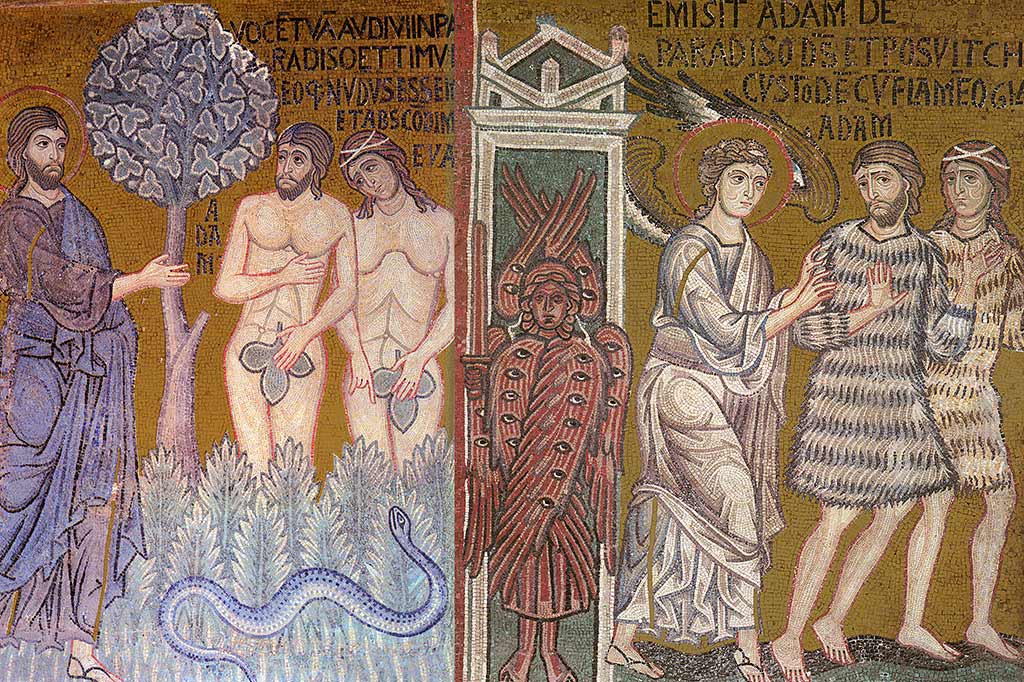
The Orthodox Church remembers the events described in this story on Forgiveness Sunday, the day before Great Lent begins. We include here the icon from that day, which shows God finding Adam and Eve, and then shows them being driven out of the Garden. Take a look at this icon and see what you notice about it.

image from www.goarch.org

Discussion questions:

1) Why did the man and the woman hide in the evening? (Because they heard God walking in the garden)

2) How do you think they were able to hear God walking in the Garden? Does God have feet? Who does the icon show with Adam and Eve in the Garden? (This is a question that encourages thought and speculation. However, within the Orthodox tradition, it is Jesus Christ Himself Who the icons show talking with Adam and Eve in the Garden, and when the Hymn of Kassiani talks about how the sinful woman washed the Lord’s feet, it makes the point that His feet were the same feet that Eve heard in the Garden, and hid herself.)

3) What did the man do when God asked if he had eaten the forbidden fruit? (He blamed the woman that God had given him…so pretty much he blamed God).

4) What did the woman do when God asked what she had done? (She blamed the snake).

5) What were the consequences for the snake? (The snake was cursed to go on its belly in the dust, and the fallen angel that had used the snake to tempt them was condemned to be the enemy of the woman and her descendants. The part about the snake’s head and the heel of Eve’s descendant was depicted in the picture last week)

6) What were the consequences for the woman? (Difficulty in childbirth, and submission to her husband. We need to note that both of these curses were lifted with Mary and her obedience. The Church has always taught that the Virgin Mary gave birth to Jesus Christ without the normal labor pains, specifically because with her, this curse is lifted. A lot of what we see about women in the Old Testament changes in the New Testament because of the Virgin Mary).

7) What were the consequences for the man? (He had to work to get food from the earth, as opposed to just picking fruit from the trees in the Garden, and he was condemned to die eventually and to go back to the earth from which he was taken. Both the man and the woman were kicked out of the Garden of Eden.)

8) What reason did God give for kicking them out of the Garden? (To make sure that they didn’t eat from the Tree of Life in their fallen condition. To live forever apart from God would be the worst thing imaginable, both for them, and for the universe at large).

Day 2 (Wednesday)

Hymns of Repentance from the Service of Confession

Since we talked on Monday about the consequences of the Fall, and how Adam and Eve lost their close relationship with God in the Garden of Eden because of their disobedience, today we’ll talk a little bit about Repentance, which is what we need to do to recover that relationship with God. We will specifically read three prayers/hymns of Repentance, which are used quite often in the life of the Church. The Priest prays these prayers every time he goes into the Church to do the Divine Liturgy, and we see them used in several other services of the Daily Cycle, and also in Paraklesis services and in the Sacrament of Confession.

“1 Have mercy on us, O Lord, have mercy on us: for at a loss for any plea, we sinners offer to You as Master this supplication: have mercy on us.

Glory to the Father and to the Son and to the Holy Spirit.

2 O Lord have mercy on us; for in You have we trusted: be not very angry with us, neither remember our iniquities. But as the Compassionate One, look down upon us even now, and deliver us from our enemies, for You are our God, and we are Your people, all being the works of Your hands, and we call upon Your name.

Both now and ever and to the ages of ages. Amen.

3 Open to us the doors of your lovingkindness, O blessed Theotokos, so that hoping in you we may not perish, but through you may be delivered from adversities; for you are the salvation of Christian people.”

There are a number of musical settings for these hymns – one beautiful version is linked below.

Discussion questions:

1) What do we ask God for in the first hymn? (For mercy)

2) What do you think it means when the hymn says “at a loss for any plea?” (It means that we don’t have any excuse or explanation to give to God for our sins – all we can give Him is our request that He have mercy on us)

3) In the 2nd hymn, what reason to we give to God to have mercy on us? (Because we have trusted in Him, because He is compassionate, and because we are His people, the work of His hands, and He is our God, and we call on His name).

4) Do you think that God is angry with us? What does the hymn say? (There may be many answers to this question – this is for discussion. I would point out that the hymn asks God NOT to be angry with us, which implies two things. The first is that God has every “right” to be angry with us; the second is that, when we ask Him for mercy, He will treat us with love, and not with anger.)

5) Who are we talking to in the 3rd Hymn? (To the Theotokos, the Virgin Mary – it may be worth reminding everyone that Theotokos means “Mother/Birthgiver of God,” and is the extra name with which we often address the Virgin Mary).

6) Why are we talking to the Virgin Mary in prayers of repentance? (When we sin, we turn away from the relationships and are selfish, acting as though we don’t need anyone else, and caring only for ourselves. Part of repentance is learning to ask for help, not only from God, but from other people, and especially from the Saints, who pray for us and by those prayers help us and support us. We especially ask the Virgin Mary for her prayers, because it was through her that salvation came into the world, in her Son, Jesus Christ our Lord and God. It is because of Him that she is the “salvation of the Christian people.”)

Day 3 (Friday)

Luke 4:14-30

Last week we saw Jesus in the desert for 40 days, being tempted by the Devil. After this, He went back to Galilee, back to His “home town” of Nazareth. There, in the synagogue, He proclaimed Himself to be the Messiah, the Christ, the Anointed One that the people were waiting for. Let’s see what happened…

“14 Then Jesus, filled with the power of the Spirit, returned to Galilee, and a report about him spread through all the surrounding country. 15 He began to teach in their synagogues and was praised by everyone.

16 When he came to Nazareth, where he had been brought up, he went to the synagogue on the sabbath day, as was his custom. He stood up to read, 17 and the scroll of the prophet Isaiah was given to him. He unrolled the scroll and found the place where it was written:

18 -19
“The Spirit of the Lord is upon me,
because he has anointed me
to bring good news to the poor.
He has sent me to proclaim release to the captives
and recovery of sight to the blind,
to let the oppressed go free,
to proclaim the year of the Lord’s favor.”

20 And he rolled up the scroll, gave it back to the attendant, and sat down. The eyes of all in the synagogue were fixed on him. 21 Then he began to say to them, “Today this scripture has been fulfilled in your hearing.” 22 All spoke well of him and were amazed at the gracious words that came from his mouth. They said, “Is not this Joseph’s son?” 23 He said to them, “Doubtless you will quote to me this proverb, ‘Doctor, cure yourself!’ And you will say, ‘Do here also in your hometown the things that we have heard you did at Capernaum.’” 24 And he said, “Truly I tell you, no prophet is accepted in the prophet’s hometown. 25 But the truth is, there were many widows in Israel in the time of Elijah, when the heaven was shut up three years and six months, and there was a severe famine over all the land; 26 yet Elijah was sent to none of them except to a widow at Zarephath in Sidon. 27 There were also many lepers[d] in Israel in the time of the prophet Elisha, and none of them was cleansed except Naaman the Syrian.” 28 When they heard this, all in the synagogue were filled with rage. 29 They got up, drove him out of the town, and led him to the brow of the hill on which their town was built, so that they might hurl him off the cliff. 30 But he passed through the midst of them and went on his way.

Discussion Questions

1) Where did Jesus go when He went back to Nazareth? (He went to the synagogue, the place where the people assembled on the Sabbath Day to read the Scripture)

2) What did He do there? (He read aloud from the prophecy of Isaiah, the prophecy of the Messiah, the Anointed One, God’s Chosen Christ – it is important to remind everyone that Messiah and Christ both mean “Anointed One.” One is the Hebrew word, the other is the Greek word, but both of them are talking about anointing, having oil poured on your head as a sign that God has chosen you to do an important job for him, like be a priest or a king or a savior.)

3) What did that prophecy say the Messiah was going to do? (To bring good news to the poor, to give sight to the blind, to give freedom to those who were enslaved or oppressed, and to announce the time of God’s favor on His people).

4) What did Jesus say when He had finished reading? (He told them that He was the fulfillment of the prophecy He had just read).

5) What did the people Jesus had grown up with say when they heard this? (First they said that He spoke very well, but then they started wondering what gave Him the right to say things like that, since He was just the son of the local carpenter, and a lot of them had known Him when He was just a child.)

6) What did Jesus say about this? (He quoted an old saying about how a prophet is never welcome in his own country, and then mentioned two stories from the Old Testament in which God’s blessings were given to strangers and foreigners, instead of to the Hebrew people. The point here, you might point out, is that Jesus is telling them that, as they question Him and try to put Him back in the box where they thought He fit, they are cutting themselves off from the blessings that He comes to give, and that those blessings will be given instead to foreigners and strangers).

7) What did the hometown crowd think of this? What did they do? (They were very angry, and tried to kill Him by throwing Him off a cliff).

8) How did Jesus escape? (He just walked through the crowd and left. We are to understand that this was a miracle, that He showed His power as God, that they were not able to hurt Him or even hold on to Him. This reminds us, as well, that Jesus could have escaped the Crucifixion at any time, had He decided to do so. That He did not escape then, as He does now, lets us see that He was there by choice, doing what He had come to do, in order to save us).

Year 1, Week 6 (October 4 – October 10)

Day 1 (Monday)

Genesis 3:1-7

Our reading for today is from chapter 3 of Genesis – it follows right after what we read last week, when God made the first woman from the rib of the first man. It describes the first sin, and how it came to happen.

“1 Now the serpent was more crafty than any other wild animal that the Lord God had made. He said to the woman, "Did God say, "You shall not eat from any tree in the garden'?" 2 The woman said to the serpent, "We may eat of the fruit of the trees in the garden; 3 but God said, "You shall not eat of the fruit of the tree that is in the middle of the garden, nor shall you touch it, or you shall die.' " 4 But the serpent said to the woman, "You will not die; 5 for God knows that when you eat of it your eyes will be opened, and you will be like God, knowing good and evil." 6 So when the woman saw that the tree was good for food, and that it was a delight to the eyes, and that the tree was to be desired to make one wise, she took of its fruit and ate; and she also gave some to her husband, who was with her, and he ate. 7 Then the eyes of both were opened, and they knew that they were naked; and they sewed fig leaves together and made loincloths for themselves. “

Discussion questions:

1) What animal spoke to the woman? (The serpent/the snake)

2) Do you think it was actually the snake talking? (It is worth noting that the text of this passage doesn’t actually say that it was the Devil speaking to Eve, but it is the general understanding of the Church over the centuries that Satan, the Devil, is using the snake to tempt the woman).

3) Why was it a bad thing to eat the fruit? (Because God had told them not to eat it)

4) What did the snake promise the woman would happen if she ate the fruit…what was tempting about it? (He told her that if she ate it, she would be like God, and would know good and evil)

5) What did the woman do after she ate the fruit? (She shared it with the man.)

6) What change happened to the man and the woman after they ate the fruit? (They realized that they were naked, and were ashamed or afraid, and so they made clothes out of fig leaves to cover themselves).

Day 2 (Wednesday)

St. Irenaeus of Lyons Explains How the Virgin Mary Makes Right What Went Wrong When Eve Sinned

On Monday we read about the first sin – today we will read what one of the earliest Church Fathers, a saint named Irenaeus, thought was important about that story. Irenaeus lived from A.D. 130 until around 200, which means he was born between 50 and 60 years after the Apostles died, or about about 100 years after Jesus ascended into heaven. Irenaeus is comparing Eve, who was the first human being to sin, with the Virgin Mary, who made a different choice.

“As Eve was seduced by the word of a fallen angel to flee from God, and so rebelled against His word, so Mary, by the word of an angel, received the glad tidings that she would bear God by obeying His word. The former, Eve, was seduced to disobey God, and so she fell, but the latter, Mary, was persuaded to obey God. In this way, the Virgin Mary became the advocate and defender of the virgin Eve. As the human race was subjected to death through the act of a virgin, so was it saved by a virgin, and thus the disobedience of one virgin was precisely balanced by the obedience of another” (From Against Heresies 5.19.1., as published in Louth, A., & Conti, M. (2001). Genesis 1–11 (pp. 78–79). Downers Grove, IL: InterVarsity Press).

St. Irenaeus is making an important point about how the first woman’s mistake was made right by the right decision of her descendant. What was broken when Eve sinned was made right when the Virgin Mary agreed to become the Mother of God, as we discussed in Week 4. There is actually a beautiful picture that depicts what St. Irenaeus is talking about, showing the Virgin Mary consoling Eve. I will include it, and a link to the source, below.

image from matthewwarner.mehttps://matthewwarner.me/beautiful-art-the-virgin-mary-consoles-eve

Discussion questions:

1) What are some things that Eve and Mary have in common? (Both of them are women, both of them are given a choice to obey God or not, both of them had an encounter with an angelic being, etc).

2) How do you think the Virgin Mary fixes what was broken when Eve sinned? (St. Irenaeus doesn’t say this in the passage, but the picture shows the answer – Mary doesn’t fix the problem herself, but through her obedience, Jesus Christ enters the world to make everything right)

3) What do you notice about the picture? (Eve is sad, but Mary is happy, Eve is holding onto the fruit of the Tree of the Knowledge of Good and Evil, but Mary is VERY pregnant with the Fruit of the Tree of Life, Eve is being held tight by the snake, but the Virgin Mary is stepping on the head of the snake.)

4) Which do Christians think is better? Men or Women? (This is a trick question – neither one is better than the other, but at various times people have argued that women are worse than men because the woman sinned first. The important Christian response to this mistake is that Eve’s mistake was made right by her daughter Mary, and the world would not be saved without Mary. Some people might remember that St. Kassiani made this point once – we’ll talk about that story another time).

Day 3 (Friday)

Luke 4:1-13

We finished reading the 1st chapter of Luke last week. Chapter 2 and Chapter 3 describe the birth of Jesus Christ, His dedication in the Temple, His time in the Temple when He was 12 years old, and His baptism by John. We will read these later on this year, in the weeks of the Feasts of Christmas, Theophany, and the Meeting of the Lord in the Temple. So we continue this week with Chapter 4, immediately after Jesus had been baptized by John.

“1 Jesus, full of the Holy Spirit, returned from the Jordan and was led by the Spirit in the wilderness, 2 where for forty days he was tempted by the devil. He ate nothing at all during those days, and when they were over, he was famished. 3 The devil said to him, "If you are the Son of God, command this stone to become a loaf of bread." 4 Jesus answered him, "It is written, "One does not live by bread alone.' " 5 Then the devil led him up and showed him in an instant all the kingdoms of the world. 6 And the devil said to him, "To you I will give their glory and all this authority; for it has been given over to me, and I give it to anyone I please. 7 If you, then, will worship me, it will all be yours." 8 Jesus answered him, "It is written, "Worship the Lord your God, and serve only him.' " 9 Then the devil took him to Jerusalem, and placed him on the pinnacle of the temple, saying to him, "If you are the Son of God, throw yourself down from here, 10 for it is written, "He will command his angels concerning you, to protect you,' 11 and "On their hands they will bear you up, so that you will not dash your foot against a stone.' " 12 Jesus answered him, "It is said, "Do not put the Lord your God to the test.' " 13 When the devil had finished every test, he departed from him until an opportune time. “

Discussion questions:

1) How long did Jesus fast when He was in the desert? (40 days).

2) What does a Fast of 40 days make you think of? (We fast for 40 days during both Great Lent and during the Nativity Fast before Christmas)

3) What happened to Jesus while He was fasting in the desert? (He was tempted by the Devil)

4) What did the Devil tempt Jesus with? (Food, Power, and a Miracle).

5) How did Jesus respond to the Devil’s temptations? (He quoted Scripture to show that the Devil’s arguments were empty and wrong)

6) Can you think of a time that you have been tempted to sin? Can you think of any words from Scripture or from the Liturgy or prayers of the Church that might help you resist temptation? (This is an open question – maybe discuss what sort of things might be helpful. At the least, besides the verses that Jesus quotes here, you might mention the simple prayer, “Lord, have mercy.”).