Year 2 – Week 13 (November 28 – December 4)

Day 1 (Monday)

Genesis 11:27 – 32; 12:1-9

Two weeks ago we read the story of the Tower of Babel, and we saw how all the nations came into being when the languages were divided and all of them were exiled from the presence of God. We discussed how with this, the whole world was falling once more into rebellion against God, and all the nations were corrupt. We also read through the genealogy of the descendants of Shem, until we reached Terah, the father of Abram and his brothers. We are moving directly to this story because this is what God did next after Babel, as He began to prepare the way for all the nations to be brought back to Him, as we see happen on the day of Pentecost. We aren’t going to read the full story of Abram this year, but will see him introduced here, and see what promises God makes to him as He calls him to leave his homeland and follow God instead.

Descendants of Terah

27 Now these are the descendants of Terah. Terah was the father of Abram, Nahor, and Haran; and Haran was the father of Lot. 28 Haran died before his father Terah in the land of his birth, in Ur of the Chal′deans. 29 And Abram and Nahor took wives; the name of Abram’s wife was Sarai, and the name of Nahor’s wife, Milcah, the daughter of Haran the father of Milcah and Iscah. 30 Now Sarai was barren; she had no child.

31 Terah took Abram his son and Lot the son of Haran, his grandson, and Sarai his daughter-in-law, his son Abram’s wife, and they went forth together from Ur of the Chaldeans to go into the land of Canaan; but when they came to Haran, they settled there. 32 The days of Terah were two hundred and five years; and Terah died in Haran.

The Call of Abram

12 Now the Lord said to Abram, “Go from your country and your kindred and your father’s house to the land that I will show you. 2 And I will make of you a great nation, and I will bless you, and make your name great, so that you will be a blessing. 3 I will bless those who bless you, and him who curses you I will curse; and by you all the families of the earth shall bless themselves.”

4 So Abram went, as the Lord had told him; and Lot went with him. Abram was seventy-five years old when he departed from Haran. 5 Abram took his wife Sarai and his brother’s son Lot, and all the possessions that they had gathered, and the persons whom they had acquired in Haran; and they set forth to go to the land of Canaan. When they had come to the land of Canaan, 6 Abram passed through the land to the place at Shechem, to the oak of Moreh. At that time the Canaanites were in the land.

7 Then the Lord appeared to Abram, and said, “To your offspring I will give this land.” So he built there an altar to the Lord, who had appeared to him. 8 From there he moved on to the hill country on the east of Bethel, and pitched his tent, with Bethel on the west and Ai on the east; and there he built an altar to the Lord and invoked the name of the Lord. 9 And Abram journeyed on by stages toward the Negeb.

Discussion questions:

1) What did you notice in today’s reading? What surprised you or what was memorable to you? (The Leader should point out what God asks Abram to do, to leave his homeland and even to leave his father’s house, to follow where God leads and to trust Him; he should also point out what God promises to Abram, that if Abram leaves the nation of his birth behind, God will make his descendants into a great nation, a new nation, and that ALL the nations of the world will be blessed through him. This promise is enacted with the covenant at Mt. Sinai that God makes with the children of Israel, and fulfilled in the birth, life, death, and resurrection of Jesus Christ, Who enters into the Creation through the Theotokos, the descendant of Abraham, and who saves all of humankind, calling us to restored communion with God, and to everlasting life, so that indeed, all of us are blessed through Abraham.)

2) Where do we see Christ in this text; what is He saying or doing here?

3) Do we see ourselves and the Church in this text; what does it say about us?

4) What do you find difficult about this reading? Is there anything confusing about it, or anything that you dislike? (This is an open question, as always. )

5) Does this reading make you think that you need to change anything in your life?

Day 2 (Wednesday)

Hymns from the Feast of the Entrance of the Theotokos into the Temple (November 21)

Every year on November 21st, we celebrate the Feast of the Entrance of the Theotokos into the Temple. The story of this feast is that when the Virgin Mary was three years old, her parents dedicated her to serve in the Temple. When she was brought to the Temple, the Priest Zacharias (the father of St. John the Baptist) greeted her, but she walked straight into the Temple by herself, and went straight into the Holy Place, and beyond the curtain into the Holy of Holies, which is where the Ark of the Covenant had used to be, until it was lost. The Holy of Holies had therefore been empty for hundreds of years, since the Temple was rebuilt, and along with its absence, the people of God understood that God’s Presence had never returned to the Temple. With the Entrance of the Theotokos into the Temple, the Fathers of the Church understand the true Ark of the Lord’s Presence, which the lost Ark had only prefigured, to have finally arrived to take her place in the Temple. The following hymns reflect on this.

3rd Hymn of the Kekragaria

You are she of whom the Prophets preached, * the Apostles' glory, and the martyrs' pride and joy. * You are the renewal of all us who were born on earth, * O Virgin Mother of God, for we have been reconciled to God through you. * And therefore we honor your procession into the Temple of God the Lord. * And together with the Angel, we cry out in psalms, Rejoice, * to you, all-holy Lady, * at whose intercession we are saved.

4th Hymn of the Kekragaria

Now the holy and blameless girl * to the Holy of Holies is * by the Holy Spirit brought in to be at home. * A holy Angel provides her food. * And she is indeed a most * holy temple of our God, * who is Holy and who has made the entire world * to be holy, by making her His dwelling, and who deified the fallen * nature of mortal humanity.

Hymn from Ode 2 of Canon 1 of the Feast

The transgression came upon mankind of old from Eve, ⁄ and now from Eve's stock our restoration and incorruption blossoms: ⁄ the Theotokos who is brought today into the house of God.

Hymn from Ode 2 of Canon 2 of the Feast

The prophets proclaimed you in ages past, speaking of you as the ark of holiness, the golden censer, the candlestick and table: as we sing your praises as the Tabernacle that held God.

Hymn from Ode 8, Canon 2 of the Feast

The saints David and Jesse exult today and Judah is filled with pride. For from their root a branch has sprung: the pure Virgin from whom the pre-eternal God is to be born.

Glory Hymn from Ode 8, Canon 2 of the Feast

Let Holy, Holy, Holy! be sung to the Father, Son and Holy Spirit: Indivisible Unity, one Godhead holding creation in the palm of His hand throughout all ages.

Both Now Hymn from Ode 8, Canon 2 of the Feast

He Who is without beginning now begins to be: according to His good pleasure the Word is born in the flesh from a Virgin Maid, both God and mortal man, and in His extreme compassion He refashions us who had fallen.

Hymn from the Praises of the Feast

The Theotokos was shown forth unto the world in truth * to be the noble offspring of a most holy promise, * superior to all things. As she is led * reverently into the house of God, * the pious prayer of her parents she now fulfills; * and by the Holy Spirit she is preserved.

Discussion questions:

1) What did you notice in today’s reading? What surprised you or what was memorable to you? (The Leader should point out, in the same way that the Fathers of the Church see the Tower of Babel and the Feast of Pentecost as two ends of the same story, they see the promise to Abraham that we read on Day 1 as the beginning of a promise and process that reaches its fulfillment with the Theotokos, the Virgin Mary. Abraham is promised that he will have many descendants, and that all the nations of the world will be blessed because of his descendants. This is talking, of course, about Jesus Christ Himself, Who has saved us from sin and death and leads us into everlasting life; but the Mother of God is the daughter of Abraham through whom this is accomplished. When the hymns today talk about the prophecies, about Eve and David and Jesse and Judah, they are simply listing the many ancestors of the Virgin Mary who had been promised that God would be faithful, and pointing out that she is the one in whom God fulfills all those promises.)

2) Where do we see Christ in this text; what is He saying or doing here?

3) Do we see ourselves and the Church in this text; what does it say about us?

4) What do you find difficult about this reading? Is there anything confusing about it, or anything that you dislike? (This is an open question, as always. )

5) Does this reading make you think that you need to change anything in your life?
Day 3 (Friday)

Mark 4:35-41

Our last reading from the Gospel of Mark, two weeks ago, included several brief parables following the Parable of the Sower from three weeks ago. We may remember that Jesus was preaching those parables on the seashore, and was even preaching from a boat a little off shore. We continue here with what happened that evening, after Jesus had finished preaching, as He leaves the crowd behind and crosses the sea with his disciples.

Jesus Stills a Storm

35 On that day, when evening had come, he said to them, “Let us go across to the other side.” 36 And leaving the crowd behind, they took him with them in the boat, just as he was. Other boats were with him. 37 A great windstorm arose, and the waves beat into the boat, so that the boat was already being swamped. 38 But he was in the stern, asleep on the cushion; and they woke him up and said to him, “Teacher, do you not care that we are perishing?” 39 He woke up and rebuked the wind, and said to the sea, “Peace! Be still!” Then the wind ceased, and there was a dead calm. 40 He said to them, “Why are you afraid? Have you still no faith?” 41 And they were filled with great awe and said to one another, “Who then is this, that even the wind and the sea obey him?”

Discussion questions:

1) What did you notice in today’s reading? What surprised you or what was memorable to you? (The Leader should point out two things that we should pay attention to here, besides the simple facts of the story, that Jesus calms the sea during the storm. First, the way in which the Lord calms the storm is one of the clearest revelations of the Divinity of Jesus that we have, next to His healing of the sick and casting out of demons. The answer to the disciples’ question at the end is clearly “only the Most High God has authority even over the wind and the sea.” The second point is in anticipation of next week’s reading: crossing the sea here was Jesus’ sole idea. Unless He wanted to show them His authority over the sea, He has something to do on the other side of the sea. We should be attentive to that as we wait for next week.)

2) Where do we see Christ in this text; what is He saying or doing here?

3) Do we see ourselves and the Church in this text; what does it say about us?

4) What do you find difficult about this reading? Is there anything confusing about it, or anything that you dislike? (This is an open question, as always. )

5) Does this reading make you think that you need to change anything in your life?

Year 2 – Week 12 (November 21 – 27)

Day 1 (Monday)

Deuteronomy 32:1-14

Because this is the week of Thanksgiving, there is no Sunday School at the Church this coming Sunday. We are therefore selecting readings a little bit off the beaten path, for those families that are reading these things at home. Last time we saw the nations divided at the Tower of Babel, and how the different nations were scattered throughout the world. We also saw how the icon of the event shows each nation being entrusted to an angel, and talked about how all of these angels began to accept human worship, and thus fell into sin, and became the demon-gods of the pagan world, those who held humanity as slaves until the Lord came to deliver them.

That deliverance began when God called Abram out from his country and his father’s house, and promised to make him the father of many nations. Abram’s descendants, the Israelites, ended up slaves in the land of Egypt, and specifically slaves to the demon-gods of Egypt, until God sent Moses to deliver them out, and to make the Israelites His own special people. Despite this deliverance, they rebelled against God again and again. Today we will read a song that Moses sang to the Israelites just before he died, as a summary of their God’s purpose for them, as an indictment of their sins, as a warning of God’s judgment that was yet to come, and as a promise of God’s final deliverance in the end. This is actually the second of the nine Biblical Odes, and is found at the end of every Orthodox Psalter.

The Song of Moses

30 Then Moses recited the words of this song, to the very end, in the hearing of the whole assembly of Israel:

32 Give ear, O heavens, and I will speak;
let the earth hear the words of my mouth.
2 May my teaching drop like the rain,
my speech condense like the dew;
like gentle rain on grass,
like showers on new growth.

3 For I will proclaim the name of the Lord;
ascribe greatness to our God!
4 The Rock, his work is perfect,
and all his ways are just.
A faithful God, without deceit,
just and upright is he;
5 yet his degenerate children have dealt falsely with him,
a perverse and crooked generation.

6 Do you thus repay the Lord,
O foolish and senseless people?
Is not he your father, who created you,
who made you and established you?
7 Remember the days of old,
consider the years long past;
ask your father, and he will inform you;
your elders, and they will tell you.

8 When the Most High apportioned the nations,
when he divided humankind,
he fixed the boundaries of the peoples
according to the number of the gods;
9 the Lord’s own portion was his people,
Jacob his allotted share.

10 He sustained him in a desert land,
in a howling wilderness waste;
he shielded him, cared for him,
guarded him as the apple of his eye.
11 As an eagle stirs up its nest,
and hovers over its young;
as it spreads its wings, takes them up,
and bears them aloft on its pinions,
12 the Lord alone guided him;
no foreign god was with him.

13 He set him atop the heights of the land,
and fed him with produce of the field;
he nursed him with honey from the crags,
with oil from flinty rock;
14 curds from the herd, and milk from the flock,
with fat of lambs and rams;
Bashan bulls and goats,
together with the choicest wheat—
you drank fine wine from the blood of grapes.

15 Jacob ate his fill;
the nation God established in righteousness grew fat, and kicked.
You grew fat, bloated, and gorged!
He abandoned God who made him,
and scoffed at the Rock of his salvation.
16 They made him jealous with strange gods,
with abhorrent things they provoked him.

17 They sacrificed to demons, not God,
to deities they had never known,
to new ones recently arrived,
whom your ancestors had not feared.
18 You were unmindful of the Rock that bore you;
you forgot the God who gave you birth.

19 The Lord saw it, and was jealous;
he spurned his sons and daughters.
20 He said: I will hide my face from them,
I will see what their end will be;
for they are a perverse generation,
children in whom there is no faithfulness.
21 They made me jealous with what is no god,
provoked me with their idols.
So I will make them jealous with what is no people,
provoke them with a foolish nation.

… (the verses we are omitting, from verse 22 through verse 34, go into detail about how God will render judgment on His people)

35 Vengeance is mine, and recompense,
for the time when their foot shall slip;
because the day of their calamity is at hand,
their doom comes swiftly.
36 Indeed the Lord will vindicate his people,
have compassion on his servants,
when he sees that their power is gone,
neither bond nor free remaining.

37 Then he will say: Where are their gods,
the rock in which they took refuge,
38 who ate the fat of their sacrifices,
and drank the wine of their libations?
Let them rise up and help you,
let them be your protection!
39 See now that I, even I, am he;
there is no god besides me.
I kill and I make alive;
I wound and I heal;
and no one can deliver from my hand.

40 For I lift up my hand to heaven,
and swear: As I live forever,
41 when I whet my flashing sword,
and my hand takes hold on judgment;
I will take vengeance on my adversaries,
and will repay those who hate me.
42 I will make my arrows drunk with blood,
and my sword shall devour flesh—
with the blood of the slain and the captives,
from the long-haired enemy.

43 Praise, O heavens, his people,
worship him, all you gods!
For he will avenge the blood of his children,
and take vengeance on his adversaries;
he will repay those who hate him,
and cleanse the land for his people.

Discussion questions:

1) What did you notice in today’s reading? What surprised you or what was memorable to you? (The Leader should point out that God is framing the entire story of Israel, and of all humanity, in terms of those who have rebelled against Him, and of what He is doing to bring them back. For those who make themselves His enemies, and persist in that despite warnings and discipline and judgment, there will be utter failure and defeat, so that for those who repent, and turn back to the Lord, there will be blessings and compassion and communion. He might point out as well that human beings tend to do very poorly when we are strong and fat, that this is when we fall into sin, when we believe that we don’t need God. Conversely, it is when we are weak, and understand that we are weak, that we are able to turn to the Lord and begin again to be His children, the sheep of His pasture, the ones that He protects and sustains against every need and every threat.)

2) Where do we see Christ in this text; what is He saying or doing here?

3) Do we see ourselves and the Church in this text; what does it say about us?

4) What do you find difficult about this reading? Is there anything confusing about it, or anything that you dislike? (This is an open question, as always. )

5) Does this reading make you think that you need to change anything in your life?

Day 2 (Wednesday)

First Vespers Prayer at the Lighting of the Lamps

At sunset each day, the Church celebrates the service of Vespers, which simply means sunset, or evening. This is built around the very ancient custom of lighting the lamps inside the Church, while Psalms are read that reflect on the coming of the night, the rest that God gives to us, and our expectation of the new day that is to come, and of the enlightenment that we are given by the Lord as He illumines our hearts and our minds. As the service begins, there are seven prayers that are read by the Priest; this is the first of those seven.

First Prayer at the Lighting of the Lamps

O Lord, compassionate and merciful, long-suffering and very merciful, give ear to our prayer and attend to the voice of our petition; accomplish a sign for good with us; lead us in Your way, that we may walk in Your truth.

Gladden our hearts that we may fear Your holy Name; for You are great, and work wonders; You alone are God, and there is none like to You among the gods, O Lord; mighty in mercy, and good in power, unto helping, and comforting, and saving all those who hope in Your holy Name.
For to You is due all glory, honor and worship, to the Father and to the Son and to the Holy Spirit, now and ever and unto the ages of ages. Amen.

Discussion questions:

1) What did you notice in today’s reading? What surprised you or what was memorable to you? (The Leader should make note, as always when we read a prayer, of how we begin by confessing Who God is, that He is merciful and compassionate. It continues, very quickly in this, by asking Him to hear us and help us to be with Him. The basic idea of this prayer is that we are confessing that it is good to be in the presence of the Lord, and that all good things come from Him, so we are asking His help to transform our hearts and help us to desire the Communion with Him for which He created us. There is a particular significance to the fact that we do this at evening, that as the light fades and as we light lamps inside, we are ask for our desire for the things of this world to fade as well, and seek to stoke our desire for the light of the Lord.)

2) Where do we see Christ in this text; what is He saying or doing here?

3) Do we see ourselves and the Church in this text; what does it say about us?

4) What do you find difficult about this reading? Is there anything confusing about it, or anything that you dislike? (This is an open question, as always. )

5) Does this reading make you think that you need to change anything in your life?

Day 3 (Friday)

1 Peter 2:18-25

We had mentioned a number of weeks ago that St. Mark the Evangelist spent much of his time with St. Peter, and as a result it is presumed that the Gospel of Mark records basically St. Peter’s witness of the Lord’s Proclamation of salvation to the world. Since we are taking something of a week “off” for Thanksgiving, we are reading then some more from the 1st Epistle of St. Peter to the Church at large, to see some other aspects of how Peter teaches and preaches.

The Example of Christ’s Suffering

18 Slaves, accept the authority of your masters with all deference, not only those who are kind and gentle but also those who are harsh. 19 For it is a credit to you if, being aware of God, you endure pain while suffering unjustly. 20 If you endure when you are beaten for doing wrong, what credit is that? But if you endure when you do right and suffer for it, you have God’s approval.

21 For to this you have been called, because Christ also suffered for you, leaving you an example, so that you should follow in his steps.
22 “He committed no sin,
and no deceit was found in his mouth.”
23 When he was abused, he did not return abuse; when he suffered, he did not threaten; but he entrusted himself to the one who judges justly.

24 He himself bore our sins in his body on the cross, so that, free from sins, we might live for righteousness; by his wounds you have been healed. 25 For you were going astray like sheep, but now you have returned to the shepherd and guardian of your souls.

Discussion questions:

1) What did you notice in today’s reading? What surprised you or what was memorable to you? (The Leader should note that this is a challenging reading. St. Peter is talking to people who are actual slaves, and is telling them to submit to their masters. It is important to note that he does NOT say that slavery is a good thing, or that it is a good thing for masters to dominate their slaves. He is, however, telling the slaves themselves how THEY should act, how they should understand their servitude, that they should take it as an opportunity to follow the example of the Lord. What we should take from this, then, is not any particular lesson about slavery (which the Church is unequivocally opposed to, to be clear), but about how we ourselves should face whatever troubles and difficulties we face in life. Instead of resenting those troubles and complaining about them, St. Peter is saying that the Christian response is to “take up our Cross” and take the opportunity to imitate Christ when suffering comes to us.)

2) Where do we see Christ in this text; what is He saying or doing here?

3) Do we see ourselves and the Church in this text; what does it say about us?

4) What do you find difficult about this reading? Is there anything confusing about it, or anything that you dislike? (This is an open question, as always. )

5) Does this reading make you think that you need to change anything in your life?

Year 2 – Week 11 (November 14 – 20)

Day 1 (Monday)

Genesis 11:1-10, 26

Last week we saw how Noah’s son Ham took a turn toward evil, taking advantage of his father’s weakness to try to seize power and dominion in the world for himself and his descendants. The next chapter in Genesis (chapter 10) gives the initial genealogy from Noah, listing the 70 nations that were known to the Israelites and where they came from. This genealogy gives the general background for how the different peoples of the world came to be. What follows explains why they went their separate ways, instead of all living together as a single people. There is an icon included here that shows the scene at the Tower of Babel, and a couple links below that explain more about this for those who are interested.

image from www.imparaklitou.gr

The Tower of Babel

11 Now the whole earth had one language and few words. 2 And as men migrated from the east, they found a plain in the land of Shinar and settled there. 3 And they said to one another, “Come, let us make bricks, and burn them thoroughly.” And they had brick for stone, and bitumen for mortar. 4 Then they said, “Come, let us build ourselves a city, and a tower with its top in the heavens, and let us make a name for ourselves, lest we be scattered abroad upon the face of the whole earth.”

5 And the Lord came down to see the city and the tower, which the sons of men had built. 6 And the Lord said, “Behold, they are one people, and they have all one language; and this is only the beginning of what they will do; and nothing that they propose to do will now be impossible for them. 7 Come, let us go down, and there confuse their language, that they may not understand one another’s speech.”

8 So the Lord scattered them abroad from there over the face of all the earth, and they left off building the city. 9 Therefore its name was called Babel, because there the Lord confused the language of all the earth; and from there the Lord scattered them abroad over the face of all the earth.

Descendants of Shem

10 These are the descendants of Shem. When Shem was a hundred years old, he became the father of Arpachshad two years after the flood.

…Arpachshad fathered Shelah, who fathered Eber, who fathered Peleg (in whose days the earth was divided at Babel – Genesis 10:25), who fathered Reu, who fathered Serug, who fathered Nahor, who fathered Terah…

26 When Terah had lived seventy years, he became the father of Abram, Nahor, and Haran.

For more information on questions of God's Divine Council, and the Mountain of Assembly discussed below, and what is happening at the Tower of Babel, please see the following links.

Genesis and "the Fall"

God’s Divine Council

Discussion questions:

1) What did you notice in today’s reading? What surprised you or what was memorable to you? (Leader needs to explain two things. First, the reason they were building the tower was that they were trying to make an artificial “Mountain of Assembly,” the place where the Most High God ruled; their goal was to control God as though He were one of the pagan gods, who could be bribed with temples and sacrifices. It is in response to this sinful action that God divides them into many nations, confusing their languages. Second, what is less obvious here, but is seen elsewhere in Scripture, as the one above, is that God gave each “new nation” into the authority and care of one of the angels, to teach them and care for them and lead them back to true and right worship of Himself. We can see these angels going with each new nation in the icon. But these angels did not do this; instead, they fell as well, and accepted human worship, and became the gods of the pagan world, the demons that Christ came to deliver humankind from.

It is from this point that God begins to prepare His people Israel, which is why the genealogy brings us up to Abram, which starts the process that ends with the Church on the day of Pentecost, when the confusion of the languages is resolved by the Holy Spirit and all the nations of the world are called back together into the Church. In the Church, we have been called back to true worship of God, invited to ascend the mountain of the Lord to meet God face to face. As an aside, this is why the Altar is elevated above the rest of the Church.)

2) Where do we see Christ in this text; what is He saying or doing here?

3) Do we see ourselves and the Church in this text; what does it say about us?

4) What do you find difficult about this reading? Is there anything confusing about it, or anything that you dislike? (This is an open question, as always. )

5) Does this reading make you think that you need to change anything in your life?

Day 2 (Wednesday)

Doxastikon for the Aposticha of the Vespers of Pentecost

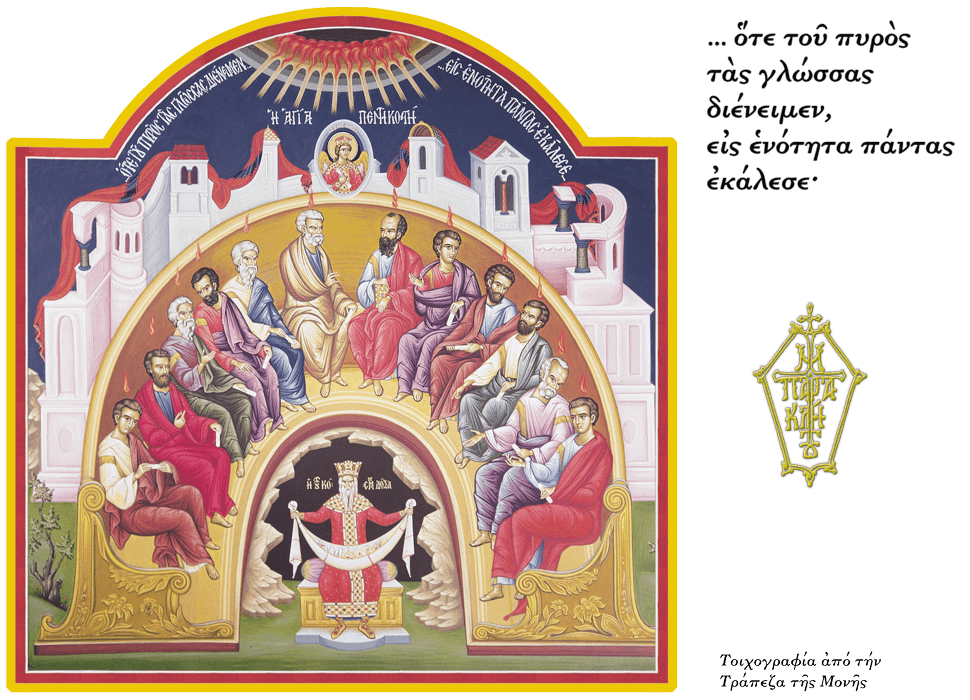
On Day 1 we read about the separation of the nations from one another at the Tower of Babel. Today we will read a short hymn from the Feast of Pentecost (which happens every year in the early summer, 50 days after Easter), and then will read a brief explanation about what the Tower of Babel has to do with Pentecost.

Doxastikon for the Aposticha of the Vespers of Pentecost

Tongues were once made useless, because human beings dared to build the Tower of Babel. Tongues now become skilled, for the glory of the knowledge of God. Then, God condemned the people who committed sacrilege, because of their sin; here, by the Spirit, Christ enlightened the fishermen. Then, speechlessness was imposed as a punishment; now harmony is restored, for the salvation of our souls.

Explanation:

This hymn is connecting the Tower of Babel and the Day of Pentecost as two ends of the same story. Human beings at Babel tried to control God, and as a result, God confused their languages and divided them into many nations. These nations came to worship many different gods as the angels to whom God entrusted them accepted worship and fell into darkness, becoming the demon-gods who enslaved them.

God doesn’t abandon humanity, though. Beginning with Abraham, and working through the entire Old Testament, God prepares Israel as a priestly people for Himself. Jesus Christ renews and perfects this priestly people in the Church, and on the Day of Pentecost, through the Holy Spirit, He calls all the nations back to Himself. On this day, all the different languages which had divided them at Babel are used by the Apostles, inspired by the Holy Spirit, not to divide the nations, but instead to call them back together to unity with one another in right and perfect communion with the Most High God.

image from www.imparaklitou.gr

Discussion questions:

1) What did you notice in today’s reading? What surprised you or what was memorable to you? (Leader should point out that the sin at Babel is trying to control God, to make Him do what we want, rather than submitting our lives to Him and and following Him. God can’t do anything for us when we try to control Him, except to leave us to our own desires, and their consequences. But when we submit ourselves to Him, then the Holy Spirit comes to us, and brings us into communion with Himself, and begins to heal all that is broken in us).

2) Where do we see Christ in this text; what is He saying or doing here?

3) Do we see ourselves and the Church in this text; what does it say about us?

4) What do you find difficult about this reading? Is there anything confusing about it, or anything that you dislike? (This is an open question, as always. )

5) Does this reading make you think that you need to change anything in your life?

Day 3 (Friday)

Mark 4:21-34

Last time Jesus preached the parable of the sower, and we discussed the different types of soil, and what needed to be done to make them good soil, and how it is our responsibility to care for the soil of our heart, to prepare it to receive the seed that is the Word of God, so that it can bear fruit in our lives. This time, we will see how Jesus continued from that parable to tell more parables about the Kingdom of God, and how He works in the world, and what our part is in that work. We should remember that the last words of the Parable of the Sower are about how the good seed bore fruit, as much as a hundred times what was sown.

A Lamp under a Bushel Basket

21 He said to them, “Is a lamp brought in to be put under the bushel basket, or under the bed, and not on the lampstand? 22 For there is nothing hidden, except to be disclosed; nor is anything secret, except to come to light. 23 Let anyone with ears to hear listen!” 24 And he said to them, “Pay attention to what you hear; the measure you give will be the measure you get, and still more will be given you. 25 For to those who have, more will be given; and from those who have nothing, even what they have will be taken away.”

The Parable of the Growing Seed

26 He also said, “The kingdom of God is as if someone would scatter seed on the ground, 27 and would sleep and rise night and day, and the seed would sprout and grow, he does not know how. 28 The earth produces of itself, first the stalk, then the head, then the full grain in the head. 29 But when the grain is ripe, at once he goes in with his sickle, because the harvest has come.”

The Parable of the Mustard Seed

30 He also said, “With what can we compare the kingdom of God, or what parable will we use for it? 31 It is like a mustard seed, which, when sown upon the ground, is the smallest of all the seeds on earth; 32 yet when it is sown it grows up and becomes the greatest of all shrubs, and puts forth large branches, so that the birds of the air can make nests in its shade.”

The Use of Parables

33 With many such parables he spoke the word to them, as they were able to hear it; 34 he did not speak to them except in parables, but he explained everything in private to his disciples.

Discussion questions:

1) What did you notice in today’s reading? What surprised you or what was memorable to you? (The Leader should point out that, while all these parables are connected with the idea of the Parable of the Sower, and the seed of the Word of God growing in the world, they have gone in a different direction, to talk about how that seed actually grows, and what that looks like. The main point seems to be that the Kingdom of God doesn’t grow in the way we expect Kingdoms to grow, with plans and strategies and quarterly reports and such. It happens in secret, in the depths of the human heart, but the fruit of it is and must be evident in our lives, as with the lamp on the lamp stand. God’s work in this world begins in humble places, in humble people, acting in humble ways, but when it comes to its fullness, it topples empires and transforms everything, not by a conquest from outside, but by a complete transformation from within.)

2) Where do we see Christ in this text; what is He saying or doing here?

3) Do we see ourselves and the Church in this text; what does it say about us?

4) What do you find difficult about this reading? Is there anything confusing about it, or anything that you dislike? (This is an open question, as always. )

5) Does this reading make you think that you need to change anything in your life?

Year 2 – Week 10 (November 7 – 13)

Day 1 (Monday)

Genesis 9:18-28

Last week we saw the final conclusion of the Flood, with God’s placing His bow in the sky as a sign of His promise to not destroy all life from the earth again. He also gave Noah and his family permission to eat meat, but commanded them never to eat or drink the blood, because the life was in the blood. We discussed this at length, and talked about how there is both a positive and a negative reason for this. The positive reason is that the only Blood we are to receive is the Blood of the Lord, which gives us everlasting life as we are united with His Life. The negative reason is that one of the ways pagan people participate in the rebellion of the demons against God is by drinking blood, with the idea of taking life and power from whatever creature they kill and making it their own. We don’t see many pagan people any longer, but this was a very normal part of pagan worship before Jesus Christ came and overthrew the power of the demons over humankind.

This week we will see what happens next to Noah and his family, and how (very sadly) one of his sons falls into a great sin, and actually, almost the exact sin that God had just forbidden.

Noah and His Sons

18 The sons of Noah who went forth from the ark were Shem, Ham, and Japheth. Ham was the father of Canaan. 19 These three were the sons of Noah; and from these the whole earth was peopled.

20 Noah was the first tiller of the soil. He planted a vineyard; 21 and he drank of the wine, and became drunk, and lay uncovered in his tent. 22 And Ham, the father of Canaan, saw the nakedness of his father, and told his two brothers outside.

23 Then Shem and Japheth took a garment, laid it upon both their shoulders, and walked backward and covered the nakedness of their father; their faces were turned away, and they did not see their father’s nakedness. 24 When Noah awoke from his wine and knew what his youngest son had done to him, 25 he said,

“Cursed be Canaan;
a slave of slaves shall he be to his brothers.”

26 He also said,

“Blessed by the Lord my God be Shem;
and let Canaan be his slave.
27 God enlarge Japheth,
and let him dwell in the tents of Shem;
and let Canaan be his slave.”

28 After the flood Noah lived three hundred and fifty years. 29 All the days of Noah were nine hundred and fifty years; and he died.

Discussion questions:

1) What did you notice in today’s reading? What surprised you or what was memorable to you? (This is a hard reading; it’s both difficult to understand, and sad to see. There are two sins here: Noah’s sin in getting drunk, and Ham’s sin, which was to spread the word about Noah’s sin. Ham’s sin is worse than Noah’s sin, because Ham was happy to see his father humiliated, and tried to humiliate him more by telling his brothers. It seems that he was trying to take advantage of his father’s weakness and use it to make himself more powerful. In a sense, then, Ham was doing the exact sort of thing that God had forbidden with the eating of blood…he was seizing power for himself from someone else’s weakness. When Noah curses Ham’s son Canaan, then, he isn’t causing Ham’s descendants to be evil and cursed, he is simply telling what the result will be of Ham’s sinfulness, and how it will not work the way that Ham wants. With his will to power and willingness to use others to get what he wants, the newly cleansed world is right back on the road to sinfulness. What we will see as we continue to read through the Bible, then, is that Ham’s descendants do in fact become powerful, for a long time, but in the end, they come to nothing, and the more righteous descendants of Shem and Japheth are the ones who prove to be truly blessed. We should note, as well, that descendants ultimately is not an issue of race, but of likeness. So those who act like Ham and try to take power at the expense of others will come to ruin; those who are humble and gracious and respectful, like Shem and Japheth, will be glorified.)

2) Where do we see Christ in this text; what is He saying or doing here?

3) Do we see ourselves and the Church in this text; what does it say about us?

4) What do you find difficult about this reading? Is there anything confusing about it, or anything that you dislike? (This is an open question, as always. )

5) Does this reading make you think that you need to change anything in your life?

Day 2 (Wednesday)

St. Nektarios on Happiness

On November 9th, the Orthodox Church celebrates the feast day of St. Nektarios, who fell asleep in the Lord in 1920. We will read one of his sayings today, since it is the day after his feast-day.

He was a bishop and a scholar, of great piety and high intelligence, very beloved by his people. Because of his success, some other bishops were jealous of him, and had him removed from his church and sent into exile, so he spent the rest of his life teaching future priests in Greece, and eventually in establishing a monastery for pious women on the island of Aegina, somewhat near to Athens. He suffered greatly throughout his life, so when he talks about true happiness, we should pay attention, because he learned where to find true happiness even while he was suffering.

Happiness Is A Pure Heart

How mistaken are those people who seek happiness outside of themselves, in foreign lands and journeys, in riches and glory, in great possessions and pleasures, in diversions and vain things, which have a bitter end! It is the same thing to construct the tower of happiness outside of ourselves as it is to build a house in a place that is consistently shaken by earthquakes.

Happiness is found within ourselves, and blessed is the man who has understood this. Happiness is a pure heart, for such a heart becomes the throne of God. Thus says Christ of those who have pure hearts: "I will visit them, and will walk in them, and I will be a God to them, and they will be my people." (II Cor. 6:16) What can be lacking to them? Nothing, nothing at all! For they have the greatest good in their hearts: God Himself!.”

Discussion questions:

1) What did you notice in today’s reading? What surprised you or what was memorable to you? (Leader should point out that St. Nektarios is saying that happiness does not and cannot come from things that are outside of us, things that happen to us, and should make the specific connection that almost everything that we work so hard to get in this life is exactly this sort of happiness. We shouldn’t be surprised that it doesn’t work. Leader should then point out where St. Nektarios says happiness CAN actually be found; with the presence of God in our hearts. But that means we need to have a pure heart. We can’t make our own heart pure, but we can repent of impurity, and turn away from things that make our hearts impure, and ask God to cleanse our hearts and to come and dwell with us. This is the whole of the Christian life.)

2) Where do we see Christ in this text; what is He saying or doing here?

3) Do we see ourselves and the Church in this text; what does it say about us?

4) What do you find difficult about this reading? Is there anything confusing about it, or anything that you dislike? (This is an open question, as always. )

5) Does this reading make you think that you need to change anything in your life?

Day 3 (Friday)

Mark 4:1-20

Last time we saw Jesus explain that He came to defeat the demons and deliver humanity from their slavery to them, and also that everyone who listened to Him was His family, as near to Him as His mother and closest family. This time we will see Him some time later, teaching by the sea again; this time, we will hear one of the most famous parables from Him.

The Parable of the Sower

4 Again he began to teach beside the sea. Such a very large crowd gathered around him that he got into a boat on the sea and sat there, while the whole crowd was beside the sea on the land. 2 He began to teach them many things in parables, and in his teaching he said to them:

3 “Listen! A sower went out to sow. 4 And as he sowed, some seed fell on the path, and the birds came and ate it up. 5 Other seed fell on rocky ground, where it did not have much soil, and it sprang up quickly, since it had no depth of soil. 6 And when the sun rose, it was scorched; and since it had no root, it withered away.

7 Other seed fell among thorns, and the thorns grew up and choked it, and it yielded no grain. 8 Other seed fell into good soil and brought forth grain, growing up and increasing and yielding thirty and sixty and a hundredfold.” 9 And he said, “Let anyone with ears to hear listen!”

The Purpose of the Parables

10 When he was alone, those who were around him along with the twelve asked him about the parables. 11 And he said to them, “To you has been given the secret of the kingdom of God, but for those outside, everything comes in parables; 12 in order that

‘they may indeed look, but not perceive,
and may indeed listen, but not understand;
so that they may not turn again and be forgiven.’”

13 And he said to them, “Do you not understand this parable? Then how will you understand all the parables? 14 The sower sows the word. 15 These are the ones on the path where the word is sown: when they hear, Satan immediately comes and takes away the word that is sown in them. 16 And these are the ones sown on rocky ground: when they hear the word, they immediately receive it with joy. 17 But they have no root, and endure only for a while; then, when trouble or persecution arises on account of the word, immediately they fall away.

18 And others are those sown among the thorns: these are the ones who hear the word, 19 but the cares of the world, and the lure of wealth, and the desire for other things come in and choke the word, and it yields nothing. 20 And these are the ones sown on the good soil: they hear the word and accept it and bear fruit, thirty and sixty and a hundredfold.”

Discussion questions:

1) What did you notice in today’s reading? What surprised you or what was memorable to you? (Leader should encourage the group to think about Ham and Noah from the Day 1 reading in terms of this passage. Which sort of ground was Ham? Which sort of ground was Noah? There may be a variety of answers; Noah is probably dealing with thorns, with the desire for other things leading to the wine and the drunkenness. Ham might be dealing with thorns as well, but he might also be a seed that fell on the path, where Satan came immediately and took it away, as he is clearly following the demons in the will to power. The most important point to take from this is that we can change what sort of ground we are; we can repent and turn away from the things in our lives that are preventing the seed of God from growing in our lives, and ask the Lord to be with us, as St. Nektarios said in the Day 2 reading. Doing that work, of breaking up the hard ground if we are a path, or pulling up the thorns or removing the rocks, is a work that we need to commit ourselves to. We can’t do it alone; success will come from God working in our lives. But we have to work at it, and repent, asking God for help, and always turn away from the sins that strangle the life that He is giving to us.)

2) Where do we see Christ in this text; what is He saying or doing here?

3) Do we see ourselves and the Church in this text; what does it say about us?

4) What do you find difficult about this reading? Is there anything confusing about it, or anything that you dislike? (This is an open question, as always. )

5) Does this reading make you think that you need to change anything in your life?