Year 1a – Week 5 (September 28 – October 4, 2025)

Day 1 (Monday)

Genesis 4:1-26 (Cain and Abel, Cain’s Descendants begin Civilization)

Last time we saw the first sin, as the first man and woman disobeyed God and ate from the tree that He had commanded them to abstain from. They were seeking what the tempter promised, to become like God, knowing good and evil, and while they gained this knowledge, it was at the cost of their communion with God, and in cutting themselves off from God, the source of life and love and goodness, they died spiritually, and began to die physically. God clothed them in garments of skins and expelled them from the Garden that was the place of His presence, and they went out into the world of chaos to live out their lives in sorrow and labor. This time, we will see children born to them, and what the next step in the fall of humanity is.

Cain and Abel

Genesis 4:1 Now the man knew his wife Eve, and she conceived and bore Cain, saying, “I have produced a man with the help of the Lord.” 2 Next she bore his brother Abel. Now Abel was a keeper of sheep, and Cain a tiller of the ground. 3 In the course of time Cain brought to the Lord an offering of the fruit of the ground, 4 and Abel for his part brought of the firstlings of his flock, their fat portions.

And the Lord had regard for Abel and his offering, 5 but for Cain and his offering he had no regard. So Cain was very angry, and his countenance fell. 6 The Lord said to Cain, “Why are you angry, and why has your countenance fallen? 7 If you do well, will you not be accepted? And if you do not do well, sin is lurking at the door; its desire is for you, but you must master it.”

8 Cain said to his brother Abel, “Let us go out to the field.” And when they were in the field, Cain rose up against his brother Abel, and killed him. 9 Then the Lord said to Cain, “Where is your brother Abel?” He said, “I do not know; am I my brother’s keeper?” 10 And the Lord said, “What have you done? Listen; your brother’s blood is crying out to me from the ground! 11 And now you are cursed from the ground, which has opened its mouth to receive your brother’s blood from your hand. 12 When you till the ground, it will no longer yield to you its strength; you will be a fugitive and a wanderer on the earth.”

13 Cain said to the Lord, “My punishment is greater than I can bear! 14 Today you have driven me away from the soil, and I shall be hidden from your face; I shall be a fugitive and a wanderer on the earth, and anyone who meets me may kill me.” 15 Then the Lord said to him, “Not so! Whoever kills Cain will suffer a sevenfold vengeance.” And the Lord put a mark on Cain, so that no one who came upon him would kill him. 16 Then Cain went away from the presence of the Lord, and settled in the land of Nod, east of Eden.

Beginnings of Civilization

17 Cain knew his wife, and she conceived and bore Enoch; and he built a city, and called the name of the city after the name of his son, Enoch. 18 To Enoch was born Irad; and Irad was the father of Mehu′ja-el, and Mehu′ja-el the father of Methu′sha-el, and Methu′sha-el the father of Lamech. 19 And Lamech took two wives; the name of the one was Adah, and the name of the other Zillah. 20 Adah bore Jabal; he was the father of those who dwell in tents and have cattle. 21 His brother’s name was Jubal; he was the father of all those who play the lyre and pipe. 22 Zillah bore Tubal-cain; he was the forger of all instruments of bronze and iron. The sister of Tubal-cain was Na′amah.

(Note – parents of young children may wish to skip verses 23 & 24 here, as they speak of polygamy, jealousy and violence)

23 Lamech said to his wives:

“Adah and Zillah, hear my voice;
you wives of Lamech, hearken to what I say:
I have slain a man for wounding me,
a young man for striking me.
24 If Cain is avenged sevenfold,
truly Lamech seventy-sevenfold.”

25 Adam knew his wife again, and she bore a son and named him Seth, for she said, “God has appointed for me another child instead of Abel, because Cain killed him.” 26 To Seth also a son was born, and he named him Enosh. At that time people began to invoke the name of the Lord.”

Reading 4 – 640 words

Discussion questions:

1) What did you notice in today’s reading? What surprised you or what was memorable to you? (The Leader should point out two things. First, it is commonly asserted in the western world that the reason Cain’s sacrifice is rejected is that he didn’t bring a sacrifice of blood, but if we pay close attention to the entire rest of the Torah, especially in Exodus and Leviticus, we will see clearly that there is nothing wrong with offerings of grain and produce. We don’t, in fact, know exactly what Cain did wrong, but it was known to him, and known to God, and that is enough. Second, the leader should point out that the markings of civilization that we see here are explicitly cast as not a good thing; they come to the rebellious and exiled line, and the fruit of them is wealth and oppression, sin and violence. This is the point of the little poem from Lamech that we see…this is the fruit of making common cause with evil.)

2) Where do we see Christ in this text; what is He saying or doing here?

3) Do we see ourselves and the Church in this text; what does it say about us?

4) What do you find difficult about this reading? Is there anything confusing about it, or anything that you dislike? (This is an open question, as always. )

5) Does this reading make you think that you need to change anything in your life?

Day 2 (Wednesday)

Several Sayings from the Saints

This week, as we reflect on the first murder in the story of Cain and Abel, we will read some sayings from a number of the Saints of the Church. St. Silouan the Athonite was a saint of the 19th century, Russian by birth, who lived out his life on the Holy Mountain. St. Anthony the Great, of course, was a saint of the 3rd and 4th century, who lived out his life in the deserts of Egypt. Both of them are some of the best beloved saints of the Church, and are renowned for the wisdom in their sayings. The sayings we have selected relate to peace of soul, peace with other people, and what in our lives is pleasing to God and productive of right relationship with Him.

A Saying of St. Silouan the Athonite
It is impossible for us to preserve peace of soul if we do not guard our mind. If someone wishes to have peace of soul, he must be abstemious, because peace is also expelled on account of our body. You must not be curious; avoid reading newspapers and worldly books, which desolate the soul and bring about listlessness and disturbance.

Do not judge others, because it is often the case that people condemn a person without knowing him, while he is similar to the Angels in mind. Do not desire to know other people’s affairs, but only your own. Take care only to entrust yourself in the Elders, and then, on account of your obedience, the Lord will help you by His Grace.

The Grace of God in the coenobium primarily withdraws because we have not learned to love our brother according to the Lord’s commandment. If a brother affronts you, and at that moment you accept thoughts of anger and hatred against him, then you will feel that Grace has left you and your peace has been lost. For the sake of peace of soul, the soul should learn to love the person that has affronted it, and to pray immediately for him.

It is not possible for the soul to have peace, if it does not ask the Lord with all its strength for the gift of loving all people. The Lord said: “Love your enemies,” and if we do not love our enemies, we will not have peace in our souls. It is necessary to acquire obedience, humility, and love, or else all of our great ascetic feats and vigils will prove to be in vain.

A certain Elder saw this vision: A person was pouring water into a basin with a perforated bottom. The man went to great efforts, but the water continuously ran out, and the basin remained empty. In a like manner, we live ascetically, but neglecting a certain virtue, the soul remains empty.

From St. Sophrony’s book: “St. Silouan the Athonite, the Writings of St. Silouan, pages 518-519.

Some Sayings of St. Anthony the Great

Saying 27
Abba Anthony said, “Our life and death depend on our brother. If we gain our brother, we gain God; but if we scandalize our brother, we sin against Christ.”

Saying 42
A brother said to Abba Anthony, “Pray for me,” and the elder said to him, “Neither I nor God will take pity on you unless you yourself make an effort and petition God.”

Saying 50
Abba Anthony said, “Once when I was staying near Abba Arphat, a virgin visited him saying, ‘Father, I have fasted six days of the week for two hundred Sundays. I have memorized the New and the Old Testaments. What is there left for me to do?’ The elder said to her, ‘Has it become an honor to be despised?’ ‘Oh, no!’ she said. ‘Or loss [become] like gain, or aliens like relatives, or indigence like luxury?’ ‘No,’ she said. The elder replied, ‘Then you have not fasted six days a week, nor have you memorized the Old and New Testaments; rather are you deceiving yourself. Go and put yourself to work, for you have accomplished nothing.’”

Discussion questions:

1) What did you notice in today’s reading? What surprised you or what was memorable to you? (The Leader should point out how these words from the saints emphasize two points. The first is that peace of soul is a precious thing, which requires carefully guarding our mind and thoughts. What we must guard against include both the news and even entertainment, but also thoughts of resentment and judgment of people around us. The second is that it is especially important that we must learn how to accept people’s bad opinion or ill treatment as an honor, and to simply hold fast to Christ. St. Silouan gives the remedy succinctly: we must learn to pray for those who offend us, and in this way, we act in love toward them, and reject the feelings of anger and resentment that arise in us. If we are not prepared to strive to live in this way, then we need to search our hearts deeply, because it is nothing less than this to which the Lord calls us.)

2) Where do we see Christ in this text; what is He saying or doing here?

3) Do we see ourselves and the Church in this text; what does it say about us?

4) What do you find difficult about this reading? Is there anything confusing about it, or anything that you dislike? (This is an open question, as always. )

5) Does this reading make you think that you need to change anything in your life?

Day 3 (Friday)

Jesus Is Named, Presented in the Temple, and Returns to Nazareth

Last time we read the story of the birth of our Lord Jesus Christ, and how He was visited by the shepherds, who had heard the news of His birth from a choir of the heavenly host. This time, we continue the story through what for us is always the final days of the year, and see what happened on the 8th day after the Lord’s birth, which for us is always January 1st, New Year’s Day.

Jesus is Named

21 And at the end of eight days, when he was circumcised, he was called Jesus, the name given by the angel before he was conceived in the womb.

Jesus Is Presented in the Temple

22 And when the time came for their purification according to the law of Moses, they brought him up to Jerusalem to present him to the Lord 23 (as it is written in the law of the Lord, “Every male that opens the womb shall be called holy to the Lord”) 24 and to offer a sacrifice according to what is said in the law of the Lord, “a pair of turtledoves, or two young pigeons.”

25 Now there was a man in Jerusalem, whose name was Simeon, and this man was righteous and devout, looking for the consolation of Israel, and the Holy Spirit was upon him. 26 And it had been revealed to him by the Holy Spirit that he should not see death before he had seen the Lord’s Christ. 27 And inspired by the Spirit he came into the temple; and when the parents brought in the child Jesus, to do for him according to the custom of the law, 28 he took him up in his arms and blessed God and said,

29 “Lord, now lettest thou thy servant depart in peace,
according to thy word;
30 for mine eyes have seen thy salvation
31 which thou hast prepared in the presence of all peoples,
32 a light for revelation to the Gentiles,
and for glory to thy people Israel.”

33 And his father and his mother marveled at what was said about him; 34 and Simeon blessed them and said to Mary his mother,

“Behold, this child is set for the fall and rising of many in Israel,
and for a sign that is spoken against
35 (and a sword will pierce through your own soul also),
that thoughts out of many hearts may be revealed.”

36 And there was a prophetess, Anna, the daughter of Phan′u-el, of the tribe of Asher; she was of a great age, having lived with her husband seven years from her virginity, 37 and as a widow till she was eighty-four. She did not depart from the temple, worshiping with fasting and prayer night and day. 38 And coming up at that very hour she gave thanks to God, and spoke of him to all who were looking for the redemption of Jerusalem.

The Return to Nazareth

39 And when they had performed everything according to the law of the Lord, they returned into Galilee, to their own city, Nazareth. 40 And the child grew and became strong, filled with wisdom; and the favor of God was upon him.

Reading 5
462 words

Discussion questions:

1) What did you notice in today’s reading? What surprised you or what was memorable to you? (The Leader should point out what the Church emphasizes to us about these events. First, how striking it is that, in both His circumcision and His presentation in the Temple, the Lord obeys and fulfills and completes the Law which He Himself gave to Moses at Mt. Sinai. Second, that by doing so, the Lord perfects in Himself the call that He gave to Israel; although they had failed to be His priestly people, the vessel of the reconciliation of all the people of the world to God their Creator, He Himself comes and assumes that High-Priestly role Himself, and reconciles Jews and Gentiles, and all humanity, to Himself in Himself. This is, not coincidentally, the content of the song of St. Symeon when he meets the Lord at the Temple.)

2) Where do we see Christ in this text; what is He saying or doing here?

3) Do we see ourselves and the Church in this text; what does it say about us?

4) What do you find difficult about this reading? Is there anything confusing about it, or anything that you dislike? (This is an open question, as always. )

5) Does this reading make you think that you need to change anything in your life?

Leave a Reply

Year 1a – Week 4 (September 21 – 27, 2025)

Day 1 (Monday)

Genesis 3:1-24 (First Sin and its Consequences)

Last time we saw the more detailed creation of the first man, his naming of the animals, and the creation of the first woman from his side, because God said that it was not good for the man to be alone. This time, we will see what follows, as the serpent tempts these first human beings and they fall into sin.

The First Sin and Its Consequences

3:1 Now the serpent was more crafty than any other wild animal that the Lord God had made. He said to the woman, “Did God say, “You shall not eat from any tree in the garden’?” 2 The woman said to the serpent, “We may eat of the fruit of the trees in the garden; 3 but God said, “You shall not eat of the fruit of the tree that is in the middle of the garden, nor shall you touch it, or you shall die.’ “

4 But the serpent said to the woman, “You will not die; 5 for God knows that when you eat of it your eyes will be opened, and you will be like God, knowing good and evil.” 6 So when the woman saw that the tree was good for food, and that it was a delight to the eyes, and that the tree was to be desired to make one wise, she took of its fruit and ate; and she also gave some to her husband, who was with her, and he ate.

7 Then the eyes of both were opened, and they knew that they were naked; and they sewed fig leaves together and made loincloths for themselves. 8 They heard the sound of the Lord God walking in the garden at the time of the evening breeze, and the man and his wife hid themselves from the presence of the Lord God among the trees of the garden.

9 But the Lord God called to the man, and said to him, “Where are you?” 10 He said, “I heard the sound of you in the garden, and I was afraid, because I was naked; and I hid myself.” 11 He said, “Who told you that you were naked? Have you eaten from the tree of which I commanded you not to eat?” 12 The man said, “The woman whom you gave to be with me, she gave me fruit from the tree, and I ate.” 13 Then the Lord God said to the woman, “What is this that you have done?” The woman said, “The serpent tricked me, and I ate.”

14 The Lord God said to the serpent, “Because you have done this, cursed are you among all animals and among all wild creatures; upon your belly you shall go, and dust you shall eat all the days of your life. 15 I will put enmity between you and the woman, and between your offspring and hers; he will strike your head, and you will strike his heel.”

16 To the woman he said, “I will greatly increase your pangs in childbearing; in pain you shall bring forth children, yet your desire shall be for your husband, and he shall rule over you.”

17 And to the man he said, “Because you have listened to the voice of your wife, and have eaten of the tree about which I commanded you, “You shall not eat of it,’ cursed is the ground because of you; in toil you shall eat of it all the days of your life; 18 thorns and thistles it shall bring forth for you; and you shall eat the plants of the field. 19 By the sweat of your face you shall eat bread until you return to the ground, for out of it you were taken; you are dust, and to dust you shall return.”

20 The man named his wife Eve, because she was the mother of all living. 21 And the Lord God made garments of skins for the man and for his wife, and clothed them. 22 Then the Lord God said, “See, the man has become like one of us, knowing good and evil; and now, he might reach out his hand and take also from the tree of life, and eat, and live forever”— 23 therefore the Lord God sent him forth from the garden of Eden, to till the ground from which he was taken. 24 He drove out the man; and at the east of the garden of Eden he placed the cherubim, and a sword flaming and turning to guard the way to the tree of life.“

Reading 3 – 700 words

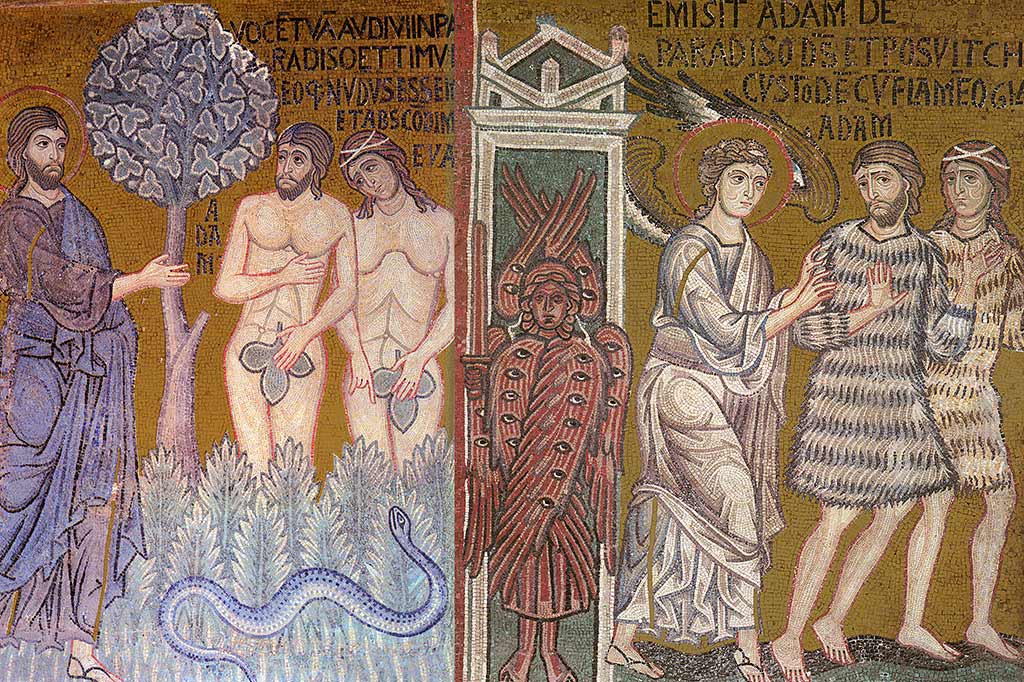
As a note, the Orthodox Church remembers the events described in this story on Forgiveness Sunday, the day before Great Lent begins. We include here the icon from that day, which shows God finding Adam and Eve, and then shows them being driven out of the Garden. Take a look at this icon and see what you notice about it.https://www.goarch.org/documents/32058/2133587/expulsion-from-paradise-mosaic-large-wide.jpg/a1b5f7d5-fb51-4d8c-8cca-b1d15b480312?t=1516814776000
Discussion questions:
1) What did you notice in today’s reading? What surprised you or what was memorable to you? (The Leader should point out that, while there are a great many points that we can draw from this passage, and it bears repeated study as one of the most important stories in the Bible, one obvious and vital lesson is the one that we learn from the first exchange. The tempter begins by misquoting God, making Him out to be strict and harsh and arbitrary. The woman begins by trying to defend God…and in so doing, she makes two mistakes. First, she not only listens, but enters into an argument with the tempter, and by that simple action, she lends strength to his attack on her. Second, she buys into the idea, even in her attempt to defend against it, that God is being arbitrary and unfair…and thus she has already left the relationship of trust and protection in which she was created. We may easily see ourselves make these same mistakes when we encounter temptation…it plays out this way every time.)
2) Where do we see Christ in this text; what is He saying or doing here?
3) Do we see ourselves and the Church in this text; what does it say about us?
4) What do you find difficult about this reading? Is there anything confusing about it, or anything that you dislike? (This is an open question, as always. )
5) Does this reading make you think that you need to change anything in your life?

Day 2 (Wednesday)

St. Irenaeus of Lyons on the Creation, the Fall, and Redemption

On Monday we read about the first sin – today we will read what one of the earliest Church Fathers, a saint named Irenaeus, thought was important about that story. Irenaeus lived from A.D. 130 until around 200, which means he was born between 50 and 60 years after the Apostles died, or about about 100 years after Jesus ascended into heaven. Irenaeus is speaking about the Lord Jesus as the Maker of the world, and the redeemer and savior of His own creation, and in the course of this, he also comparing Eve, who was the first human being to sin, with the Virgin Mary, who made a different choice.

Against Heresies 5:18:3.
For the Maker of the world is truly the Word of God. He is also our Lord, who in the last times became man, who is in this world and in an invisible manner contains all things created and is inscribed in the form of a cross on the entire creation, inasmuch as he is the Word of God who governs and disposes all things. Therefore, He came to his own in a visible manner and became flesh and hung on a tree, that he might recapitulate in himself all things.

And his own people received him not. Moses made this very thing clear to the people: And your life shall hang in doubt before your eyes, and you shall have assurance of your life. Those, therefore, who did not accept him did not receive life: To all who received him he gave power to become children of God.

For it is he who has power from the Father over all things, since he is the Word of God and true Man, ruling over invisible things in a rational manner, and in an intelligent manner making a law that all things should continue in their own order; over visible and human beings, however, he rules in a visible manner, and passes deserving and just judgment on all.

David pointed out his visible coming in these words: God comes manifestly and does not keep silence. Then he pointed out the judgment that is passed by him. He said, Before him is a devouring fire; round about him a mighty tempest. He calls to the heavens above, and to the earth, that he may judge his people.

Against Heresies 5:19:1
Chapter 19

EVE’S DISOBEDIENCE IS REMEDIED BY MARY’S OBEDIENCE.

1. The Lord, therefore, came manifestly into his own possessions. Thus his own creation, which was borne by him, bears him; and he recapitulated the disobedience that was by means of a tree, through the obedience that was by means of a tree. Thus the deception by which the virgin Eve, who was already wedded to a man, was wickedly deceived, was destroyed through the truth, by which the Virgin Mary, who was already wedded to a man, was brought the good news by the angel.

For just as the former was deceived by an angel’s word, so that she fled from God upon having transgressed his word, so the latter, too, was brought the good news by an angel’s word, that she might bear God upon being obedient to his word. And as the former was deceived to disobey God, so the latter, too, was persuaded to obey God, in order that the Virgin Mary might become the advocate of the virgin Eve.

And just as the human race was put in bonds to death through a virgin, it was loosed through a virgin. Thus the virginal disobedience was balanced by the virginal obedience. Moreover, the sin of the First-fashioned man was rectified by the correction of the First-born. Thus the Serpent’s cunning was overcome by the dove’s simplicity; and the bonds by which we were bound to death were loosed.

St. Irenaeus of Lyons, St. Irenaeus of Lyons: Against the Heresies Books 4 & 5, trans. Dominic Unger and Scott D. Moringiello, vol. 72, Ancient Christian Writers (Mahwah, NJ: The Newman Press, 2024), 167–168.

Beautiful Art: The Virgin Consoles Eve

Discussion questions:

1) What did you notice in today’s reading? What surprised you or what was memorable to you? (Leader should note that St. Irenaeus is making an important point about how the first woman’s mistake was made right by the right decision of her descendant. What was broken when Eve sinned was made right when the Virgin Mary agreed to become the Mother of God. There is actually a beautiful picture that depicts what St. Irenaeus is talking about, showing the Virgin Mary consoling Eve. I will include it, and a link to the source, above. As for the means by which Mary consoles Eve…this is affirmed by Irenaeus in the final line of our reading, that it is the fruit of Mary’s womb that heals the wound, as is shown in the image above as well. Mary doesn’t fix the problem herself, but through her obedience, Jesus Christ enters the world to make everything right. The other thing the Leader should point out is how often this text is misused to demean women as those who first sinned. This is not an appropriate Christian response, nor is the desire to determine whether men or women are better. People have often argued that women are worse than men because the woman sinned first, but the important Christian response to this mistake is that Eve’s mistake was made right by her daughter Mary, and the world would not be saved without Mary. Some people might remember that St. Kassiani made this point once – we’ll talk about that story another time).

2) Where do we see Christ in this text; what is He saying or doing here?

3) Do we see ourselves and the Church in this text; what does it say about us?

4) What do you find difficult about this reading? Is there anything confusing about it, or anything that you dislike? (This is an open question, as always. )

5) Does this reading make you think that you need to change anything in your life?
Day 3 (Friday)

The Birth of Jesus

Last time, we saw the birth of John the Baptist, and this week, we will see St. Luke’s account of the birth of our Lord Jesus Christ. It may be strange that we read this now, and not at Christmas time, but then again, we will of course read this in the Church at that point. One point that may be of some interest is that some people argue that the date of the Lord was actually in September, based on astronomical records which record a striking conjunction of the Planet Jupiter with the star Regulus, the brightest star in the constellation of Leo, in the year 3 B.C. This is not particularly important, but it may add an interesting wrinkle to our reading of the passage in this autumn season (which is, incidentally, always associated with the Jewish New Year).

The Birth of Jesus

2 In those days a decree went out from Caesar Augustus that all the world should be enrolled. 2 This was the first enrollment, when Quirin′i-us was governor of Syria. 3 And all went to be enrolled, each to his own city. 4 And Joseph also went up from Galilee, from the city of Nazareth, to Judea, to the city of David, which is called Bethlehem, because he was of the house and lineage of David, 5 to be enrolled with Mary, his betrothed, who was with child.

6 And while they were there, the time came for her to be delivered. 7 And she gave birth to her first-born son and wrapped him in swaddling cloths, and laid him in a manger, because there was no place for them in the inn.

The Shepherds and the Angels

8 And in that region there were shepherds out in the field, keeping watch over their flock by night. 9 And an angel of the Lord appeared to them, and the glory of the Lord shone around them, and they were filled with fear.

10 And the angel said to them, “Be not afraid; for behold, I bring you good news of a great joy which will come to all the people; 11 for to you is born this day in the city of David a Savior, who is Christ the Lord. 12 And this will be a sign for you: you will find a babe wrapped in swaddling cloths and lying in a manger.”

13 And suddenly there was with the angel a multitude of the heavenly host praising God and saying,

14 “Glory to God in the highest,
and on earth peace among men with whom he is pleased!”

15 When the angels went away from them into heaven, the shepherds said to one another, “Let us go over to Bethlehem and see this thing that has happened, which the Lord has made known to us.” 16 And they went with haste, and found Mary and Joseph, and the babe lying in a manger.

17 And when they saw it they made known the saying which had been told them concerning this child; 18 and all who heard it wondered at what the shepherds told them. 19 But Mary kept all these things, pondering them in her heart. 20 And the shepherds returned, glorifying and praising God for all they had heard and seen, as it had been told them.

Reading 4
417 words

Discussion questions:

1) What did you notice in today’s reading? What surprised you or what was memorable to you? (Leader should note two things. First, remembering Irenaeus’ point about the Lord being the Maker of the entire Creation, we can read the statement that Mary gave birth to her firstborn son differently…she gave birth to her son, the Firstborn, and laid Him in a manger. That is to say, her son is the only-begotten Son of God, first in all things, and the first-born from the dead…this is a way in which the early Church spoke about the Lord, and confessed His divinity, and may be what St. Luke intends here. Second, we see her the clearest sign yet that St. Luke had spoken with the Theotokos, and that these matters are recorded from on the basis of her own direct eyewitness memory, when he tells us that “Mary kept all these things, pondering them in her heart.” Luke couldn’t know that unless she had told him that).

2) Where do we see Christ in this text; what is He saying or doing here?

3) Do we see ourselves and the Church in this text; what does it say about us?

4) What do you find difficult about this reading? Is there anything confusing about it, or anything that you dislike? (This is an open question, as always. )

5) Does this reading make you think that you need to change anything in your life?

Leave a Reply

Year 1a – Week 3 (September 14 – 20, 2025)

Day 1 (Monday)

Genesis 2:1-25 (Creation of Garden of Eden, Man and Woman, Tree of Life, Naming of Animals)

Last time we saw the account of the first six days of Creation, in which God made the heavens and the earth, the empty space and the physical matter that occupies it, and we saw Him systematically give shape to that formless matter, and then fill that newly ordered matter with living things, with the heavenly bodies, the sea creatures, the birds and the creatures that walk the earth. Last of all, God made man in His image, male and female, and gave them dominion over the entire creation. This time, we will see a different summary of the Creation, and how exactly God went about making woman.

Genesis 2
1 Thus the heavens and the earth were finished, and all their multitude. 2 And on the seventh day God finished the work that he had done, and he rested on the seventh day from all the work that he had done. 3 So God blessed the seventh day and hallowed it, because on it God rested from all the work that he had done in creation.

4 This is the account of the heavens and the earth when they were created, when the LORD God made the earth and the heavens. 5 Now no shrub had yet appeared on the earth and no plant had yet sprung up, for the LORD God had not sent rain on the earth and there was no one to work the ground, 6 but streams came up from the earth and watered the whole surface of the ground. 7 Then the LORD God formed a man from the dust of the ground and breathed into his nostrils the breath of life, and the man became a living being. 8 Now the LORD God had planted a garden in the east, in Eden; and there he put the man he had formed. 9 The LORD God made all kinds of trees grow out of the ground—trees that were pleasing to the eye and good for food. In the middle of the garden were the tree of life and the tree of the knowledge of good and evil.

10 A river flowed out of Eden to water the garden, and there it divided and became four rivers. 11 The name of the first is Pishon; it is the one which flows around the whole land of Hav′ilah, where there is gold; 12 and the gold of that land is good; bdellium and onyx stone are there. 13 The name of the second river is Gihon; it is the one which flows around the whole land of Cush. 14 And the name of the third river is Tigris, which flows east of Assyria. And the fourth river is the Euphra′tes.

15 The LORD God took the man and put him in the Garden of Eden to work it and take care of it. 16 And the LORD God commanded the man, “You are free to eat from any tree in the garden; 17 but you must not eat from the tree of the knowledge of good and evil, for when you eat from it you will certainly die.” 18 The LORD God said, “It is not good for the man to be alone. I will make a helper suitable for him.”

19 Now the LORD God had formed out of the ground all the wild animals and all the birds in the sky. He brought them to the man to see what he would name them; and whatever the man called each living creature, that was its name. 20 So the man gave names to all the livestock, the birds in the sky and all the wild animals. But for Adam no suitable helper was found.

21 So the LORD God caused the man to fall into a deep sleep; and while he was sleeping, he took one of the man’s ribs and then closed up the place with flesh. 22 Then the LORD God made a woman from the rib he had taken out of the man, and he brought her to the man. 23 The man said, “This is now bone of my bones and flesh of my flesh; she shall be called ‘woman,’ for she was taken out of man.” 24 That is why a man leaves his father and mother and is united to his wife, and they become one flesh. 25 Adam and his wife were both naked, and they felt no shame.

Reading 2 – 637 words

Discussion questions:
1) What did you notice in today’s reading? What surprised you or what was memorable to you? (The Leader should point out how it’s tempting to view this account as at odds with the account we see in chapter 1, but how it reads just as well, and perhaps better, as a sort of “zooming in” on the very general picture that we get in chapter 1. Now we see that, although God has created many plants, they have not yet begun to grow, except for in the one space where God places the man that He has created, a garden in Eden, from which four rivers flow. That last image is important, because it means that this is an elevated place, a hill or mountain, and being a garden, it is implied that it is enclosed, that there is a fence around it. The ancients would have associated such an enclosed and elevated garden with the garden of a king and the mountain of the gods; what this is saying, then, is that not all the earth was a garden, but this one space where God Himself dwelt was, and it was here that God placed man, to tend the garden, to name the animals, and to enlarge this tended and orderly space out into all the world. We also see the Creation of woman, but we will talk more about that with one of the readings for Day 2.)

2) Where do we see Christ in this text; what is He saying or doing here?

3) Do we see ourselves and the Church in this text; what does it say about us?

4) What do you find difficult about this reading? Is there anything confusing about it, or anything that you dislike? (This is an open question, as always. )

5) Does this reading make you think that you need to change anything in your life?

Day 2 (Wednesday)

Hymns from the Feast of the Elevation of the Holy Cross AND St. Augustine on the Creation of Woman

Today for our selection from Church Tradition, we’ll be looking at some of the hymns from the great Feast of the Church that we celebrate on September 14th, the Elevation of the Precious and Holy Cross. This feast commemorates both the finding of the Cross by St. Helen, and its recovery and return to Jerusalem in 627, after its seizure by the Persians a decade before. The feast of the Cross is a Strict Fast, and functions almost like mini celebration of the themes of Holy Week, all distilled into a single feast day, in the fall.

1st Hymn of the Liti
Today, what David said in the holy Psalm has truly come to pass. Lo and behold, we are worshiping at the footstool of Your immaculate feet. And now, we who are hopeful in the shadow of Your wings, cry out to You, all-compassionate Lord: Let the light of Your face be stamped on us! Exalt the horn of Your Orthodox people, by the exaltation of Your holy Cross, O very merciful Christ.

2nd Hymn of the Aposticha
Rejoice, O precious Cross of the Lord. * Through you mankind has been released from the primal curse; * the sign indicating true joy, * O wood respected by all, * in your exaltation cursing enemies. * For us you are help in need, and the strength of the Emperors, * might of the righteous, and the dignity of the priests, * for when you are signed, you redeem us from miseries. * Rod of the power from above, * by which we are shepherded; * the shield of peace that the Angels in fear attend to respectfully; * divine holy glory * of the Master Christ who grants His great mercy to the world.

Hymn from Ode 4 of the Canon
The people of Israel, ⁄ a sacred army drawn up in four divisions, ⁄ marched in this figure before the Ark of the testimony, ⁄ gaining glory by their ranks formed in the sign of the Cross.

Oikos of the Cross
Paul, who was caught up into Paradise beyond the third heaven, and who heard the unspeakable and divine words that it is not permissible for tongues to utter, writes to the Galatians what you, as lovers of the Scriptures, have read and already know. “God forbid,” says he, “that I should boast except in the Cross of the Lord, whereby He suffered and thus killed the passions.” This very Cross of the Lord, then, let us all surely hold as our boast. For this wood is our salvation, the shield of peace, the trophy invincible.

Hymn from Ode 9 of the Canon
You did not let the bitter taste of the tree annihilate us, O Lord our God, * but by Your Cross You eradicated it. * And to prefigure what Your Cross would do, * the wood dissolved the bitterness * of the water of Marah in times of old. * This power of the Cross is by all the hosts of heaven magnified.

Also St. Augustine on the Creation of Woman

There are a lot of things that happen in the Bible that seem very strange and complicated. This is especially true for the book of Genesis. It can be helpful to see what the Saints of the Church have said about these things in the past. On Day 1 we read about how God made the first woman, Eve, from a rib of the first man, Adam. The meaning of this is…not obvious, and there have been many troubling interpretations of this passage. Fortunately, St. Augustine, a 4th century saint from North Africa, has an idea about why it was that God made Eve from Adam’s side, and we will read that as well today.

“There was a reason that God made the woman from the rib of the sleeping man. God wanted to symbolize the union of Christ and His Church. When Adam slept, it was a symbol of Christ’s death. When Christ died, and the soldier stabbed His side, blood and water came from His side. That blood and water represents the Sacraments of the Church, like Communion, and Baptism, and Holy Water. These Sacraments build the Church; they make Christians, as all of us are built as Christians through Baptism (Water) and Holy Communion (Flesh & Blood). The Bible even uses the word build; it says that God built Adam’s rib into a woman, the same way that St. Paul talks about building up the Body of Christ, the Church. This means that the woman is just as much God’s Creation as the man is; she was only made differently from the man to show that the man and the woman are one, and this is important most of all to remind us of the one-ness of Christ and the Church.”

(The above is adapted from the following, in order to make it more comprehensible. Those who are interested can read this “original” more exacting translation as well)

“Even in the beginning, when woman was made from a rib in the side of the sleeping man, that had no less a purpose than to symbolize prophetically the union of Christ and his church. Adam’s sleep was a mystical foreshadowing of Christ’s death, and when his dead body hanging from the cross was pierced by the lance, it was from his side that there issued forth that blood and water that, as we know, signifies the sacraments by which the church is built up. “Built” is the very word the Scripture uses in connection with Eve: “He built the rib into a woman.” … So too St. Paul speaks of “building up the body of Christ,” which is his church. Therefore woman is as much the creation of God as man is. If she was made from the man, this was to show her oneness with him; and if she was made in the way she was, this was to prefigure the oneness of Christ and the church. (From the City of God, 22.17, as quoted in Louth, A., & Conti, M. (2001). Genesis 1–11 (p. 70). Downers Grove, IL: InterVarsity Press.)”

Discussion questions:

1) What did you notice in today’s reading? What surprised you or what was memorable to you? (Leader should note that these two readings, different though they are, are surprisingly connected. It is by means of the Cross that the Lord united Himself with us in death, and having done so, He renewed our broken nature and raised us upas His glorious Bride, the Church, and it is this precise reality of which the creation of the woman from the man’s rib was a sign and prophecy. In troubled times, it is also vital that we remember the manner in which the Lord has won this utter victory of the enemies arrayed against Him and against us; by humility, obedience, endurance, humiliation, and suffering. We pray that, as we abide in His love, having sprung up from the very blood that flowed from His side, we may always walk in faithfulness to Him, and take up and carry our Cross at all times.)

2) Where do we see Christ in this text; what is He saying or doing here?

3) Do we see ourselves and the Church in this text; what does it say about us?

4) What do you find difficult about this reading? Is there anything confusing about it, or anything that you dislike? (This is an open question, as always. )

5) Does this reading make you think that you need to change anything in your life?

Day 3 (Friday)

Luke 1:26-56 (Birth of John the Baptist)

Last time, we saw the Annunciation, as the Archangel Gabriel brought to the Virgin Mary the news of imminent conception of the Son of God. Mary questioned the angel calmly, and then assented to this great task, and having done so, hurried to visit her relative Elizabeth, and upon her entry into the house, St. John the Baptist proclaimed for the first time the coming of the Messiah as he leapt in his mother’s womb. Following this wonder, the Virgin Mary spoke the great hymn of praise to God which we call the Magnificat or Megalynarion. She remained for three months, and then returned to her home, which indicates that either she was present for the birth of the Forerunner, or returned immediately beforehand. We will see this birth in our reading today.

The Birth of John the Baptist

57 Now the time came for Elizabeth to be delivered, and she gave birth to a son. 58 And her neighbors and kinsfolk heard that the Lord had shown great mercy to her, and they rejoiced with her. 59 And on the eighth day they came to circumcise the child; and they would have named him Zechari′ah after his father, 60 but his mother said, “Not so; he shall be called John.” 61 And they said to her, “None of your kindred is called by this name.”

62 And they made signs to his father, inquiring what he would have him called. 63 And he asked for a writing tablet, and wrote, “His name is John.” And they all marveled. 64 And immediately his mouth was opened and his tongue loosed, and he spoke, blessing God. 65 And fear came on all their neighbors. And all these things were talked about through all the hill country of Judea; 66 and all who heard them laid them up in their hearts, saying, “What then will this child be?” For the hand of the Lord was with him.

Zechariah’s Prophecy

67 And his father Zechari′ah was filled with the Holy Spirit, and prophesied, saying,

68 “Blessed be the Lord God of Israel,
for he has visited and redeemed his people,
69 and has raised up a horn of salvation for us
in the house of his servant David,
70 as he spoke by the mouth of his holy prophets from of old,
71 that we should be saved from our enemies,
and from the hand of all who hate us;
72 to perform the mercy promised to our fathers,
and to remember his holy covenant,
73 the oath which he swore to our father Abraham, 74 to grant us
that we, being delivered from the hand of our enemies,
might serve him without fear,
75 in holiness and righteousness before him all the days of our life.

76 And you, child, will be called the prophet of the Most High;
for you will go before the Lord to prepare his ways,
77 to give knowledge of salvation to his people
in the forgiveness of their sins,
78 through the tender mercy of our God,
when the day shall dawn upon us from on high
79 to give light to those who sit in darkness and in the shadow of death,
to guide our feet into the way of peace.”

80 And the child grew and became strong in spirit, and he was in the wilderness till the day of his manifestation to Israel.

Reading 3
441 words

Discussion questions:

1) What did you notice in today’s reading? What surprised you or what was memorable to you? (The Leader should note that, whatever Zechariah’s doubts when the Archangel came to him before in the Temple, they are gone now; his prophecy is nothing less than the proclamation that the Messiah is indeed about to be born (and if Mary remained for the birth, then Zechariah is in fact proclaiming that He is already present, even there in the room at that moment). The language with which he speaks expresses the full consolation of the long hopes and griefs of Israel, and the fulfillment of the oldest prophecies, even from the book of Genesis; we have indeed seen one of these prophecies this week in the creation of the woman from the rib of the man, and will see another one in the coming two weeks, as we see the promise that the seed of the woman will bruise or crush the head of the serpent.)

2) Where do we see Christ in this text; what is He saying or doing here?

3) Do we see ourselves and the Church in this text; what does it say about us?

4) What do you find difficult about this reading? Is there anything confusing about it, or anything that you dislike? (This is an open question, as always. )

5) Does this reading make you think that you need to change anything in your life?

Typepad is Shutting Down – New Site for Readings

Beloved in the Lord,

At the end of August, Typepad subscribers received the announcement that Typepad would be shutting down as of September 30th. In the course of the last week, the site has been up and down, mostly down, and we have spent the time finding and setting up a new home for the Religious Education Initiative and the other materials hosted here.

You can find that new home at:

https://theruleoffaith.org/rei

God willing, we'll be able to post the archives from here over there, but the past five years have really just been a rough draft, so nothing too valuable will be lost.

Thank you for your patience with the transfer period, and see you over at the new site.

May God bless you all!

+Fr. Anthony Cook

Year 1a – Week 2 (September 7 – 13, 2025)

Day 1 (Monday)

Genesis 1:1-31 (Creation)

The first book of the Bible is called Genesis, which is a Greek word that means creation or becoming. It is called this because it tells the story of God creating the universe. It divides this story up into seven days; on the first first four days, which we will read today, God made light, and space, and earth, and plants, and heavenly bodies. On the fifth and sixth days, He made sea creatures and land creatures, and finished by creating human beings last of all. On the seventh day God rested. This is the beginning of the Bible, the beginning of the Torah (the five books of Moses), and the opening act of the Lord’s revelation to us. It is worth noting that the Gospel of John begins with very similar words, in what is surely an intentional reference.

Six Days of Creation and the Sabbath

1 In the beginning God created the heavens and the earth. 2 The earth was without form and void, and darkness was upon the face of the deep; and the Spirit of God was moving over the face of the waters.

3 And God said, “Let there be light”; and there was light. 4 And God saw that the light was good; and God separated the light from the darkness. 5 God called the light Day, and the darkness he called Night. And there was evening and there was morning, one day.

6 And God said, “Let there be a firmament in the midst of the waters, and let it separate the waters from the waters.” 7 And God made the firmament and separated the waters which were under the firmament from the waters which were above the firmament. And it was so. 8 And God called the firmament Heaven. And there was evening and there was morning, a second day.

9 And God said, “Let the waters under the heavens be gathered together into one place, and let the dry land appear.” And it was so. 10 God called the dry land Earth, and the waters that were gathered together he called Seas. And God saw that it was good. 11 And God said, “Let the earth put forth vegetation, plants yielding seed, and fruit trees bearing fruit in which is their seed, each according to its kind, upon the earth.” And it was so. 12 The earth brought forth vegetation, plants yielding seed according to their own kinds, and trees bearing fruit in which is their seed, each according to its kind. And God saw that it was good. 13 And there was evening and there was morning, a third day.

14 And God said, “Let there be lights in the firmament of the heavens to separate the day from the night; and let them be for signs and for seasons and for days and years, 15 and let them be lights in the firmament of the heavens to give light upon the earth.” And it was so. 16 And God made the two great lights, the greater light to rule the day, and the lesser light to rule the night; he made the stars also. 17 And God set them in the firmament of the heavens to give light upon the earth, 18 to rule over the day and over the night, and to separate the light from the darkness. And God saw that it was good. 19 And there was evening and there was morning, a fourth day.

20 And God said, “Let the waters bring forth swarms of living creatures, and let birds fly above the earth across the dome of the sky.” 21 So God created the great sea monsters and every living creature that moves, of every kind, with which the waters swarm, and every winged bird of every kind. And God saw that it was good. 22 God blessed them, saying, “Be fruitful and multiply and fill the waters in the seas, and let birds multiply on the earth.” 23 And there was evening and there was morning, the fifth day. 24 And God said, “Let the earth bring forth living creatures of every kind: cattle and creeping things and wild animals of the earth of every kind.” And it was so. 25 God made the wild animals of the earth of every kind, and the cattle of every kind, and everything that creeps upon the ground of every kind. And God saw that it was good.

26 Then God said, “Let us make humankind in our image, according to our likeness; and let them have dominion over the fish of the sea, and over the birds of the air, and over the cattle, and over all the wild animals of the earth, and over every creeping thing that creeps upon the earth.” 27 So God created humankind in his image, in the image of God he created them; male and female he created them. 28 God blessed them, and God said to them, “Be fruitful and multiply, and fill the earth and subdue it; and have dominion over the fish of the sea and over the birds of the air and over every living thing that moves upon the earth.” 29 God said, “See, I have given you every plant yielding seed that is upon the face of all the earth, and every tree with seed in its fruit; you shall have them for food. 30 And to every beast of the earth, and to every bird of the air, and to everything that creeps on the earth, everything that has the breath of life, I have given every green plant for food.” And it was so. 31 God saw everything that he had made, and indeed, it was very good. And there was evening and there was morning, the sixth day.

Reading 1 – 821 words

Discussion questions:

1) What did you notice in today’s reading? What surprised you or what was memorable to you? (The Leader should point out that there is a pattern to the days of the Creation. First, in the very first verse, God creates the heavens and the earth. Then, as they are formless and empty, in the first three days, He gives them form, and in the remaining three days, He fills them with life. If we can read the text in this way, then we will understand something of how the ancient people of God understood the Creation in three distinct phases. First, the making of existence by God, Who is beyond existence and transcends time and space and all that we can understand. Second, by the ordering of all that exists. And third, the filling of that order with every living thing. Lastly, the Leader should note that the 6th day, on which God makes man, in His own image and likeness, is fulfilled on the Great and Holy 6th Day, as our Lord Jesus Christ is crucified, uniting Himself to us in the brokenness that we and our sin have brought upon the Creation that He created, and ordered, and filled with life, and in His very death, He fills even death with His life, and restores that order, and renews that Creation.)

2) Where do we see Christ in this text; what is He saying or doing here?

3) Do we see ourselves and the Church in this text; what does it say about us?

4) What do you find difficult about this reading? Is there anything confusing about it, or anything that you dislike? (This is an open question, as always. )

5) Does this reading make you think that you need to change anything in your life?

Day 2 (Wednesday)

Feast of the Nativity of the Theotokos

As we begin the new Church Year, we always make a start with the celebration of the feast of the Birth of the Theotokos, the Mother of God. Her birth marks the formal beginning of the Lord’s work of His Incarnation, so it is fitting that we start the Church Year with this commemoration. This feast emphasizes the long waiting and hoping of the people of God for deliverance and salvation, looking to the birth of the Mother of God as the moment when these hopes begin to see their fulfillment. It is a fitting thing for us not just to celebrate this fulfillment, and as we celebrate this great feast, we will take the occasion, then, to read together some of the significant hymns of the Feast.

2nd Hymn of the Kekragaria
This is the Lord’s Day, O people, be filled with gladness! Behold! The bridal chamber of the Light and the book of the Word of Life has come forth from the womb. The Temple Gate that faces east has been born, and she awaits the entry of the Great High Priest. She alone introduces the only Christ to the world, for the salvation of our souls.

1st Hymn of the Liti
Today, people, the first fruit of our salvation is here! ⁄ For behold, she who was foreordained from generations of old ⁄ as Mother and Virgin and receiver of God, ⁄ comes forth in birth from a barren woman: ⁄ A flower has blossomed from Jesse, ⁄ and from his root a branch has sprung. ⁄ Let Adam our forefather be glad ⁄ and let Eve rejoice with exultation! ⁄ For behold, she who was made from the rib of Adam ⁄ plainly declares her daughter and descendant blessed. ⁄ For, she says, deliverance is born to me, ⁄ through which I shall be set free from the bonds of hell. ⁄ Let David rejoice, striking upon the harp, ⁄ and let him bless God: ⁄ For behold, the Virgin comes forth from a barren rock, ⁄⁄ for the salvation of our souls!

1st Kathisma Hymn of the Orthros
Shout, O David, and declare, * what oath did God swear to you? * And he answers, “What He swore, behold, He also has fulfilled, * for He has given the Virgin as the fruit of my loins. * From her has Christ the new Adam and Fashioner * been born, as it is written, to be King on my throne. * And He whose reign is unshakable is reigning today and forevermore. * The barren woman bears the Theotokos, * the nourisher of our Life.”

Hymn from Ode 4 of the Canon of the Feast
Let us, the faithful, in songs and hymns ⁄ glorify the all-holy birth of the Theotokos! ⁄ Let us worship with faith the God Who never lies, ⁄ and Who swore of old to David to give him the fruit of his body.

Exaposteilarion 1 of the Feast
Today the reaches of the world * are festive and most jubilant * because of your birth, O Mary, * the Maiden and Theotokos, * and Virgin Bride who knew no man. * In being born, you have reversed * the sad reproach of barrenness * on your parents and the curse in childbirth * on Eve our ancestral mother.

Doxastikon of the Praises
This is the Lord’s Day, O people, be filled with gladness! Behold! The bridal chamber of the Light and the book of the Word of Life has come forth from the womb. The Temple Gate that faces east has been born, and she awaits the entry of the Great High Priest. She alone introduces the only Christ to the world, for the salvation of our souls.

Discussion questions:

1) What did you notice in today’s reading? What surprised you or what was memorable to you? (Leader should note that, as we celebrate the fulfillment of the many promises and hopes of the Old Testament, rejoicing in the birth of the Virgin Mary, we should also reflect on our own hopes and struggles, and recognize that the Lord is faithful with us, even as He was faithful with the saints of the Old Testament. As we learn to wait upon Him, we will see Him faithful to us; but at the same time, we should note that He often comes to us, as He came to the parents of the Virgin, when hope is gone, when we are past our own efforts, when we are, and feel ourselves to be, barren. This is where our faithfulness to God is most difficult and most fruitful; this is where He comes to bring life and hope in the face of death and despair.)

2) Where do we see Christ in this text; what is He saying or doing here?

3) Do we see ourselves and the Church in this text; what does it say about us?

4) What do you find difficult about this reading? Is there anything confusing about it, or anything that you dislike? (This is an open question, as always. )

5) Does this reading make you think that you need to change anything in your life?

Day 3 (Friday)

Luke 1:26-56 (Annunciation & Megalynarion/Magnificat)

Last time, we saw the beginning of the Gospel of Luke, as he told the story of how the Archangel Gabriel brought to the priest Zacharias the news that he and his wife would have a son in their old age, and that that son would be the herald and forerunner of the Messiah. We ended with the note that Zacharias’ wife Elisabeth did indeed conceive, and then secluded herself for the first five months of her pregnancy. We pick up the story in the sixth month, and see the promise of the Archangel fulfilled as he goes to another with still greater news.

The Birth of Jesus Foretold

26 In the sixth month the angel Gabriel was sent from God to a city of Galilee named Nazareth, 27 to a virgin betrothed to a man whose name was Joseph, of the house of David; and the virgin’s name was Mary. 28 And he came to her and said, “Hail, full of grace, the Lord is with you!” 29 But she was greatly troubled at the saying, and considered in her mind what sort of greeting this might be. 30 And the angel said to her, “Do not be afraid, Mary, for you have found favor with God. 31 And behold, you will conceive in your womb and bear a son, and you shall call his name Jesus.

32 He will be great, and will be called the Son of the Most High;
and the Lord God will give to him the throne of his father David,
33 and he will reign over the house of Jacob for ever;
and of his kingdom there will be no end.”

34 And Mary said to the angel, “How can this be, since I have no husband (literally: since I do not know a man)?” 35 And the angel said to her,

“The Holy Spirit will come upon you,
and the power of the Most High will overshadow you;
therefore the child to be born will be called holy,
the Son of God.

36 And behold, your kinswoman Elizabeth in her old age has also conceived a son; and this is the sixth month with her who was called barren. 37 For with God nothing will be impossible.” 38 And Mary said, “Behold, I am the handmaid of the Lord; let it be to me according to your word.” And the angel departed from her.

Mary Visits Elizabeth

39 In those days Mary arose and went with haste into the hill country, to a city of Judah, 40 and she entered the house of Zechari′ah and greeted Elizabeth. 41 And when Elizabeth heard the greeting of Mary, the babe leaped in her womb; and Elizabeth was filled with the Holy Spirit 42 and she exclaimed with a loud cry, “Blessed are you among women, and blessed is the fruit of your womb! 43 And why is this granted me, that the mother of my Lord should come to me? 44 For behold, when the voice of your greeting came to my ears, the babe in my womb leaped for joy. 45 And blessed is she who believed that there would be[i] a fulfilment of what was spoken to her from the Lord.” 46 And Mary said,

Mary’s Song of Praise

“My soul magnifies the Lord,
47 and my spirit rejoices in God my Savior,
48 for he has regarded the low estate of his handmaiden.
For behold, henceforth all generations will call me blessed;
49 for he who is mighty has done great things for me,
and holy is his name.
50 And his mercy is on those who fear him
from generation to generation.
51 He has shown strength with his arm,
he has scattered the proud in the imagination of their hearts,
52 he has put down the mighty from their thrones,
and exalted those of low degree;
53 he has filled the hungry with good things,
and the rich he has sent empty away.
54 He has helped his servant Israel,
in remembrance of his mercy,
55 as he spoke to our fathers,
to Abraham and to his posterity for ever.”

56 And Mary remained with her about three months, and returned to her home.

Reading 2
600 words

Discussion questions:

1) What did you notice in today’s reading? What surprised you or what was memorable to you? (The Leader should note that, when the Virgin Mary expresses surprise, it does not make sense to translate that in the way that our text does, as it would not be an surprising thing for a young woman betrothed to a man to hear that she would conceive a child. This is one point in the Scriptural text which aligns with the tradition of the Church, that the Virgin Mary was dedicated to serve in the Temple, and her betrothal to Joseph was always intended to be a chaste relationship to provide her with protection until she came of age to return to the Temple. The other point that should be emphasized is that the Archangel, and with him all of Creation, waited upon the word of the Virgin, assenting to the call of the Lord; it is through her obedience and humility that God becomes human and dwells in our midst, and it is in this that she sets an example for all of us.)

2) Where do we see Christ in this text; what is He saying or doing here?

3) Do we see ourselves and the Church in this text; what does it say about us?

4) What do you find difficult about this reading? Is there anything confusing about it, or anything that you dislike? (This is an open question, as always. )

5) Does this reading make you think that you need to change anything in your life?