
Day 1 (Monday)
2 Kingdoms 6:1-23; 7:1-29 (David Brings the Ark to Jerusalem, God’s Covenant with David)
Last time, we saw David take up the kingship over all Israel and set up his new capital in Jerusalem. We also saw the many things that were troubled about his young reign, with the violence, betrayal, and murder that attended the final fall of the kingdom of Saul’s son Ish-baal, and David’s own slow fall into the polygamy of the pagan nations, as he took many wives and fathered many children by them. This time, we will see what seems to be the high point of David’s reign, as he moves toward establishing the worship of Yahweh, the God of Israel, in Jerusalem.
David Brings the Ark to Jerusalem
6 David again gathered all the chosen men of Israel, thirty thousand. 2 David and all the people with him set out and went from Baale-judah, to bring up from there the ark of God, which is called by the name of the Lord of hosts who is enthroned on the cherubim. 3 They carried the ark of God on a new cart, and brought it out of the house of Abinadab, which was on the hill. Uzzah and Ahio, the sons of Abinadab, were driving the new cart 4 with the ark of God; and Ahio went in front of the ark. 5 David and all the house of Israel were dancing before the Lord with all their might, with songs and lyres and harps and tambourines and castanets and cymbals.
6 When they came to the threshing floor of Nacon, Uzzah reached out his hand to the ark of God and took hold of it, for the oxen shook it. 7 The anger of the Lord was kindled against Uzzah; and God struck him there because he reached out his hand to the ark; and he died there beside the ark of God. 8 David was angry because the Lord had burst forth with an outburst upon Uzzah; so that place is called Perez-uzzah, to this day. 9 David was afraid of the Lord that day; he said, “How can the ark of the Lord come into my care?” 10 So David was unwilling to take the ark of the Lord into his care in the city of David; instead David took it to the house of Obed-edom the Gittite. 11 The ark of the Lord remained in the house of Obed-edom the Gittite three months; and the Lord blessed Obed-edom and all his household.
12 It was told King David, “The Lord has blessed the household of Obed-edom and all that belongs to him, because of the ark of God.” So David went and brought up the ark of God from the house of Obed-edom to the city of David with rejoicing…
For the sake of time, we will skip over this journey; David had the Ark carried, as it ought to be transported, this time, and made sacrifices to the Lord and danced before the Lord as he brought it to Jerusalem and into the tent he had prepared for it, and then distributed food to all the people before they went home.
God’s Covenant with David
7 Now when the king was settled in his house, and the Lord had given him rest from all his enemies around him, 2 the king said to the prophet Nathan, “See now, I am living in a house of cedar, but the ark of God stays in a tent.” 3 Nathan said to the king, “Go, do all that you have in mind; for the Lord is with you.”
4 But that same night the word of the Lord came to Nathan: 5 Go and tell my servant David: Thus says the Lord: Are you the one to build me a house to live in? 6 I have not lived in a house since the day I brought up the people of Israel from Egypt to this day, but I have been moving about in a tent and a tabernacle. 7 Wherever I have moved about among all the people of Israel, did I ever speak a word with any of the tribal leaders of Israel, whom I commanded to shepherd my people Israel, saying, “Why have you not built me a house of cedar?”
8 Now therefore thus you shall say to my servant David: Thus says the Lord of hosts: I took you from the pasture, from following the sheep to be prince over my people Israel; 9 and I have been with you wherever you went, and have cut off all your enemies from before you; and I will make for you a great name, like the name of the great ones of the earth. 10 And I will appoint a place for my people Israel and will plant them, so that they may live in their own place, and be disturbed no more; and evildoers shall afflict them no more, as formerly, 11 from the time that I appointed judges over my people Israel; and I will give you rest from all your enemies. Moreover the Lord declares to you that the Lord will make you a house.
12 When your days are fulfilled and you lie down with your ancestors, I will raise up your offspring after you, who shall come forth from your body, and I will establish his kingdom. 13 He shall build a house for my name, and I will establish the throne of his kingdom forever. 14 I will be a father to him, and he shall be a son to me. When he commits iniquity, I will punish him with a rod such as mortals use, with blows inflicted by human beings. 15 But I will not take my steadfast love from him, as I took it from Saul, whom I put away from before you. 16 Your house and your kingdom shall be made sure forever before me; your throne shall be established forever. 17 In accordance with all these words and with all this vision, Nathan spoke to David.
David’s Prayer
18 Then King David went in and sat before the Lord, and said, “Who am I, O Lord God, and what is my house, that you have brought me thus far? 19 And yet this was a small thing in your eyes, O Lord God; you have spoken also of your servant’s house for a great while to come. May this be instruction for the people, O Lord God! 20 And what more can David say to you? For you know your servant, O Lord God! 21 Because of your promise, and according to your own heart, you have wrought all this greatness, so that your servant may know it. 22 Therefore you are great, O Lord God; for there is no one like you, and there is no God besides you, according to all that we have heard with our ears.
23 Who is like your people, like Israel? Is there another nation on earth whose God went to redeem it as a people, and to make a name for himself, doing great and awesome things for them, by driving out before his people nations and their gods? 24 And you established your people Israel for yourself to be your people forever; and you, O Lord, became their God. 25 And now, O Lord God, as for the word that you have spoken concerning your servant and concerning his house, confirm it forever; do as you have promised. 26 Thus your name will be magnified forever in the saying, ‘The Lord of hosts is God over Israel’; and the house of your servant David will be established before you.
27 For you, O Lord of hosts, the God of Israel, have made this revelation to your servant, saying, ‘I will build you a house’; therefore your servant has found courage to pray this prayer to you. 28 And now, O Lord God, you are God, and your words are true, and you have promised this good thing to your servant; 29 now therefore may it please you to bless the house of your servant, so that it may continue forever before you; for you, O Lord God, have spoken, and with your blessing shall the house of your servant be blessed forever.”
Discussion questions:
1) What did you notice in today’s reading? What surprised you or what was memorable to you? (The Leader should point out that David first falls into the trap of viewing the Ark as some totem to be possessed, transporting it on an ox-cart as some common piece of luggage. This carelessness with the Presence of God is met with a “breaking out” of God’s holiness, which destroys the unworthy and careless Uzzah. When David returns to finish the journey, he seems to have the Ark carried as God commanded in the Torah, but there is still an element of impropriety here. We should note that, while David has inquired of God about what he should do many times, he does not ask God if he should bring the Ark to Jerusalem. Even the prophet is caught up in the spirit of establishing a strong principle for the kingdom on a religious basis as well as a military basis; he approves David’s plan in God’s name, but without asking the Lord. With that said, we should note that David accepts the correction, and the Lord renews His promise to David at this point, as we have seen Him do with Abraham, Isaac, and Jacob previously. David’s prayer, however, reflects something of a misunderstanding of Israel’s role in the world; they were not simply God’s chosen people, preferred by God over all the other nations. Israel is rather God’s instrument to reconcile all the nations to Himself…David is missing this at the moment, and seems to be thinking only in terms of his own kingdom, as we can see by his acting in the role of both priest and king, offering sacrifices himself along the way, as it seems, a thing which is not permitted to a ruler of Israel, and which we saw Saul punished for doing. This triumph of bringing the Ark into Jerusalem is therefore both a positive sign anticipating the day when the Lord will set up a Temple that will never be destroyed in Jerusalem, and a sinister foreshadowing of the trouble that is about to come to David and his household. We will return to David’s story after Pascha, however; for the next few weeks, we will read the story of Jonah.)
2) Where do we see Christ in this text; what is He saying or doing here?
3) Do we see ourselves and the Church in this text; what does it say about us?
4) What do you find difficult about this reading? Is there anything confusing about it, or anything that you dislike? (This is an open question, as always. )
5) Does this reading make you think that you need to change anything in your life?
Day 2 (Wednesday)
Gospel of Nicodemus – 1 of 5
The Gospel of Nicodemus is a text whose precise date and author is unknown. It is certainly not of Apostolic dating and origin, but reflects rather the mindset and understanding of the Gospel accounts and of the thinking of the Church about the matters of the Lord’s Passion, Death, and Resurrection, at the time of writing. It appears in the corpus around the 4th century, in a number of different versions in both Greek and Latin, and then, translated from the Latin, in a great many languages throughout Western Europe, including even in Old English. It does not seem to have been as popular in the East, but despite this, you will no doubt recognize the scene described in the next few weeks’ readings from the iconography of the Church.
THE GOSPEL OF NICODEMUS
PART II.—CHRIST’S DESCENT INTO HELL
LATIN. FIRST VERSION
Reading 1
CHAP. 1 (17)—And Joseph (of Arimathea) rose up and said to Annas and Caiaphas: Truly and well do you wonder, since you have heard that Jesus has been seen alive from the dead, ascending up into heaven. But it is more to be wondered at that he is not the only one who has risen from the dead; but he has raised up alive out of their tombs many others of the dead, and they have been seen by many in Jerusalem. And hear me now, that we all know the blessed Simeon, the great priest, who took up with his hands Jesus, when an infant, in the temple.
And Simeon himself had two sons, full brothers; and we all were at their filling asleep, and at their burial. Go, therefore, and see their tombs: for they are open, because they have risen; and, behold, they are in the city of Arimathæa, living together in prayers. And, indeed, they are heard crying out, but speaking with nobody, and they are silent as the dead. But come, let us go to them; let us conduct them to us with all honour and respect. And if we adjure them, perhaps they will speak to us of the mystery of their resurrection.
At hearing this they all rejoiced. And Annas and Caiaphas, Nicodemus, and Joseph, and Gamaliel, went, and did not find them in their sepulchres; but, walking into the city of Arimathea, they found them there, on their bended knees, and spending their time in prayer. And kissing them, they conducted them to Jerusalem, into the synagogue, with all veneration and fear of God. And shutting the doors, and lifting up the law of the Lord, they put it in their hands, adjuring them by the God Adonai, and the God of Israel, who by the law and the prophets spoke to our fathers, saying: Do you believe that it was Jesus who raised you from the dead? Tell us how you have risen from the dead.
Karinus and Leucius, hearing this adjuration, trembled in their body, and groaned, being disturbed in heart. And together they looked towards heaven, and with their fingers made the sign of the cross on their tongues, and immediately they spoke together, saying: Give each of us sheets of paper, and let us write what we have seen and heard. And they gave it to them. And they sat down, and each of them wrote, saying:—
CHAP. 2 (18)—O Lord Jesus Christ, the resurrection and the life of the dead, permit us to speak mysteries through the death of Thy cross, because we have been adjured by Thee. For Thou didst order Thy servants to relate to no one the secrets of Thy divine majesty which Thou didst in Hades. And when we were, along with all our fathers, lying in the deep, in the blackness of darkness, suddenly there appeared a golden heat of the sun, and a purple royal light shining upon us.
And immediately the father of all the human race, with all the patriarchs and prophets, exulted, saying: That light is the source of eternal light, which hath promised to transmit to us co-eternal light. And Esaias cried out, and said: This is the light of the Father, the Son of God, as I predicted when I was alive upon earth: The land of Zabulon and the land of Nephthalim across Jordan, Galilee of the nations, the people who sat in darkness, have seen a great light; and light was shining among those who are in the region of the shadow of death. And now it has come and shone upon us sitting in death.
And when we were all exulting in the light which shone over us, there came up to us our father Simeon; and he said, exulting: Glorify the Lord Jesus Christ, the Son of God; because I took Him up when born, an infant, in my hands in the temple; and instigated by the Holy Spirit, I said to Him, confessing: Now mine eyes have seen Thy salvation, which Thou hast prepared in the sight of all peoples, a light for the revealing of the nations, and the glory of Thy people Israel. When they heard this, all the multitude of the saints exulted more.
And after this there comes up, as it were, a dweller in the desert; and he is asked by all: Who art thou? To whom he says in answer: I am John, the voice and prophet of the Most High, going before the face of His coming to prepare His ways, to give the knowledge of salvation to His people for the remission of their sins. And seeing Him coming to me, instigated by the Holy Spirit, I said: Behold the Lamb of God! behold Him who taketh away the sins of the world! And I baptized Him in the river of Jordan, and I saw the Holy Spirit descending upon Him in the form of a dove; and I heard a voice from the heavens saying, This is my beloved Son, in whom I am well pleased. And now I have gone before His face, and have descended to announce to you that the rising Son of God is close at hand to visit us, coming from on high to us sitting in darkness and the shadow of death.
Alexander Roberts, James Donaldson, and A. Cleveland Coxe, eds., “The Gospel of Nicodemus,” in The Ante-Nicene Fathers: Fathers of the Third and Fourth Centuries: The Twelve Patriarchs, Excerpts and Epistles, the Clementina, Apocrypha, Decretals, Memoirs of Edessa and Syriac Documents, Remains of the First Ages, trans. Alexander Walker, vol. 8 (Buffalo, NY: Christian Literature Company, 1886), 448–453.
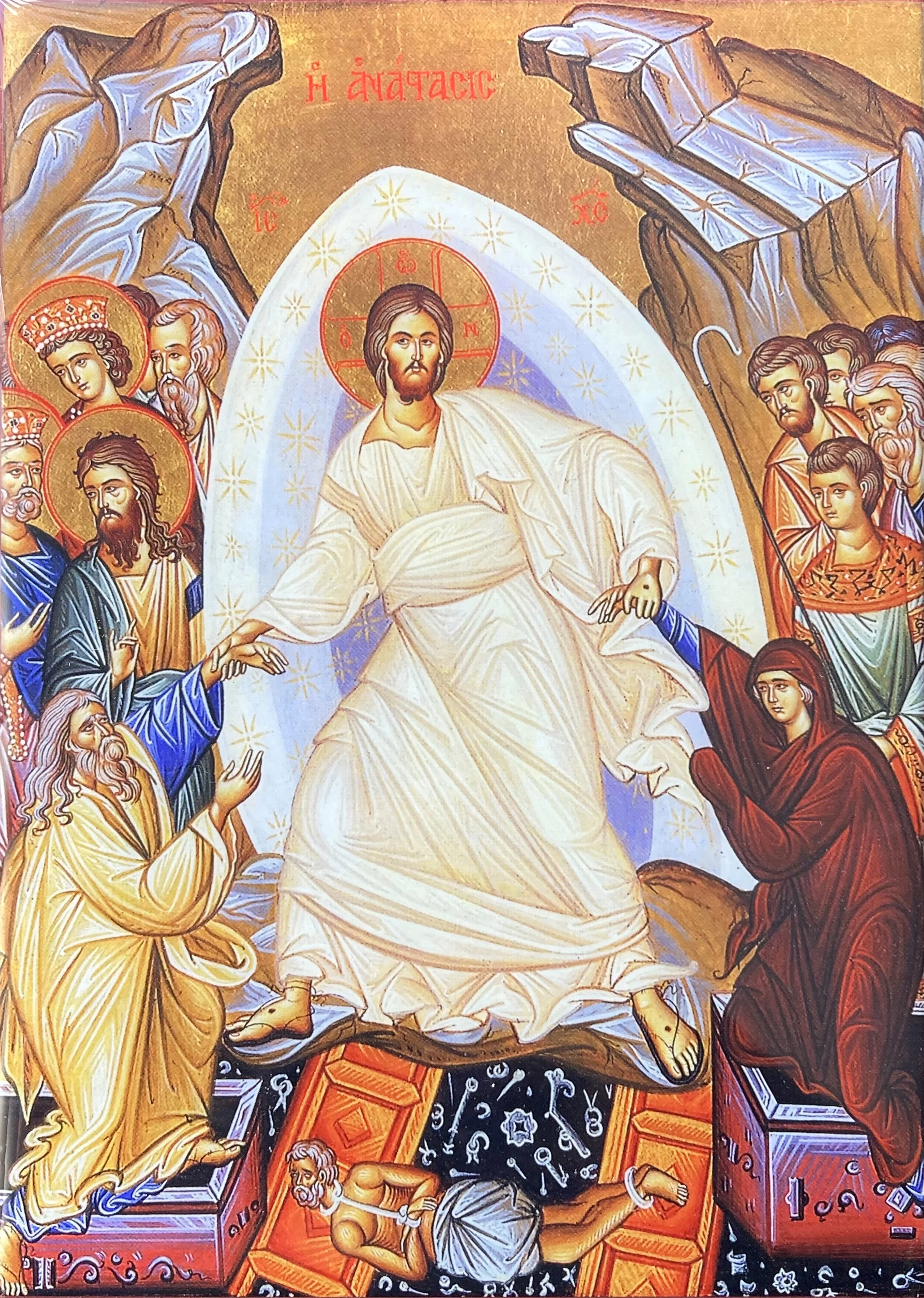
Icon from the link below:
https://www.instituteofsacredarts.com/illuminations/2021/5/14/john-capones-the-anastasis-icon-a-homily
Discussion questions:
1) What did you notice in today’s reading? What surprised you or what was memorable to you? (The Leader should point out how, while this scene is not intended to be read as entirely historical, the frame narrative involving Joseph of Arimathea, the high priests, and the sons of the righteous Symeon is intended to provide us with a lens through which to see what we know happened when the Lord gave up His spirit on the Cross, that He, as St. Peter bears witness in his 1st general Epistle, “went and proclaimed to the spirits” (1 Peter 3:19), and as St. Paul says, that He triumphed over the enemy, and “disarmed the rules and authorities and put them to open shame, by triumphing over them in the Cross” (Colossians 2:15). In short, we are given by this frame narrative a glimpse into Hades, where all the righteous were imprisoned, as the light of the Lord coming to overthrow the power of death begins to dawn upon them. It is especially important that here we see St. John the Baptist speaking first, as what is described here is what we hear of in his apolytikion as well, that: “The memory of the just is observed with hymns of praise; for you suffices the testimony of the Lord, O Forerunner. You have proved to be truly more ven'rable than the Prophets, since you were granted to baptize in the river the One whom they proclaimed. Therefore, when for the truth you had contested, rejoicing, to those in Hades you preached the Gospel, that God was manifested in the flesh, and takes away the sin of the world, and grants to us the great mercy.” And, of course, we see the Forerunner pointing toward the Lord in the icon that we link above.)
2) Where do we see Christ in this text; what is He saying or doing here?
3) Do we see ourselves and the Church in this text; what does it say about us?
4) What do you find difficult about this reading? Is there anything confusing about it, or anything that you dislike? (This is an open question, as always. )
5) Does this reading make you think that you need to change anything in your life?
Day 3 (Friday)
John 18:38b-40; 19:1-7 (Jesus Sentenced to Death)
Last week we saw the chief priests bring Jesus to Pilate, and although the governor tried to avoid dealing with Jesus at all, telling them to manage the matter themselves, they pushed back hard, insisting that Jesus was worthy of death. When Pilate examined Jesus specifically about the question of whether He claimed to be a king, and found himself confused, as Jesus did not claim to be a king, but to have come into the world to proclaim the truth. Pilate professes doubt about whether there is any truth that can be known, and then goes out to speak to those accusing Jesus. We pick up the story there.
Jesus Sentenced to Death
After he had said this, he went out to the Jews again and told them, “I find no case against him. 39 But you have a custom that I release someone for you at the Passover. Do you want me to release for you the King of the Jews?” 40 They shouted in reply, “Not this man, but Barabbas!” Now Barabbas was a bandit.
19 Then Pilate took Jesus and had him flogged. 2 And the soldiers wove a crown of thorns and put it on his head, and they dressed him in a purple robe. 3 They kept coming up to him, saying, “Hail, King of the Jews!” and striking him on the face. 4 Pilate went out again and said to them, “Look, I am bringing him out to you to let you know that I find no case against him.”
5 So Jesus came out, wearing the crown of thorns and the purple robe. Pilate said to them, “Here is the man!” 6 When the chief priests and the police saw him, they shouted, “Crucify him! Crucify him!” Pilate said to them, “Take him yourselves and crucify him; I find no case against him.” 7 The Jews answered him, “We have a law, and according to that law he ought to die because he has claimed to be the Son of God.”

Image from Uncut Mountain Supply:
https://www.uncutmountainsupply.com/icons/of-christ/icon-of-christ-the-bridegroom-20th-c-11s12/
Discussion questions:
1) What did you notice in today’s reading? What surprised you or what was memorable to you? (The Leader should point out that this scene, when Pilate presents Jesus and says: “Behold the man,” in a mocking manner, is the one that we depict in the Church with the Icon of the Bridegroom, which we set out in the Church during the first three days of Holy Week. Besides this, we see those accusing Jesus make very clear what it is that they are accusing Him of, precisely that He has claimed to be the Son of God. In their accusation, and Pilate’s mockery, we have proclaimed the truth of Jesus’ person, that He is both God and Man, and thus He is the Bridegroom of the Church, come to sanctify and wed His Bride, the Church.)
2) Where do we see Christ in this text; what is He saying or doing here?
3) Do we see ourselves and the Church in this text; what does it say about us?
4) What do you find difficult about this reading? Is there anything confusing about it, or anything that you dislike? (This is an open question, as always. )
5) Does this reading make you think that you need to change anything in your life?