Year 2 – Week 9 (October 31 – November 6)

Day 1 (Monday)

Genesis 9:1-17

Last week we saw the Flood end, and Noah and his family leave the Ark and offer sacrifice to God. We saw God promise never again to destroy every living creature He had made, with a hint in that promise that God’s purpose is not to destroy the sinful world, but to save it, as He does in His Incarnation by assuming human nature. This time, we will see God respond further to the sacrifice, and establish a new covenant with Noah and his family, as He had done with Adam and Eve in the Garden. This new covenant includes new requirements and new promises.

The Covenant With Noah

9 And God blessed Noah and his sons, and said to them, “Be fruitful and multiply, and fill the earth. 2 The fear of you and the dread of you shall be upon every beast of the earth, and upon every bird of the air, upon everything that creeps on the ground and all the fish of the sea; into your hand they are delivered. 3 Every moving thing that lives shall be food for you; and as I gave you the green plants, I give you everything.

4 Only you shall not eat flesh with its life, that is, its blood. 5 For your lifeblood I will surely require a reckoning; of every beast I will require it and of man; of every man’s brother I will require the life of man. 6 Whoever sheds the blood of man, by man shall his blood be shed; for God made man in his own image. 7 And you, be fruitful and multiply, bring forth abundantly on the earth and multiply in it.”

8 Then God said to Noah and to his sons with him, 9 “Behold, I establish my covenant with you and your descendants after you, 10 and with every living creature that is with you, the birds, the cattle, and every beast of the earth with you, as many as came out of the ark. 11 I establish my covenant with you, that never again shall all flesh be cut off by the waters of a flood, and never again shall there be a flood to destroy the earth.”

12 And God said, “This is the sign of the covenant which I make between me and you and every living creature that is with you, for all future generations: 13 I set my bow in the cloud, and it shall be a sign of the covenant between me and the earth. 14 When I bring clouds over the earth and the bow is seen in the clouds, 15 I will remember my covenant which is between me and you and every living creature of all flesh; and the waters shall never again become a flood to destroy all flesh.

16 When the bow is in the clouds, I will look upon it and remember the everlasting covenant between God and every living creature of all flesh that is upon the earth.” 17 God said to Noah, “This is the sign of the covenant which I have established between me and all flesh that is upon the earth.”

Discussion questions:

1) What did you notice in today’s reading? What surprised you or what was memorable to you? (The Leader should point out two things. First, that God gives a commandment again, as He did in the Garden of Eden. He tells them what they can eat, that is, the flesh of every living thing, and what they cannot eat, which is to say, the blood of those animals. He then repeats the command to “be fruitful and multiply”, and then makes a promise, that He will never again destroy the world. Second, we need to pay attention to the blood; this is the place where we see that blood is treated as a sacred thing; we’ll see more about why this is so on Day 2, but for now, we need to remember that even from this point, the focus on blood is anticipating the Blood of our Lord Jesus Christ, which He sheds for the life of the world at the Crucifixion.)

2) Where do we see Christ in this text; what is He saying or doing here?

3) Do we see ourselves and the Church in this text; what does it say about us?

4) What do you find difficult about this reading? Is there anything confusing about it, or anything that you dislike? (This is an open question, as always. )

5) Does this reading make you think that you need to change anything in your life?
Day 2 (Wednesday)

Leviticus 17:10–16 & Acts 15:28-29

On Day 2 we usually read something from outside the Bible; however, the Day 1 reading shows us God forbidding humanity to eat blood, and this seems strange to us until we see that this is a consistent part of God’s instructions to us, in both the Old Testament and the New. Today we will read where this commandment is repeated in the Law of Moses, and again in the Acts of the Apostles. This thing about not eating blood is one of the only parts of the Law of Moses that applies not only to the people of Israel, but even to others living among them. It doesn’t immediately make sense to us, but if we first recognize THAT it is something God commands, then we can start to think about what it means.

Leviticus 17:10–16

Eating Blood Prohibited

10 If anyone of the house of Israel or of the aliens who reside among them eats any blood, I will set my face against that person who eats blood, and will cut that person off from the people. 11 For the life of the flesh is in the blood; and I have given it to you for making atonement for your lives on the altar; for, as life, it is the blood that makes atonement.

12 Therefore I have said to the people of Israel: No person among you shall eat blood, nor shall any alien who resides among you eat blood. 13 And anyone of the people of Israel, or of the aliens who reside among them, who hunts down an animal or bird that may be eaten shall pour out its blood and cover it with earth.

14 For the life of every creature—its blood is its life; therefore I have said to the people of Israel: You shall not eat the blood of any creature, for the life of every creature is its blood; whoever eats it shall be cut off. 15 All persons, citizens or aliens, who eat what dies of itself or what has been torn by wild animals, shall wash their clothes, and bathe themselves in water, and be unclean until the evening; then they shall be clean. 16 But if they do not wash themselves or bathe their body, they shall bear their guilt.

This prohibition against eating blood is also one of the few parts of the Law of Moses that non-Jewish Christians were required to observe. During the early years of the life of the Church, the question was raised whether Christians who weren’t Jews needed to “become Jews” in order to be a part of the Church. Some thought that they did, that they needed to become circumcised, and observe all the requirements about food and clothing and washing and fasting. But when the Apostles and other leaders of the early Church met in Jerusalem, they decided only to require the things that God had commanded to Noah, which we see in the Day 1 reading, and see repeated above in Leviticus.

Acts 15:28–29 (NRSV)

28 For it has seemed good to the Holy Spirit and to us to impose on you no further burden than these essentials: 29 that you abstain from what has been sacrificed to idols and from blood and from what is strangled and from fornication. If you keep yourselves from these, you will do well. Farewell.”

Discussion questions:

1) What did you notice in today’s reading? What surprised you or what was memorable to you? (There are two reasons, basically, that they are forbidden to eat blood. The first is that it is by the Blood of Christ, when He gives up His life for the life of the world, that we are saved; for this reason, all blood is to be treated with respect, even in the Old Testament. In the sacrifices of the Old Testament, the blood is always a part of the sacrifice, and is an essential part of the reconciliation with God that the sacrifice accomplishes; the blood is wiped or smeared on people and things in order to wipe away sins. To eat it would be to mis-use it, and to “steal” what belongs to God, what has not been given to us…this makes sense especially now, that we have actually been given the Blood of God to consume for our salvation, in Holy Communion. The second reason that the eating of blood is forbidden is that it was common in pagan sacrifices to do precisely that, and therefore eating the blood of animals is strongly associated with idolatry. That the worship of demons should mis-use and corrupt the proper use of animal sacrifice is not surprising, but it does explain why this remained a significant issue, even in the New Testament. Eating the blood of the animals functioned as a mockery of Holy Communion, and is therefore still to be avoided.)

2) Where do we see Christ in this text; what is He saying or doing here?

3) Do we see ourselves and the Church in this text; what does it say about us?

4) What do you find difficult about this reading? Is there anything confusing about it, or anything that you dislike? (This is an open question, as always. )

5) Does this reading make you think that you need to change anything in your life?

Day 3 (Friday)

Mark 3:13-35

Last time we saw Jesus in conflict with the Pharisees about the observance of the Sabbath; to their criticisms, He replied that it was right to do good on the Sabbath, and that the day of rest had been given to humanity for their sake. They had not been created for the sole purpose of observing strict rules about the Sabbath, as the Pharisees seemed to think. This time, we will see Jesus finally pick out the twelve particular disciples.

Jesus Appoints the Twelve

13 He went up the mountain and called to him those whom he wanted, and they came to him. 14 And he appointed twelve, whom he also named apostles, to be with him, and to be sent out to proclaim the message, 15 and to have authority to cast out demons. 16 So he appointed the twelve: Simon (to whom he gave the name Peter); 17 James son of Zebedee and John the brother of James (to whom he gave the name Boanerges, that is, Sons of Thunder); 18 and Andrew, and Philip, and Bartholomew, and Matthew, and Thomas, and James son of Alphaeus, and Thaddaeus, and Simon the Cananaean, 19 and Judas Iscariot, who betrayed him.

Jesus and Beelzebul

Then he went home; 20 and the crowd came together again, so that they could not even eat. 21 When his family heard it, they went out to restrain him, for people were saying, “He has gone out of his mind.” 22 And the scribes who came down from Jerusalem said, “He has Beelzebul, and by the ruler of the demons he casts out demons.”

23 And he called them to him, and spoke to them in parables, “How can Satan cast out Satan? 24 If a kingdom is divided against itself, that kingdom cannot stand. 25 And if a house is divided against itself, that house will not be able to stand. 26 And if Satan has risen up against himself and is divided, he cannot stand, but his end has come. 27 But no one can enter a strong man’s house and plunder his property without first tying up the strong man; then indeed the house can be plundered.

28 “Truly I tell you, people will be forgiven for their sins and whatever blasphemies they utter; 29 but whoever blasphemes against the Holy Spirit can never have forgiveness, but is guilty of an eternal sin”— 30 for they had said, “He has an unclean spirit.”

The True Kindred of Jesus

31 Then his mother and his brothers came; and standing outside, they sent to him and called him. 32 A crowd was sitting around him; and they said to him, “Your mother and your brothers and sisters are outside, asking for you.” 33 And he replied, “Who are my mother and my brothers?” 34 And looking at those who sat around him, he said, “Here are my mother and my brothers! 35 Whoever does the will of God is my brother and sister and mother.”

Discussion questions:

1) What did you notice in today’s reading? What surprised you or what was memorable to you? (The Leader should point out that Jesus, in choosing out twelve disciples, is basically re-establishing the nation of Israel, His own priestly people, as He had originally called them to be at Mount Sinai. He should point out, too, that God’s entire purpose for the nation of Israel was to call all the peoples of the world back to Himself, and to overthrow the domination of fallen angels and evil spirits who had been ruling over the world for so long. This is why the issue of how He casts out the demons comes up, and why He replies so strongly. He is coming precisely to bind the strong ones, that is, the demon-gods of the pagan world, and to plunder them, by bringing their followers back to Him. Those who call this good thing evil, who say that God’s action against demons is itself a work of demons, are committing blasphemy. If they refuse to repent of this, they will indeed have no salvation, for they are precisely rejecting the saving action of the One Who comes to save them.

2) Where do we see Christ in this text; what is He saying or doing here?

3) Do we see ourselves and the Church in this text; what does it say about us?

4) What do you find difficult about this reading? Is there anything confusing about it, or anything that you dislike? (This is an open question, as always. )

5) Does this reading make you think that you need to change anything in your life?

Year 2 – Week 8 (October 24 – 30)

Day 1 (Monday)

Genesis 8:1-22

These last several weeks we have been leading up to the great Flood that came upon the world in the time of Noah. Last week we saw the Flood finally arrive, after God gathered the animals and had all of them go aboard the Ark with Noah and his family. Before the Flood began, God gave a final warning, and left the door of the Ark open for seven days before the rain began to fall, so that anyone willing to repent and be saved could enter the Ark. After the seven days, God closed the door, and the Flood began. It rained for 40 days. Today we will see how the Flood ends.

The Flood Subsides

8 But God remembered Noah and all the beasts and all the cattle that were with him in the ark. And God made a wind blow over the earth, and the waters subsided; 2 the fountains of the deep and the windows of the heavens were closed, the rain from the heavens was restrained, 3 and the waters receded from the earth continually.

At the end of a hundred and fifty days the waters had abated; 4 and in the seventh month, on the seventeenth day of the month, the ark came to rest upon the mountains of Ararat. 5 And the waters continued to abate until the tenth month; in the tenth month, on the first day of the month, the tops of the mountains were seen.

6 At the end of forty days Noah opened the window of the ark which he had made, 7 and sent forth a raven; and it went to and fro until the waters were dried up from the earth. 8 Then he sent forth a dove from him, to see if the waters had subsided from the face of the ground; 9 but the dove found no place to set her foot, and she returned to him to the ark, for the waters were still on the face of the whole earth. So he put forth his hand and took her and brought her into the ark with him.

10 He waited another seven days, and again he sent forth the dove out of the ark; 11 and the dove came back to him in the evening, and lo, in her mouth a freshly plucked olive leaf; so Noah knew that the waters had subsided from the earth. 12 Then he waited another seven days, and sent forth the dove; and she did not return to him any more.

13 In the six hundred and first year, in the first month, the first day of the month, the waters were dried from off the earth; and Noah removed the covering of the ark, and looked, and behold, the face of the ground was dry. 14 In the second month, on the twenty-seventh day of the month, the earth was dry. 15 Then God said to Noah, 16 “Go forth from the ark, you and your wife, and your sons and your sons’ wives with you.

17 Bring forth with you every living thing that is with you of all flesh—birds and animals and every creeping thing that creeps on the earth—that they may breed abundantly on the earth, and be fruitful and multiply upon the earth.” 18 So Noah went forth, and his sons and his wife and his sons’ wives with him. 19 And every beast, every creeping thing, and every bird, everything that moves upon the earth, went forth by families out of the ark.

God’s Promise to Noah

20 Then Noah built an altar to the Lord, and took of every clean animal and of every clean bird, and offered burnt offerings on the altar. 21 And when the Lord smelled the pleasing odor, the Lord said in his heart, “I will never again curse the ground because of man, for the imagination of man’s heart is evil from his youth; neither will I ever again destroy every living creature as I have done. 22 While the earth remains, seedtime and harvest, cold and heat, summer and winter, day and night, shall not cease.”

Discussion questions:

1) What did you notice in today’s reading? What surprised you or what was memorable to you? (The Leader should point out the timeline, that the time from when the rain began until the Ark came to rest on the mountain was 150 days, and then another 73 days until they saw the top of other mountains, and then 40 days until Noah sent out first the raven, which didn’t return, and the dove, which did, and then another seven days until he sent out the dove the second time, when it brought back the olive branch, and then a final seven days until he sent it out the last time, and it didn’t return. It was then (finally) the first day of the new year that he took the cover off the ark because the earth was no longer underwater, and not until the end of the 2nd month that they all finally left the ark. So they were on the ark for 40 days with rain, 110 floating, 73 aground until they could see other mountains, 40 until he sent out the raven and dove, 7 until he sent out the dove and it came back with the olive branch, and 7 until it didn’t come back at all, which would have been the 24th day of the 11th month, and almost to the New Year, when they took off the cover on the Ark. But in total, they were on the Ark for over a year, from the 17th day of the 2nd month of one year until the 27th day of the 2nd month in the next year. That’s a long time to be on a boat. It’s important also to note God’s promise not to destroy everything on the earth again, for as long as the earth itself remains, and to note that Christ’s coming as a human being, taking our created nature upon Himself, is a guarantee of this; God is committed to SAVING the world, instead of destroying it.)

2) Where do we see Christ in this text; what is He saying or doing here?

3) Do we see ourselves and the Church in this text; what does it say about us?

4) What do you find difficult about this reading? Is there anything confusing about it, or anything that you dislike? (This is an open question, as always. )

5) Does this reading make you think that you need to change anything in your life?

Day 2 (Wednesday)

Prayer for the Oil from the Baptismal Service + An Explanation of the Dove and Olive from St. Bede the Venerable

For Day 2 this week, we will read two separate selections connecting the dove and the olive branch that we saw on Day 1 with the life of the Church. The first selection is from the service of Baptism, and comes right before the baptismal immersion takes place, as the one who is coming to be baptized is anointed with oil.

The other selection is from a sermon preached by St. Bede, a saint of northern England who lived from 673 to 735. He wrote many things, including a history of the English Church from its conversion on, but in his own time, he was best known for the many commentaries and sermons that he wrote. This excerpt is one that he preached on the Gospels, and as we read, you will see the connection.

Prayer for the Oil (from the Baptismal Service)

O Lord and Master, the God of our Fathers, who sent to those in Noah’s Ark a dove carrying a twig of olive in its beak as a symbol of reconciliation and of deliverance from the Flood; who through these signs prefigured the mystery of grace; who supplied the fruit of the olive for the fulfilment of your holy Sacraments-and through it filled with the Holy Spirit those who were under the Law and made perfect those under grace; bless this oil through the power and energy and visitation of the Holy Spirit, so that it may become an anointing of incorruption, a weapon of justice, a renewal of soul and body, a defense against every influence of the Devil, and a release from evil, to all those who are anointed with it in faith, or partake of it, to your glory, and that of your only-begotten Son, and your all- holy and good and life-giving Spirit, now and ever, and to the ages of ages.

St. Bede the Venerable on the Dove, the Olive Branch, the Ark, and the Church

After Noah sent the raven, he sent a dove, and it came to him in the evening, carrying in its mouth an olive branch with green leaves.
You are paying attention, I believe, and with your intellect you anticipate me as I speak. The olive branch with green leaves is a figure of the grace of the Holy Spirit, rich in the words of life, the fullness of which rests upon Christ, as the psalm says, “God, your God, has anointed you with the oil of gladness above your fellows.”

Concerning this gift given to Christ’s fellows, John speaks: “You have the anointing from the holy one, and you know all things.”13 And by a most beautiful conjunction the figure is in agreement with the fulfillment—a corporeal dove brought the olive branch to the ark which was washed by the waters of the flood; the Holy Spirit descended in the form of a corporeal dove upon the Lord when he was baptized in the waters of the Jordan.

Not only the human beings but also the living things which the ark contained, and also the very wood from which the ark was made, prefigure us members of Christ and of the church after our reception of the washing of the waters of regeneration. Through the anointing of the sacred chrism may we be signed with the grace of the Holy Spirit, and may he deign to keep it inviolate in us who himself gave it [to us], Jesus Christ our Lord who with the almighty Father in the unity of the same Holy Spirit lives and reigns for all ages. Amen.

HOMILY 1.12.
Louth, A., & Conti, M. (2001). Genesis 1–11 (pp. 145–146). Downers Grove, IL: InterVarsity Press.

Discussion questions:

1) What did you notice in today’s reading? What surprised you or what was memorable to you? (Leader should point out the these two sources are drawing different lessons from the same text. The prayer from Baptism associates the olive branch and the dove with reconciliation between God and humanity, since the dove with the olive was a sign that the Flood was ending and the judgment was over, and then makes use of the oil of the olive as the final preparation for Baptism, in water, we should notice, which perfectly reconciles us to God, as we are baptized into the death and resurrection of Jesus Christ, and made members of His body, the Church. The quote from St. Bede instead focuses on the Dove hovering above the waters, and makes a connection between the descent of the Holy Spirit in the form of a dove when Jesus was baptized and our own receiving of the Holy Spirit when we are baptized. Both selections, however, make a connection between the Ark and the Flood and the Dove and the Olive and the Church and Baptism and the grace that we receive in being brought into the Church.)

2) Where do we see Christ in this text; what is He saying or doing here?

3) Do we see ourselves and the Church in this text; what does it say about us?

4) What do you find difficult about this reading? Is there anything confusing about it, or anything that you dislike? (This is an open question, as always. )

5) Does this reading make you think that you need to change anything in your life?

Day 3 (Friday)

Mark 2:23-28; 3:1-12

Last time we saw the Lord call Levi to be one of his disciples, and then begin to have conflict with the religious authorities about how His disciples were not fasting and behaving in the way that the Pharisees thought that they should. This sort of conflict will continue in today’s passage, as the Lord heals on the Sabbath Day, and the Pharisees criticize Him for “doing work” on the Sabbath day, the seventh day of the week on which God rested at the Creation, and on which the Hebrew people were commanded to observe a strict rest. This connects with what Jesus said about clothing patches and wineskins last week, but becomes more pronounced.

Pronouncement about the Sabbath

23 One sabbath he was going through the grainfields; and as they made their way his disciples began to pluck heads of grain. 24 The Pharisees said to him, “Look, why are they doing what is not lawful on the sabbath?” 25 And he said to them, “Have you never read what David did when he and his companions were hungry and in need of food? 26 He entered the house of God, when Abiathar was high priest, and ate the bread of the Presence, which it is not lawful for any but the priests to eat, and he gave some to his companions.” 27 Then he said to them, “The sabbath was made for humankind, and not humankind for the sabbath; 28 so the Son of Man is lord even of the sabbath.”

The Man with a Withered Hand

3 Again he entered the synagogue, and a man was there who had a withered hand. 2 They watched him to see whether he would cure him on the sabbath, so that they might accuse him. 3 And he said to the man who had the withered hand, “Come forward.” 4 Then he said to them, “Is it lawful to do good or to do harm on the sabbath, to save life or to kill?” But they were silent.

5 He looked around at them with anger; he was grieved at their hardness of heart and said to the man, “Stretch out your hand.” He stretched it out, and his hand was restored. 6 The Pharisees went out and immediately conspired with the Herodians against him, how to destroy him.

A Multitude at the Seaside

7 Jesus departed with his disciples to the sea, and a great multitude from Galilee followed him; 8 hearing all that he was doing, they came to him in great numbers from Judea, Jerusalem, Idumea, beyond the Jordan, and the region around Tyre and Sidon. 9 He told his disciples to have a boat ready for him because of the crowd, so that they would not crush him; 10 for he had cured many, so that all who had diseases pressed upon him to touch him. 11 Whenever the unclean spirits saw him, they fell down before him and shouted, “You are the Son of God!” 12 But he sternly ordered them not to make him known.

Discussion questions:

1) What did you notice in today’s reading? What surprised you or what was memorable to you? (The Leader should note that the conflict over the Sabbath is ultimately about a misunderstanding of who God is. The Pharisees think that God is arbitrary and legalistic, and cares only that His rules are carried out. Jesus is pointing out that the point of the Sabbath is to honor God, which we do most clearly by loving one another and doing what is right. The point is NOT that God doesn’t care at all about what we do…it’s that we have a responsibility to actually serve God, and not just follow a few rigid rules that make no sense. We have to actually love God and love our fellow human beings.)

2) Where do we see Christ in this text; what is He saying or doing here?

3) Do we see ourselves and the Church in this text; what does it say about us?

4) What do you find difficult about this reading? Is there anything confusing about it, or anything that you dislike? (This is an open question, as always. )

5) Does this reading make you think that you need to change anything in your life?

Year 2 – Week 7 (October 17 – 23)

Day 1 (Monday)

Genesis 7:1-24

Last week we saw God command Noah to build the Ark, and to prepare for the coming Flood, which would judge corrupt humanity and cleanse the earth of the taint that had come upon it through human sinfulness. We also saw God promise to keep Noah and his family alive, along with a remnant of all the animals of the earth, and to make His covenant with them; and saw that what God was planning with them was to remove them from the corrupted earth, to cleanse the earth, and to begin again with faithful people, that is, with Noah and his family. We should note that we see Noah first when he is 500 years old, when God tells him to begin to build the ark. Today, 100 years later, we will see the Flood arrive.

The Great Flood

7 Then the Lord said to Noah, “Go into the ark, you and all your household, for I have seen that you are righteous before me in this generation. 2 Take with you seven pairs of all clean animals, the male and his mate; and a pair of the animals that are not clean, the male and his mate; 3 and seven pairs of the birds of the air also, male and female, to keep their kind alive upon the face of all the earth.

4 For in seven days I will send rain upon the earth forty days and forty nights; and every living thing that I have made I will blot out from the face of the ground.” 5 And Noah did all that the Lord had commanded him.

6 Noah was six hundred years old when the flood of waters came upon the earth. 7 And Noah and his sons and his wife and his sons’ wives with him went into the ark, to escape the waters of the flood. 8 Of clean animals, and of animals that are not clean, and of birds, and of everything that creeps on the ground, 9 two and two, male and female, went into the ark with Noah, as God had commanded Noah. 10 And after seven days the waters of the flood came upon the earth.

11 In the six hundredth year of Noah’s life, in the second month, on the seventeenth day of the month, on that day all the fountains of the great deep burst forth, and the windows of the heavens were opened. 12 And rain fell upon the earth forty days and forty nights.

13 On the very same day Noah and his sons, Shem and Ham and Japheth, and Noah’s wife and the three wives of his sons with them entered the ark, 14 they and every beast according to its kind, and all the cattle according to their kinds, and every creeping thing that creeps on the earth according to its kind, and every bird according to its kind, every bird of every sort.

15 They went into the ark with Noah, two and two of all flesh in which there was the breath of life. 16 And they that entered, male and female of all flesh, went in as God had commanded him; and the Lord shut him in.

17 The flood continued forty days upon the earth; and the waters increased, and bore up the ark, and it rose high above the earth. 18 The waters prevailed and increased greatly upon the earth; and the ark floated on the face of the waters. 19 And the waters prevailed so mightily upon the earth that all the high mountains under the whole heaven were covered; 20 the waters prevailed above the mountains, covering them fifteen cubits deep.

21 And all flesh died that moved upon the earth, birds, cattle, beasts, all swarming creatures that swarm upon the earth, and every man; 22 everything on the dry land in whose nostrils was the breath of life died. 23 He blotted out every living thing that was upon the face of the ground, man and animals and creeping things and birds of the air; they were blotted out from the earth. Only Noah was left, and those that were with him in the ark. 24 And the waters prevailed upon the earth a hundred and fifty days.

Discussion questions:

1) What did you notice in today’s reading? What surprised you or what was memorable to you? (The Leader should point out three things here. First, God gives time, first 100 years, and then 7 days, for everyone else to repent; the only people who refuse to board the Ark are the ones who reject the salvation that He offers. Second, that it rains for 40 days, which is the first time that we see this number 40 in the Bible. This is, it seems, the amount of time it takes for the earth to be cleansed; it is also, not coincidentally, the length of both Great Lent and the Nativity Fast. Third, that both clean and unclean animals are brought on board the Ark, even though we haven’t yet seen what makes an animal clean or unclean. This is seen by several of the Fathers to foreshadow the Church, in which both the clean, that is, the Hebrew people, and the unclean, the Gentiles, are saved, so long as they are faithful to the Lord.)

2) Where do we see Christ in this text; what is He saying or doing here?

3) Do we see ourselves and the Church in this text; what does it say about us?

4) What do you find difficult about this reading? Is there anything confusing about it, or anything that you dislike? (This is an open question, as always. )

5) Does this reading make you think that you need to change anything in your life?

Day 2 (Wednesday)

St. Ephrem the Syrian On the Mercy of God in the Flood

St. Ephrem the Syrian lived in the cities of Nisibis and Edessa, in the far eastern part of what is now Turkey. He served a community that spoke Aramaic, rather than Greek, and as a result he preached and wrote in that language. He lived from 306 to 373, and was therefore a contemporary of St. Basil the Great and the many other great saints of the 4th century. He wrote many hymns, and especially hymns that were used to teach, but he also wrote a number of commentaries on the Scripture, including one on the book of Genesis. From him, then, we are able to see what a saint of the 4th century thought was important about the story of Noah and the Flood.

Invitation to Repentance

Noah began the ark in the first year that was allowed that generation for repentance and he finished it in one hundred years. Although Noah was an example to that generation by his righteousness and had, in his uprightness, announced to them the flood during that one hundred years, they still did not repent. So Noah said to them, “Some of all flesh will come to be saved with me in the ark.” But they mocked him [saying], “How will all the beasts and birds that are scattered throughout every corner of the earth come from all those regions?”

(2) On that same day elephants came from the east, apes and peacocks approached from the south, other animals gathered from the west, and still others hastened to come from the north. Lions came from the jungles and wild beasts arrived from their lairs. Deer and wild donkeys came from their lands and the mountain beasts gathered from their mountains.

(3) When those of that generation gathered [to see] this novel sight, it was not to repent, but rather to amuse themselves. Then, in their very presence, the lions began to enter the ark and the bulls, with no fear, hurried in right on their heels to seek shelter with the lions. The wolves and the lambs entered together and the hawks and the sparrows together with the doves and the eagles.

10. When those of that generation were still not persuaded, neither by the gathering of all the animals at that time nor by the love that instantly grew between [the animals], the Lord said to Noah, “In seven days, I will blot out everything that I have made.”

So God granted one hundred years while the ark was being made to that generation, and still they did not repent. God summoned beasts that they had never seen and still they showed no remorse. He established a state of peace between the predatory animals and those who are preyed upon, and still they had no awe. God delayed yet seven more days for them, even after Noah and every creature had entered the ark, leaving the gate of the ark open to them. This is a wondrous thing that no lion remembered its jungle and no species of beast or bird visited its customary haunt! Although those of that generation saw all that went on outside and inside the ark, they were still not persuaded to renounce their evil deeds.…

(2) For this reason, at the end of the seven days, in the six hundredth year of Noah’s life, in the second month, on the seventeenth day of the month, the springs of the great abyss burst forth and the flood gates of heaven were opened. The Lord shut the door before Noah, lest those left behind come at the time of the floods and break down the gate of the ark. The deluge came and God blotted out all flesh. Only Noah was left and those that were with him in the ark. The springs of the abyss and the flood gates of heaven were open forty days and forty nights, and the ark was afloat for one hundred fifty days.

Ephrem the Syrian. (2004). St. Ephrem the Syrian: Selected Prose Works. (T. P. Halton & K. McVey, Eds., E. G. Mathews Jr. & J. P. Amar, Trans.) (Vol. 91, pp. 138–141). Washington, DC: The Catholic University of America Press.

Discussion questions:

1) What did you notice in today’s reading? What surprised you or what was memorable to you? (The Leader should point out that St. Ephrem makes very clear that the Flood was not something that God did in a sudden flash of temper, but something that He did only after many, many years of warnings, accompanied by preaching and miracles, urging the people of that time to repent and to return to faithfulness. He gave them an example of righteousness (in Noah), a proof that He was serious about the Flood (in the building of the Ark itself, and then in the assembly of all the animals), and then a final seven days for them to be saved before He closed the door Himself and sent the waters of the Flood. Therefore, we can be certain that there was no one innocent, no one who wanted to repent and be saved, who was drowned in the Flood. Everyone was completely corrupt and evil, to the point that they rejected the salvation that was offered to them.)

2) Where do we see Christ in this text; what is He saying or doing here?

3) Do we see ourselves and the Church in this text; what does it say about us?

4) What do you find difficult about this reading? Is there anything confusing about it, or anything that you dislike? (This is an open question, as always. )

5) Does this reading make you think that you need to change anything in your life?

Day 3 (Friday)

Mark 2:13-22

Last week we saw Jesus go out into the countryside around Capernaum, where He healed a leper, and then return to Capernaum, where He healed the paralytic whose friends climbed up on the roof of the house in which Jesus was preaching and broke open the roof so they could let their friend down in front of the Lord. We saw Him declare Himself to be God by first forgiving the man’s sins, and then proving His authority to do so by healing him with a word. We should note that up to this point, He has called only four disciples: Simon (Peter) & Andrew, & James and John.

Jesus Calls Levi

13 Jesus went out again beside the sea; the whole crowd gathered around him, and he taught them. 14 As he was walking along, he saw Levi son of Alphaeus sitting at the tax booth, and he said to him, “Follow me.” And he got up and followed him.

15 And as he sat at dinner in Levi’s house, many tax collectors and sinners were also sitting with Jesus and his disciples—for there were many who followed him. 16 When the scribes of the Pharisees saw that he was eating with sinners and tax collectors, they said to his disciples, “Why does he eat with tax collectors and sinners?” 17 When Jesus heard this, he said to them, “Those who are well have no need of a physician, but those who are sick; I have come to call not the righteous but sinners.”

The Question about Fasting

18 Now John’s disciples and the Pharisees were fasting; and people came and said to him, “Why do John’s disciples and the disciples of the Pharisees fast, but your disciples do not fast?” 19 Jesus said to them, “The wedding guests cannot fast while the bridegroom is with them, can they? As long as they have the bridegroom with them, they cannot fast. 20 The days will come when the bridegroom is taken away from them, and then they will fast on that day.

21 “No one sews a piece of unshrunk cloth on an old cloak; otherwise, the patch pulls away from it, the new from the old, and a worse tear is made. 22 And no one puts new wine into old wineskins; otherwise, the wine will burst the skins, and the wine is lost, and so are the skins; but one puts new wine into fresh wineskins.”

Discussion questions:

1) What did you notice in today’s reading? What surprised you or what was memorable to you? (The Leader should point out that there are two main lessons to this reading. The first is that Jesus comes to save sinners, as He calls Levi meets with Levi’s sinful friends. Note along with this that He doesn’t just eat with them, but He preaches to them, and calls them to repentance. This is precisely WHY He comes and spends time with sinners…to call them to leave their sin behind and to follow Him. The second lesson is that those who follow Him behave differently from other people. This shows that the Way He is proclaiming isn’t just another sect of Judaism, just another human religious practice, because it’s not just about the ideas or the practices, but about being with Him. More advanced students may enjoy thinking about what the cloth patch and wineskins paragraph has to do with what goes before.)

2) Where do we see Christ in this text; what is He saying or doing here?

3) Do we see ourselves and the Church in this text; what does it say about us?

4) What do you find difficult about this reading? Is there anything confusing about it, or anything that you dislike? (This is an open question, as always. )

5) Does this reading make you think that you need to change anything in your life?

Year 2 – Week 6 (October 10 – 16)

Day 1 (Monday)

Genesis 6:9-22

Last time we read about how things had gone in the world after Adam and Eve, how most of their descendants had become wicked, either through their own passions and desires (especially anger and possessiveness), or through the temptation and influence of fallen angels (which is to say, of demons). We saw, too, that there were still some righteous people, including Enoch, who lived his life so close to God that he was taken up into heaven and never died; we can rightly call him the first saint. We saw the world had grown so evil that God was preparing to bring judgment, to put an end to that evil, but that Enoch’s great-grandson, a man named Noah, was righteous, and that he had found favor with God. We will be reading his story for the next several weeks.

Noah Pleases God

9 These are the generations of Noah. Noah was a righteous man, blameless in his generation; Noah walked with God. 10 And Noah had three sons, Shem, Ham, and Japheth.

11 Now the earth was corrupt in God’s sight, and the earth was filled with violence. 12 And God saw the earth, and behold, it was corrupt; for all flesh had corrupted their way upon the earth. 13 And God said to Noah, “I have determined to make an end of all flesh; for the earth is filled with violence through them; behold, I will destroy them with the earth.

14 Make yourself an ark of gopher wood; make rooms in the ark, and cover it inside and out with pitch. 15 This is how you are to make it: the length of the ark three hundred cubits, its breadth fifty cubits, and its height thirty cubits. 16 Make a roof for the ark, and finish it to a cubit above; and set the door of the ark in its side; make it with lower, second, and third decks. 17 For behold, I will bring a flood of waters upon the earth, to destroy all flesh in which is the breath of life from under heaven; everything that is on the earth shall die.

18 But I will establish my covenant with you; and you shall come into the ark, you, your sons, your wife, and your sons’ wives with you. 19 And of every living thing of all flesh, you shall bring two of every sort into the ark, to keep them alive with you; they shall be male and female.

20 Of the birds according to their kinds, and of the animals according to their kinds, of every creeping thing of the ground according to its kind, two of every sort shall come in to you, to keep them alive. 21 Also take with you every sort of food that is eaten, and store it up; and it shall serve as food for you and for them.” 22 Noah did this; he did all that God commanded him.

Discussion questions:

1) What did you notice in today’s reading? What surprised you or what was memorable to you? (The Leader should point out that God’s judgment comes after much patience; we saw last time God giving warnings, talking about how sinful humankind would be given 120 years more to repent. It’s not explicit in Scripture, but the tradition of the Church has been clear that part of the responsibility of the righteous line of Seth was to preach and proclaim and to warn and to urge the rest of humankind to repent, and that they were faithful in doing so. So God does not just come and destroy the world; He points out their sin, calls them to repentance, and gives them a great deal of time before the judgment comes. And when it does come, as we see here, God saves everyone who is willing to be saved (even though it seems like such a small number, we can be confident that God saved everyone who had not rejected Him), and saves all kinds of the animals, so that life will not be destroyed with the wicked. This shows us both the mercy of God, and the capacity of sinful humanity to destroy ourselves and the world around us by rejecting the mercy and love of God; from this, we should both take comfort, and understand a profound warning about the consequences of rebellion against God.)

2) Where do we see Christ in this text; what is He saying or doing here?

3) Do we see ourselves and the Church in this text; what does it say about us?

4) What do you find difficult about this reading? Is there anything confusing about it, or anything that you dislike? (This is an open question, as always. )

5) Does this reading make you think that you need to change anything in your life?

Day 2 (Wednesday)

St. Augustine on the Ark of Noah

On Day 1 we talked about the Ark as showing God’s mercy, as well as the reality of the consequences of rebellion against Him. Today, we’ll look at how one of the Church Fathers, St. Augustine, interprets the story of Noah and the Ark. This is a nice example of how stories in the Bible can mean more than one thing; in this case, St. Augustine is saying that, besides being a story of human sin and divine judgment in the depths of the past, the Ark gives us an image, even a prophecy, of the coming of the Lord to be the perfect deliverance from sin and death.

The Ark is a Symbol of the Church

Undoubtedly the ark is a symbol of the city of God on its pilgrimage in history. It is a figure of the church that was saved by the wood on which there hung the “Mediator between God and men, himself man, Jesus Christ.” Even the very measurements of length, height and width of the ark are meant to point to the reality of the human body into which the Lord came, as it was foretold that He would come.

It will be recalled that the length of a normal body from head to foot is six times the width from one side to the other and ten times the thickness from back to front. Measure a man who is lying on the ground, either face down or face up. He is six times as long from head to foot as he is wide from left to right or right to left, and he is ten times as long as he is high from the ground up. That is why the ark was made three hundred cubits in length, fifty in breadth and thirty in height.

As for the door in the side, that surely, symbolizes the open wound made by the lance in the side of the Crucified—the door by which those who come to him enter in, in the sense that believers enter the church by means of the sacraments that issued from that wound.

It was ordered that the ark be made out of squared timbers—a symbol of the foursquare stability of a holy life, which, like a cube, stands firm however it is turned. So it is with every other detail of the ark’s construction. They are all symbols of something in the church.”

– St. Augustine of Hippo; The City of God, 15.26.

Discussion questions:

1) What did you notice in today’s reading? What surprised you or what was memorable to you? (Leader should point out that the connection between the Ark of Noah and the Church as “vessels of salvation” is a very common one in the life of the Church. St. Augustine makes the connection specific, not just in the similarity of what the Ark and the Church do (that is, save those who go inside them), but in connecting the dimensions of the Ark with the Incarnation of the Lord, that He became human, and by doing so, even to the point of death, has saved us from death and sin and brings us into everlasting life). Especially important is Augustine’s reference to the door, as showing the wound in the Lord’s side. In the Gospel of John (19:34) we see that one of the soldiers pierced Jesus’ side with a spear after He had died, and blood and water came out; we read this verse as we fill the Chalice with wine in preparation for the Divine Liturgy, so Augustine is connecting the door of the Ark with the Sacraments, saying that we enter into the vessel of salvation by receiving what God gives to us in the Church, which is to say, we are baptized in water, and receive His Body and Blood, and by these things we become members of His Body and are saved, being brought within the Ark of Salvation that is the Church.)

2) Where do we see Christ in this text; what is He saying or doing here?

3) Do we see ourselves and the Church in this text; what does it say about us?

4) What do you find difficult about this reading? Is there anything confusing about it, or anything that you dislike? (This is an open question, as always. )

5) Does this reading make you think that you need to change anything in your life?

Day 3 (Friday)

Mark 1:40-45; 2:1-12

Last week we saw Jesus begin to preach, to heal, and to cast out demons, beginning in the city of Capernaum, from the house of Simon and Andrew. After healing many people, He went out into the wilderness to pray, and Simon, Andrew, James & John found Him there. They wanted Him to go back to the city, because everyone was looking for Him, but He told them that He was instead going to go out to the neighboring towns; He was coming to save more than just the city of Capernaum.

Jesus Cleanses a Leper

40 A leper came to him begging him, and kneeling he said to him, “If you choose, you can make me clean.” 41 Moved with pity, Jesus stretched out his hand and touched him, and said to him, “I do choose. Be made clean!” 42 Immediately the leprosy left him, and he was made clean.

43 After sternly warning him he sent him away at once, 44 saying to him, “See that you say nothing to anyone; but go, show yourself to the priest, and offer for your cleansing what Moses commanded, as a testimony to them.”

45 But he went out and began to proclaim it freely, and to spread the word, so that Jesus could no longer go into a town openly, but stayed out in the country; and people came to him from every quarter.

Jesus Heals a Paralytic

2 When he returned to Capernaum after some days, it was reported that he was at home. 2 So many gathered around that there was no longer room for them, not even in front of the door; and he was speaking the word to them.

3 Then some people came, bringing to him a paralyzed man, carried by four of them. 4 And when they could not bring him to Jesus because of the crowd, they removed the roof above him; and after having dug through it, they let down the mat on which the paralytic lay.

5 When Jesus saw their faith, he said to the paralytic, “Son, your sins are forgiven.” 6 Now some of the scribes were sitting there, questioning in their hearts, 7 “Why does this fellow speak in this way? It is blasphemy! Who can forgive sins but God alone?”

8 At once Jesus perceived in his spirit that they were discussing these questions among themselves; and he said to them, “Why do you raise such questions in your hearts? 9 Which is easier, to say to the paralytic, ‘Your sins are forgiven,’ or to say, ‘Stand up and take your mat and walk’?

10 But so that you may know that the Son of Man has authority on earth to forgive sins”—he said to the paralytic— 11 “I say to you, stand up, take your mat and go to your home.” 12 And he stood up, and immediately took the mat and went out before all of them; so that they were all amazed and glorified God, saying, “We have never seen anything like this!”

Discussion questions:

1) What did you notice in today’s reading? What surprised you or what was memorable to you? (Leader should point out two things. The first is that Jesus isn’t just doing an advanced form of medicine here, nor is He doing magic tricks. Both of those sorts of things require some effort or some method, but He simply speaks, and what He speaks comes to be; only God Himself could do this, so Mark shows us clearly that Jesus is God. The second point is that the people who are healed don’t convince Jesus to heal them, much less pay Him for healing; the ones that we see healed in this passage are specifically those who entrust and submit themselves to Him (which is what faith means). This is the same point that Augustine made in the Day 2 reading…there is no way to get into the Ark of Salvation without actually binding and submitting ourselves to the Lord. This is what we do when we are baptized and when we receive Holy Communion…but we need to be sure that we actually mean it, that we are actually being Faithful to God, when we receive Communion and the other sacraments of the Church. Otherwise, they will do us no good.)

2) Where do we see Christ in this text; what is He saying or doing here?

3) Do we see ourselves and the Church in this text; what does it say about us?

4) What do you find difficult about this reading? Is there anything confusing about it, or anything that you dislike? (This is an open question, as always. )

5) Does this reading make you think that you need to change anything in your life?

Year 2 – Week 5 (October 3 – 9)

Day 1 (Monday)

Genesis 5:1-5, 21-32; 6:1-8

Last week we read about the first four days of the Creation. We know, of course, that on the sixth day, God made humanity. We know that the first man and woman, Adam and Eve, disobeyed God and fell into sin; they rebelled against God through the temptation of a fallen angel, so they had to leave the garden of the presence of God and go into exile, out into the world. We know that their oldest son Cain was wicked, and killed his brother Abel, who was righteous, and we know that God punished Cain by cursing him from the ground, and sending him away as a fugitive and wanderer on the earth.

Cain then went away to a different place and built a city and established a civilization of his own, as though he was trying to prove God wrong. We see in Genesis 4:17-26 that this was an ugly civilization, full of violence and boasting and power struggles between people, in which men had more than one wife and considering their wives to be their property. The civilization advanced, and was making things out of metal, and making music, and domesticating animals, but using all that advancement for evil.

Meanwhile, Adam and Eve then had another son, named Seth, who they prayed and hoped would be the one through whom salvation would come to them. We’ll pick up the story there, in Genesis 5, and see how things develop. We won’t read the whole chapter (which is just a list of generations), but we’ll touch on the important points.

Adam’s Descendants to Noah and His Sons

5 This is the book of the generations of Adam. When God created man, he made him in the likeness of God. 2 Male and female he created them, and he blessed them and named them Man when they were created. 3 When Adam had lived a hundred and thirty years, he became the father of a son in his own likeness, after his image, and named him Seth. 4 The days of Adam after he became the father of Seth were eight hundred years; and he had other sons and daughters. 5 Thus all the days that Adam lived were nine hundred and thirty years; and he died.

Seth had a son named Enosh, who had a son named Kenan, who had a son named Mahalalel, who had a son named Jared, who had a son named Enoch.

21 When Enoch had lived sixty-five years, he became the father of Methu′selah. 22 Enoch walked with God after the birth of Methu′selah three hundred years, and had other sons and daughters. 23 Thus all the days of Enoch were three hundred and sixty-five years. 24 Enoch walked with God; and he was not, for God took him.

25 When Methu′selah had lived a hundred and eighty-seven years, he became the father of Lamech. 26 Methu′selah lived after the birth of Lamech seven hundred and eighty-two years, and had other sons and daughters. 27 Thus all the days of Methu′selah were nine hundred and sixty-nine years; and he died.

28 When Lamech had lived a hundred and eighty-two years, he became the father of a son, 29 and called his name Noah, saying, “Out of the ground which the Lord has cursed this one shall bring us relief from our work and from the toil of our hands.” 30 Lamech lived after the birth of Noah five hundred and ninety-five years, and had other sons and daughters. 31 Thus all the days of Lamech were seven hundred and seventy-seven years; and he died.

32 After Noah was five hundred years old, Noah became the father of Shem, Ham, and Japheth.

The Wickedness of Mankind

6 When men began to multiply on the face of the ground, and daughters were born to them, 2 the sons of God saw that the daughters of men were fair; and they took to wife such of them as they chose. 3 Then the Lord said, “My spirit shall not abide in man for ever, for he is flesh, but his days shall be a hundred and twenty years.” 4 The Nephilim were on the earth in those days, and also afterward, when the sons of God came in to the daughters of men, and they bore children to them. These were the mighty men that were of old, the men of renown.

5 The Lord saw that the wickedness of man was great in the earth, and that every imagination of the thoughts of his heart was only evil continually. 6 And the Lord was sorry that he had made man on the earth, and it grieved him to his heart. 7 So the Lord said, “I will blot out man whom I have created from the face of the ground, man and beast and creeping things and birds of the air, for I am sorry that I have made them.” 8 But Noah found favor in the eyes of the Lord.

Discussion questions:

1) What did you notice in today’s reading? What surprised you or what was memorable to you? (Leader should point out the contrast between the righteous descendants of Adam, and the wickedness happening with the rest of the world. Especially, if no one else notices, the leader should point out Enoch, who doesn’t die, but is taken directly to heaven; in many ways, we can understand Enoch to be the first Saint, the first righteous human being included in the Divine Council of the Lord, together with the faithful angels. What happens to him is similar to what we see with Moses, and Elijah, and eventually with Panagia. Elijah, like Enoch, is caught up to heaven without dying, while Moses and Panagia both die before being caught up into the presence of the Lord. Finally, for older classes, it would be good to discuss the connection that we see here for the first time in the Bible, between the envy and evil of fallen angels, and human sexual sin and depravity. This is a very large part of the reason that the Church is so insistent on sexual morality.)

2) Where do we see Christ in this text; what is He saying or doing here?

3) Do we see ourselves and the Church in this text; what does it say about us?

4) What do you find difficult about this reading? Is there anything confusing about it, or anything that you dislike? (This is an open question, as always. )

5) Does this reading make you think that you need to change anything in your life?

Note: for more discussion of Enoch's situation, interested readers can look here, at the Whole Counsel of God blog.

Day 2 (Wednesday)

Excerpt from a Homily Explaining that God is Not the Cause of Evil

In both our Day 1 and Day 3 readings this week, we are talking about demons, fallen angels, those who are in rebellion against God, and their connection to human sin and the brokenness of the world. In the Bible, however, while we often see angels and demons talked about, we never get a clear explanation of how they came to be evil. Today, then, we will read a passage from a sermon of St. Basil the Great, talking about how the devil came to be evil.

For What Reason is the Devil Evil?

[Now we come to] the question about the devil. From where does the devil come, if evils are not from God? What then shall we say? That the same argument that was offered regarding wickedness in the human being also helps us in this inquiry.

But for what reason is the human being evil? Because of his freedom of choice. For what reason is the devil evil? For the same reason; the devil possesses a life endowed with self-determination, and the authority rests in himself either to remain with God or to become estranged (to separate himself, to “become a stranger”) from the good.

Gabriel is an angel, and he stood by God continually. Satan is an angel, and he fell away from his proper place entirely. The free choice of the one kept him in things above, and the self-determination of the other threw him down. For the one (Gabriel) could have become an enemy, and the other (Satan) need not have fallen, but the Gabriel was preserved by his insatiable love of God, while his withdrawal from God showed Satan as worthless.

Evil consists in estrangement (separation) from God. With a small turning of the eye, we are either facing the sun or facing the shadow of our own body. Thus one who looks upward easily finds illumination, but for one who turns toward the shadow, darkening is inevitable. Thus the devil is wicked because he possesses wickedness by free choice, not through a natural opposition to the good.

Why does he fight against us? Because, being a receptacle of all evils, he also accepted the disease of malice and envied our honor. For he could not bear our life free from pain in paradise. With tricks and contrivances he thoroughly deceived the human being, and, misusing the desire the human being had for likeness to God to deceive him, [Satan] showed him the tree and promised that through eating it he would be made like God.

‘For if you eat,’ he said, ‘you will be like gods, knowing good and evil’ (Gen. 3:5). Accordingly, he was not fashioned as our enemy, but out of jealousy he stood against us in enmity. For seeing himself thrown down from among the angels, he could not bear to see the earthly one lifted through progress to the rank of the angels.

(On the Human Condition, St. Basil the Great, p. 75-76, SVS Press 2005).

Discussion questions:

1) What did you notice in today’s reading? What surprised you or what was memorable to you? (The Leader should point out the two main points: first, that Satan, and all the demons, were not created evil, but chose to become evil in rebellion against God. God made them free, as He made us free, so that they, and we, could love God in truth and freedom. But the demons chose to rebel instead. Second, St. Basil explains WHY the demons rebelled, that it was out of jealousy of human beings. They were created very great, but when they saw that God intended for us human beings, created much lower, even with physical bodies, to be raised up to the heights, so much that God Himself would become a human being, they rebelled against us, deciding to destroy what God intended to be greater than them. The Saints are the examples that show their failure…this is why it is so important that we call the Virgin Mary “more honorable than the cherubim and more glorious than the seraphim.”)

2) Where do we see Christ in this text; what is He saying or doing here?

3) Do we see ourselves and the Church in this text; what does it say about us?

4) What do you find difficult about this reading? Is there anything confusing about it, or anything that you dislike? (This is an open question, as always. )

5) Does this reading make you think that you need to change anything in your life?

Day 3 (Friday)

Mark 1:16-34

Last time we saw St. Mark introduce Jesus as the Son of God and the prophesied Messiah, and we saw Jesus begin to preach that the time was fulfilled, and the Kingdom of God was near, and that everyone should repent and trust in the Gospel. We talked a little bit about how the Gospel is a proclamation of victory and authority, that Jesus is proclaiming that the rule of sin and death, which the demons had brought about in the world through their temptation of human beings to sin, and their ongoing deception and domination of humanity in the many false religions of the pagan world, is over. So let’s see what Jesus does first!

Jesus Calls the First Disciples

16 As Jesus passed along the Sea of Galilee, he saw Simon and his brother Andrew casting a net into the sea—for they were fishermen. 17 And Jesus said to them, “Follow me and I will make you fish for people.” 18 And immediately they left their nets and followed him. 19 As he went a little farther, he saw James son of Zebedee and his brother John, who were in their boat mending the nets. 20 Immediately he called them; and they left their father Zebedee in the boat with the hired men, and followed him.

The Man with an Unclean Spirit

21 They went to Capernaum; and when the sabbath came, he entered the synagogue and taught. 22 They were astounded at his teaching, for he taught them as one having authority, and not as the scribes. 23 Just then there was in their synagogue a man with an unclean spirit, 24 and he cried out, “What have you to do with us, Jesus of Nazareth? Have you come to destroy us? I know who you are, the Holy One of God.”

25 But Jesus rebuked him, saying, “Be silent, and come out of him!” 26 And the unclean spirit, convulsing him and crying with a loud voice, came out of him. 27 They were all amazed, and they kept on asking one another, “What is this? A new teaching—with authority! He commands even the unclean spirits, and they obey him.” 28 At once his fame began to spread throughout the surrounding region of Galilee.

Jesus Heals Many at Simon’s House

29 As soon as they left the synagogue, they entered the house of Simon and Andrew, with James and John. 30 Now Simon’s mother-in-law was in bed with a fever, and they told him about her at once. 31 He came and took her by the hand and lifted her up. Then the fever left her, and she began to serve them.

32 That evening, at sunset, they brought to him all who were sick or possessed with demons. 33 And the whole city was gathered around the door. 34 And he cured many who were sick with various diseases, and cast out many demons; and he would not permit the demons to speak, because they knew him.

A Preaching Tour in Galilee

35 In the morning, while it was still very dark, he got up and went out to a deserted place, and there he prayed. 36 And Simon and his companions hunted for him. 37 When they found him, they said to him, “Everyone is searching for you.” 38 He answered, “Let us go on to the neighboring towns, so that I may proclaim the message there also; for that is what I came out to do.” 39 And he went throughout Galilee, proclaiming the message in their synagogues and casting out demons.

Discussion questions:

1) What did you notice in today’s reading? What surprised you or what was memorable to you? (The Leader should point out the basic points of what Jesus does. First, He calls some disciples, beginning with the four He calls here, but ultimately He will have twelve disciples, the same number as the tribes of Israel. This is on purpose; Jesus is rebuilding the priestly people of Israel, as He did the first time at Mt. Sinai, in order to call the nations of the world back to Himself. Then, He preaches with authority, and as soon as He preaches, a demon who is possessing a man accosts Him; but the Lord casts the demon out, and frees the man from its control. Then He does the same thing for many other people at Simon Peter’s home, and then takes His new disciples to visit the neighboring towns, preaching and casting out demons everywhere He goes. In short; God has come to earth, and is setting everything in order, driving out the imposter powers who had enslaved His people. This is what the Gospel proclaims, and this is what Jesus is doing.)

2) Where do we see Christ in this text; what is He saying or doing here?

3) Do we see ourselves and the Church in this text; what does it say about us?

4) What do you find difficult about this reading? Is there anything confusing about it, or anything that you dislike? (This is an open question, as always. )

5) Does this reading make you think that you need to change anything in your life?

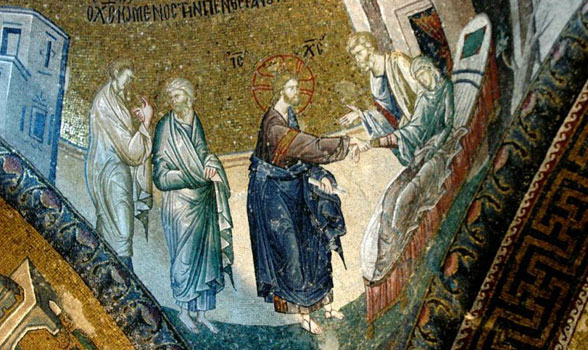
image from www.choramuseum.com