Day 1 (Monday)
Genesis 14:1-24 (Abram Goes to War, Meets Melchizedek)
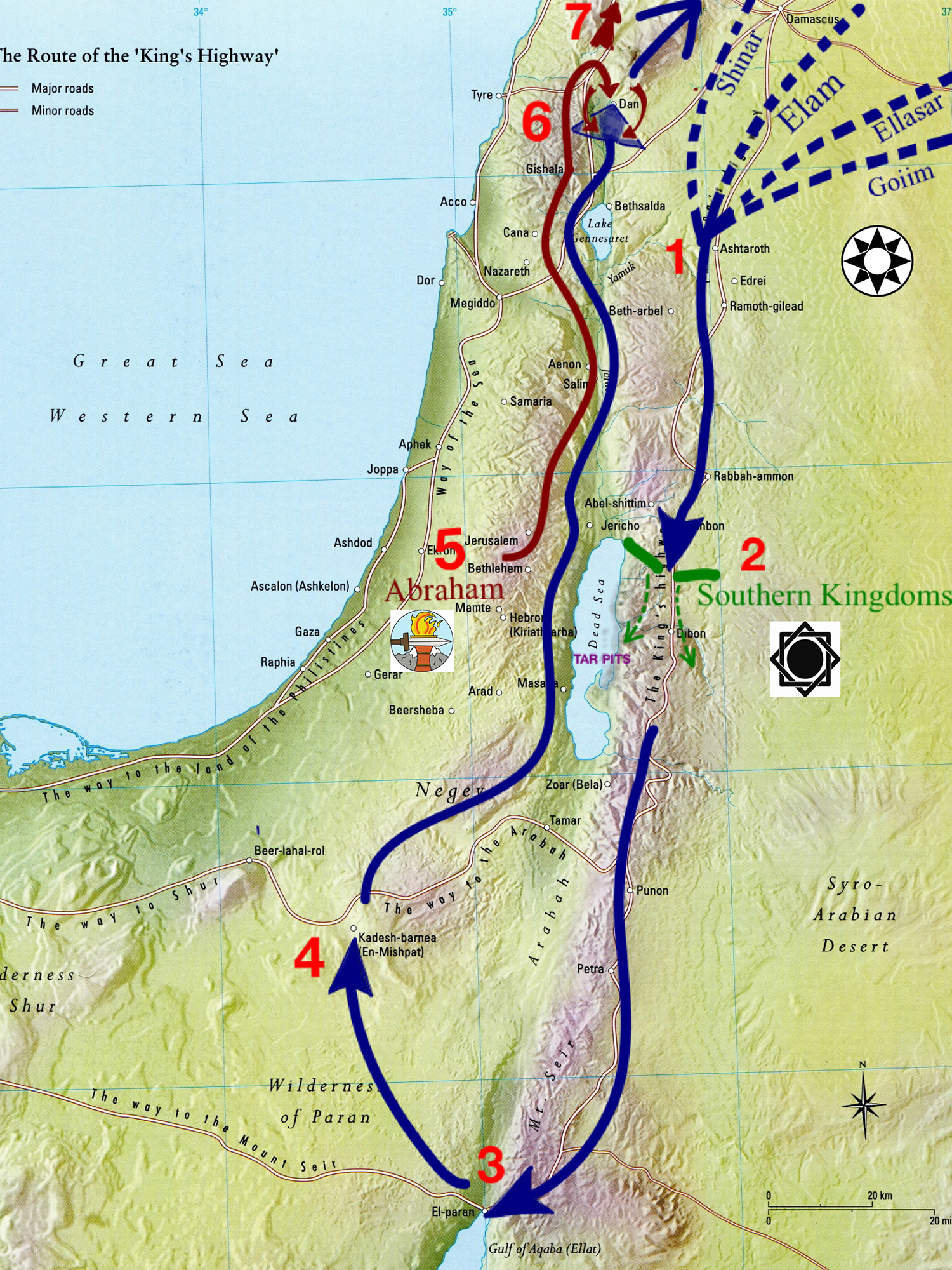
Last time we read about Abram and Lot encamping between Bethel and Ai, and then finding that there was not room enough in the land for both of them. So they separated, with Lot choosing the rich low country near the Dead Sea (although it was not dead at that time, but was rather a fertile and lush river valley), and Abram remaining in the hill country. At that time, God came to him and promised that his descendants would possess everything he could see, in all directions. At this point, Abram moved south, from Bethel/Ai to Hebron (a map showing the rough locations being discussed in these chapters may be found here: http://godswarplan.com/wp-content/uploads/2016/04/06-BATTLE-of-SIDDIM-Main-LG.jpg. Please note – the rest of the linked webpage may be interesting, but I can’t vouch for its quality or accuracy. The map should be helpful, however.) This time we will see what happens to Lot after he settles in this rich and fertile country.
Lot’s Captivity and Rescue
14 In the days of King Amraphel of Shinar, King Arioch of Ellasar, King Chedorlaomer of Elam, and King Tidal of Goiim, 2 these kings made war with King Bera of Sodom, King Birsha of Gomorrah, King Shinab of Admah, King Shemeber of Zeboiim, and the king of Bela (that is, Zoar). 3 All these joined forces in the Valley of Siddim (that is, the Dead Sea). 4 Twelve years they had served Chedorlaomer, but in the thirteenth year they rebelled.
5 In the fourteenth year Chedorlaomer and the kings who were with him came and subdued the Rephaim in Ashteroth-karnaim, the Zuzim in Ham, the Emim in Shaveh-kiriathaim, 6 and the Horites in the hill country of Seir as far as El-paran on the edge of the wilderness; 7 then they turned back and came to En-mishpat (that is, Kadesh), and subdued all the country of the Amalekites, and also the Amorites who lived in Hazazon-tamar.
8 Then the king of Sodom, the king of Gomorrah, the king of Admah, the king of Zeboiim, and the king of Bela (that is, Zoar) went out, and they joined battle in the Valley of Siddim 9 with King Chedorlaomer of Elam, King Tidal of Goiim, King Amraphel of Shinar, and King Arioch of Ellasar, four kings against five. 10 Now the Valley of Siddim was full of bitumen pits; and as the kings of Sodom and Gomorrah fled, some fell into them, and the rest fled to the hill country. 11 So the enemy took all the goods of Sodom and Gomorrah, and all their provisions, and went their way; 12 they also took Lot, the son of Abram’s brother, who lived in Sodom, and his goods, and departed.
13 Then one who had escaped came and told Abram the Hebrew, who was living by the oaks of Mamre the Amorite, brother of Eshcol and of Aner; these were allies of Abram. 14 When Abram heard that his nephew had been taken captive, he led forth his trained men, born in his house, three hundred eighteen of them, and went in pursuit as far as Dan. 15 He divided his forces against them by night, he and his servants, and routed them and pursued them to Hobah, north of Damascus. 16 Then he brought back all the goods, and also brought back his nephew Lot with his goods, and the women and the people.
Abram Blessed by Melchizedek
17 After his return from the defeat of Chedorlaomer and the kings who were with him, the king of Sodom went out to meet him at the Valley of Shaveh (that is, the King’s Valley). 18 And King Melchizedek of Salem brought out bread and wine; he was priest of God Most High. 19 He blessed him and said,
“Blessed be Abram by God Most High,
maker of heaven and earth;
20 and blessed be God Most High,
who has delivered your enemies into your hand!”
And Abram gave him one-tenth of everything. 21 Then the king of Sodom said to Abram, “Give me the persons, but take the goods for yourself.” 22 But Abram said to the king of Sodom, “I have sworn to the Lord, God Most High, maker of heaven and earth, 23 that I would not take a thread or a sandal-thong or anything that is yours, so that you might not say, ‘I have made Abram rich.’ 24 I will take nothing but what the young men have eaten, and the share of the men who went with me—Aner, Eshcol, and Mamre. Let them take their share.”
Discussion questions:
1) What did you notice in today’s reading? What surprised you or what was memorable to you? (Leader should point out that Abram doesn’t seem to go out to fight by himself, with only the 318 men from his household, as it speaks also of his allies going with him, and taking their share. Nonetheless, his force must have been tremendously outnumbered by this army that represents five significant and powerful city states in Mesopotamia. His victory should be considered a miracle, God fighting for Abram, and his refusal to take any spoils should be seen as another indication of this point. It should also be noted that Melchizedek here is apparently a faithful worshipper of Yahweh, living in the midst of peoples worshipping other gods. His name is heathen, but his actions and faith are not. Finally, it should be noted that this passage is read each time we celebrate the First Ecumenical Council at Nicaea, as there were 318 Fathers present at that council, and their rejection of the heresy of Arius is seen as typologically connected with this miraculous victory over invaders.)
2) Where do we see Christ in this text; what is He saying or doing here?
3) Do we see ourselves and the Church in this text; what does it say about us?
4) What do you find difficult about this reading? Is there anything confusing about it, or anything that you dislike? (This is an open question, as always. )
5) Does this reading make you think that you need to change anything in your life?
Day 2 (Wednesday)
St. Dionysios: Excerpt from "On the Divine Names"
The Church celebrates the feast of St. Dionysios the Areopagite on October 3rd, so it is appropriate that we should read something of his writings today. St. Dionysios was one of the first converts to Christianity in Athens, and has attributed to him some of the most important writings on how the Orthodox approach and speak about God. St. Dionysios affirms clearly that God can be known through prayer, and yet often speaks of God as unknowable, beyond human reason and understanding. This is a point that we often affirm in the Church (in summary) by stating that God can be encountered personally, but NEVER comprehended rationally. It is good, however, that we should read what St. Dionysios himself, and not merely what others say about him.
Chapter 3; Section 1
The power of prayer
1. For a start, then, let us look, if you will, at the most important name, “Good,” which shows forth all the processions of God. But we should really begin with an invocation of the Trinity, the source and, indeed, the superior of what is good. The Trinity shows forth every one of its most excellent processions and we should be uplifted to it and be shaped by it so as to learn of those good gifts which are gathered together around it. For the Trinity is present to all things, though all things are not present to it.
But if we invoke it with prayers that are holy, with untroubled mind, with a suitability for union with God, then we are surely present to it. For the Trinity is not in any one location in such a manner as to be “away from” one place or moving from “one spot to another.” Even to speak of it as “present in everything” is inaccurate since this does not convey the fact that it infinitely transcends everything and yet gathers everything within it.
So let us stretch ourselves prayerfully upward to the more lofty elevation of the kindly Rays of God. Imagine a great shining chain hanging downward from the heights of heaven to the world below. We grab hold of it with one hand and then another, and we seem to be pulling it down toward us. Actually it is already there on the heights and down below and instead of pulling it to us we are being lifted upward to that brilliance above, to the dazzling light of those beams.
Or picture ourselves aboard a boat. There are hawsers joining it to some rock. We take hold of them and pull on them, and it is as if we were dragging the rock to us when in fact we are hauling ourselves and our boat toward that rock. And, from another point of view, when someone on the boat pushes away the rock which is on the shore he will have no effect on the rock, which stands immovable, but will make a space between it and himself, and the more he pushes the greater will be the space.
That is why we must begin with a prayer before everything we do, but especially when we are about to talk of God. We will not pull down to ourselves that power which is both everywhere and yet nowhere, but by divine reminders and invocations we may commend ourselves to it and be joined to it.
Pseudo-Dionysius, Pseudo-Dionysius: The Complete Works, ed. John Farina, trans. Colm Luibheid and Paul Rorem, The Classics of Western Spirituality (New York; Mahwah, NJ: Paulist Press, 1987), 68–69.
Discussion questions:
1) What did you notice in today’s reading? What surprised you or what was memorable to you? (The Leader should point the central point of St. Dionysios’ teaching here: we cannot bring God down to us, as He is at once already present everywhere and entirely beyond our comprehension and power; but we can learn to be present with God, as He is always present with us, and to no longer push ourselves away from Him and separate ourselves from Him. This is, in a very real sense, the entire work of the Christian life: learning to be present with God, that is, to pray, and learning to lay aside every unworthy action which pushes us away from Him, that is, every sin.)
2) Where do we see Christ in this text; what is He saying or doing here?
3) Do we see ourselves and the Church in this text; what does it say about us?
4) What do you find difficult about this reading? Is there anything confusing about it, or anything that you dislike? (This is an open question, as always. )
5) Does this reading make you think that you need to change anything in your life?
Day 3 (Friday)
Matthew 3:13-17; 4:1-11 (Baptism & Temptation of Jesus)
Last time we saw Jesus return from Egypt to live in Nazareth, and then we jumped forward in time to see John the Baptist begin to preach, preparing the way for the Lord out in the wilderness beyond Jordan, calling the people to repentance. This time, we will see Jesus go to John and be baptized, and then go out into the wilderness, where Satan will tempt him.
The Baptism of Jesus
13 Then Jesus came from Galilee to John at the Jordan, to be baptized by him. 14 John would have prevented him, saying, “I need to be baptized by you, and do you come to me?” 15 But Jesus answered him, “Let it be so now; for it is proper for us in this way to fulfill all righteousness.” Then he consented. 16 And when Jesus had been baptized, just as he came up from the water, suddenly the heavens were opened to him and he saw the Spirit of God descending like a dove and alighting on him. 17 And a voice from heaven said, “This is my Son, the Beloved, with whom I am well pleased.”
The Temptation of Jesus
4 Then Jesus was led up by the Spirit into the wilderness to be tempted by the devil. 2 He fasted forty days and forty nights, and afterwards he was famished. 3 The tempter came and said to him, “If you are the Son of God, command these stones to become loaves of bread.” 4 But he answered, “It is written,
‘One does not live by bread alone,
but by every word that comes from the mouth of God.’”
5 Then the devil took him to the holy city and placed him on the pinnacle of the temple, 6 saying to him, “If you are the Son of God, throw yourself down; for it is written,
‘He will command his angels concerning you,’
and ‘On their hands they will bear you up,
so that you will not dash your foot against a stone.’”
7 Jesus said to him, “Again it is written, ‘Do not put the Lord your God to the test.’”
8 Again, the devil took him to a very high mountain and showed him all the kingdoms of the world and their splendor; 9 and he said to him, “All these I will give you, if you will fall down and worship me.” 10 Jesus said to him, “Away with you, Satan! for it is written,
‘Worship the Lord your God,
and serve only him.’”
11 Then the devil left him, and suddenly angels came and waited on him.
Discussion questions:
1) What did you notice in today’s reading? What surprised you or what was memorable to you? (The Leader should ask the group the important question of why it was “necessary to fulfil all righteousness” for Jesus to be baptized, and note that the Lord’s baptism is a sign of His Incarnation, and especially of death and resurrection. His blessing of the water by being immersed in the water is a sign and token of His trampling death by means of death. It is also worth noting how Satan tempted the Lord, and the Lord met the challenge with Scripture. In this, the Lord shows us an important element of resisting temptation; He gives no space to the temptation, nor does He even argue with it. He simply abides in the truth of the relationship between God and humanity, as expressed in Scripture, and denies the temptation.)
2) Where do we see Christ in this text; what is He saying or doing here?
3) Do we see ourselves and the Church in this text; what does it say about us?
4) What do you find difficult about this reading? Is there anything confusing about it, or anything that you dislike? (This is an open question, as always. )
5) Does this reading make you think that you need to change anything in your life?