Day 1 (Monday)
Genesis 18:1-15 (God Appears to Abraham, Sarah Laughs at God)
In the last two weeks, we saw Abram at the age of 99, when God finally came to him to seal the promise from 25 years before. God gave a new name to both Abram and Sarai, calling them Abraham and Sarah, and promised that Sarah would bear a son to Abraham the very next year. This time, we will see the Lord come in person to Abraham in His tent, and confirm the promise face to face, over a meal.
A Son Promised to Abraham and Sarah
18 The Lord appeared to Abraham by the oaks of Mamre, as he sat at the entrance of his tent in the heat of the day. 2 He looked up and saw three men standing near him. When he saw them, he ran from the tent entrance to meet them, and bowed down to the ground. 3 He said, “My Lord, if I find favor with you, do not pass by your servant. 4 Let a little water be brought, and wash your feet, and rest yourselves under the tree. 5 Let me bring a little bread, that you may refresh yourselves, and after that you may pass on—since you have come to your servant.”
So they said, “Do as you have said.” 6 And Abraham hastened into the tent to Sarah, and said, “Make ready quickly three measures of choice flour, knead it, and make cakes.” 7 Abraham ran to the herd, and took a calf, tender and good, and gave it to the servant, who hastened to prepare it. 8 Then he took curds and milk and the calf that he had prepared, and set it before them; and he stood by them under the tree while they ate.
9 They said to him, “Where is your wife Sarah?” And he said, “There, in the tent.” 10 Then one said, “I will surely return to you in due season, and your wife Sarah shall have a son.” And Sarah was listening at the tent entrance behind him. 11 Now Abraham and Sarah were old, advanced in age; it had ceased to be with Sarah after the manner of women. 12 So Sarah laughed to herself, saying, “After I have grown old, and my husband is old, shall I have conception?”
13 The Lord said to Abraham, “Why did Sarah laugh, and say, ‘Shall I indeed bear a child, now that I am old?’ 14 Is anything too wonderful for the Lord? At the set time I will return to you, in due season, and Sarah shall have a son.” 15 But Sarah denied, saying, “I did not laugh”; for she was afraid. He said, “Oh yes, you did laugh.”
Discussion questions:
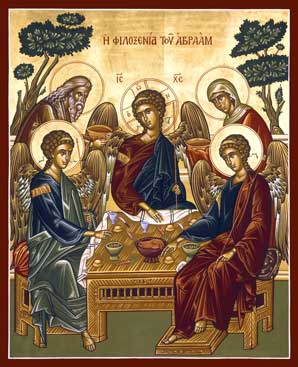
1) What did you notice in today’s reading? What surprised you or what was memorable to you? (The Leader should point out that here, as well as in the previous chapters we have read, when it says “The Lord” appeared to Abraham, once again “The Lord” is rendering the Hebrew name Yahweh. This means a few things; it means that this story is being told after the fact, as God does not reveal His name Yahweh until He gives it to Moses on Mt. Sinai several hundred years after the events described here. So the narrator here is telling the story of God’s appearance to Abraham at the Oak of Mamre, and making very clear to us that this is not just some angel, but is God Himself, Yahweh the God of Israel. The icon shown above makes this very clear by including both the Greek letters Ο ΩΝ (ὁ ὤν) above the head of the center “angel,” but by also including the normal iconic abbreviations of the name of our Lord Jesus Christ, “ΙΣ ΧΣ,” above His head. In this scene, then, the 2nd Person of the Holy Trinity comes literally, visibly, and in person, together with two angels, and eats a meal with Abraham, receiving His hospitality as He guarantees His long promise with His own presence. We may note, as well, the miraculous strangeness and intimacy of the scene, as Sarah laughs at the promise, and the Lord calls her on her laughter, His knowledge of her inner heart and mind itself a sign of His divinity and a proof that the promise is sure.)
2) Where do we see Christ in this text; what is He saying or doing here?
3) Do we see ourselves and the Church in this text; what does it say about us?
4) What do you find difficult about this reading? Is there anything confusing about it, or anything that you dislike? (This is an open question, as always. )
5) Does this reading make you think that you need to change anything in your life?
Day 2 (Wednesday)
St. John of Damascus on the Holy Trinity (and the traditional icon depicting the Holy Trinity)
For our Church Tradition reading this week, we will look at something that may seem unrelated to our other readings, but is in fact directly connected to our Day 1 reading. We will see what St. John of Damascus says about the Holy Trinity, One God in Three Persons. This is relevant to what we saw on Day 1 because the Church has always understood God’s coming to Abraham and Sarah at the Oak of Mamre to be a Theophany, a revelation of God to them, with the three angels speaking and acting in perfect unity providing an image to them of the Holy Trinity. This scene has therefore become the theme of the only normal and appropriate icon of the Holy Trinity. So we will see what St. John of Damascus has to say about the Holy Trinity, and then we will look at several different examples of this icon from the history of the Church.
From “An Exact Exposition on the Orthodox Faith” by St. John of Damascus, Book 1, Chapter 12
And so, God is called ‘Mind,’ and ‘Reason,’ and Spirit,’ and ‘Wisdom,’ because He is the cause of these, and because He is immaterial, and because He is all-working and all-powerful. And these names, both those given by negation and those given by affirmation, are applied jointly to the whole Godhead. They also apply in the same way, identically, and without exception, to each one of the Persons of the Holy Trinity, Thus, when I think of one of the Persons, I know that He is perfect God, a perfect substance/hypostasis, but when I put them together and combine them, I know one perfect God. For the Godhead is not compounded, but is one perfect, indivisible, and uncompounded being in three perfect beings….
…Consequently, whatsoever pertains to the Father as cause, well-spring, and begetter must be attributed to the Father alone. Whatsoever pertains to the Son as caused, begotten son, word, primordial force, will, and wisdom must be attributed to the Son alone. And whatsoever pertains to the caused, proceeding, revealing, and perfecting power must be attributed to the Holy Ghost.
The Father is well-spring and cause of Son and Holy Ghost—He is Father of the only Son and Emitter of the Holy Ghost. The Son is son, word, wisdom, power, image, radiance, and type of the Father, and He is from the Father. And the Holy Ghost is not a son of the Father, but He is the Spirit of the Father as proceeding from the Father. For, without the Spirit, there is no impulsion. And He is the Spirit of the Son, not as being from Him, but as proceeding through Him from the Father—for the Father alone is Cause.
John Damascene, Writings, ed. Hermigild Dressler, trans. Frederic H. Chase Jr., vol. 37, The Fathers of the Church (Washington, DC: The Catholic University of America Press, 1958), 195–196.


Discussion questions:
1) What did you notice in today’s reading? What surprised you or what was memorable to you? (Leader should point out how St. John talks about both the unity of the Three Persons of the Trinity, and also their distinctions. They should then show the icons, and point out the figures of Abraham and Sarah (or their absence) and the three angels seated. Sometimes the central angel is identified as the Son and Logos of God with the cross-shape and letters about His head, while other times the identity between that angel and the Son is conveyed by the color of His clothing. In Rublev’s icon, and one other, the central and right-hand figures are inclining their heads toward the left-hand figure, as a sign of the primacy of the Father, and there as well, the angel on the right is clothed in green, the traditional color for feasts of the Holy Spirit.
In general, the intent and understanding of the Church as confessed by this icon is that it is Christ Himself Who is present with Abraham, along with two angels, who by their threeness and unity with Him reveal the Trinity, while as they proceed on to Sodom they are shown to be “only” angels, while He is Himself God, as Abraham addresses Him, and as the text of Scripture identifies Him.
It should be noted that this icon of the Hospitality of Abraham, showing the Theophany to Abraham at Mamre, is the appropriate icon for celebrating and proclaiming the Holy Trinity.
For a further discussion of this scene, and the icons that have depicted it over the centuries, and the way in which the Fathers of the Church have interpreted this passage across the centuries, we include links to two different websites which provide a fairly thorough presentation.
https://iconreader.wordpress.com/2011/02/20/icon-of-the-holy-trinity/
https://parochianus.blog/category/the-hospitality-of-abraham/)
2) Where do we see Christ in this text; what is He saying or doing here?
3) Do we see ourselves and the Church in this text; what does it say about us?
4) What do you find difficult about this reading? Is there anything confusing about it, or anything that you dislike? (This is an open question, as always. )
5) Does this reading make you think that you need to change anything in your life?
Day 3 (Friday)
Matthew 6:1-18 (Almsgiving, Prayer & Fasting)
Last time we finished Chapter 5 of Matthew’s Gospel, the first of the three chapters of the Sermon on the Mount, in which the Lord talked about a different way of living in the world, and commanded His followers to love even their enemies. This time we will see Him continue with more specific instructions for how they should conduct themselves in the spiritual disciplines of Almsgiving, Prayer, and Fasting.
Concerning Almsgiving
6 “Beware of practicing your piety before others in order to be seen by them; for then you have no reward from your Father in heaven.
2 “So whenever you give alms, do not sound a trumpet before you, as the hypocrites do in the synagogues and in the streets, so that they may be praised by others. Truly I tell you, they have received their reward. 3 But when you give alms, do not let your left hand know what your right hand is doing, 4 so that your alms may be done in secret; and your Father who sees in secret will reward you.
Concerning Prayer
5 “And whenever you pray, do not be like the hypocrites; for they love to stand and pray in the synagogues and at the street corners, so that they may be seen by others. Truly I tell you, they have received their reward. 6 But whenever you pray, go into your room and shut the door and pray to your Father who is in secret; and your Father who sees in secret will reward you.
7 “When you are praying, do not heap up empty phrases as the Gentiles do; for they think that they will be heard because of their many words. 8 Do not be like them, for your Father knows what you need before you ask him.
9 “Pray then in this way:
Our Father in heaven,
hallowed be your name.
10 Your kingdom come.
Your will be done,
on earth as it is in heaven.
11 Give us this day our daily bread.
12 And forgive us our debts,
as we also have forgiven our debtors.
13 And do not bring us to the time of trial,
but rescue us from the evil one.
14 For if you forgive others their trespasses, your heavenly Father will also forgive you; 15 but if you do not forgive others, neither will your Father forgive your trespasses.
Concerning Fasting
16 “And whenever you fast, do not look dismal, like the hypocrites, for they disfigure their faces so as to show others that they are fasting. Truly I tell you, they have received their reward. 17 But when you fast, put oil on your head and wash your face, 18 so that your fasting may be seen not by others but by your Father who is in secret; and your Father who sees in secret will reward you.
Discussion questions:
1) What did you notice in today’s reading? What surprised you or what was memorable to you? (Leader should note that these three disciplines are addressed together by the Lord, even as they are considered together with participation in the worship life of the Church as the three essential pillars of the spiritual life. What the Lord insists in all three cases is that these actions should be genuine, not merely external, but offerings from the heart, not for the sake of gaining the praise of others, but for the sake of true communion with God. In all three cases, we are commanded to keep our actions secret, so that we do not fall into the temptation of pride or vanity, but keep our attention on the Lord Himself.)
2) Where do we see Christ in this text; what is He saying or doing here?
3) Do we see ourselves and the Church in this text; what does it say about us?
4) What do you find difficult about this reading? Is there anything confusing about it, or anything that you dislike? (This is an open question, as always. )
5) Does this reading make you think that you need to change anything in your life?