Note: This week's readings are a bit longer than last week's, and touch on some fairly complex themes. Parents are urged to modify the readings (if necessary) and to select from the discussion questions as they feel is most appropriate for their children, depending on the age.
This week especially, you may find your conversations going far afield from the discussion questions; that's ok! Don't be afraid if you don't complete the discussion questions, so long as the family is talking about the reading and what it means.
Day 1 (Monday)
Genesis 3:8-24
Last week we read about the Fall, when the first woman and man disobeyed God and ate the forbidden fruit. This week we will see what happened next, when God came to them after their sin.
“8 They heard the sound of the Lord God walking in the garden at the time of the evening breeze, and the man and his wife hid themselves from the presence of the Lord God among the trees of the garden.
9 But the Lord God called to the man, and said to him, "Where are you?" 10 He said, "I heard the sound of you in the garden, and I was afraid, because I was naked; and I hid myself." 11 He said, "Who told you that you were naked? Have you eaten from the tree of which I commanded you not to eat?"
12 The man said, "The woman whom you gave to be with me, she gave me fruit from the tree, and I ate." 13 Then the Lord God said to the woman, "What is this that you have done?" The woman said, "The serpent tricked me, and I ate."
14 The Lord God said to the serpent, "Because you have done this, cursed are you among all animals and among all wild creatures; upon your belly you shall go, and dust you shall eat all the days of your life. 15 I will put enmity between you and the woman, and between your offspring and hers; he will strike your head, and you will strike his heel."
16 To the woman he said, "I will greatly increase your pangs in childbearing; in pain you shall bring forth children, yet your desire shall be for your husband, and he shall rule over you."
17 And to the man he said, "Because you have listened to the voice of your wife, and have eaten of the tree about which I commanded you, "You shall not eat of it,' cursed is the ground because of you; in toil you shall eat of it all the days of your life; 18 thorns and thistles it shall bring forth for you; and you shall eat the plants of the field. 19 By the sweat of your face you shall eat bread until you return to the ground, for out of it you were taken; you are dust, and to dust you shall return."
20 The man named his wife Eve, because she was the mother of all living. 21 And the Lord God made garments of skins for the man and for his wife, and clothed them. 22 Then the Lord God said, "See, the man has become like one of us, knowing good and evil; and now, he might reach out his hand and take also from the tree of life, and eat, and live forever"— 23 therefore the Lord God sent him forth from the garden of Eden, to till the ground from which he was taken. 24 He drove out the man; and at the east of the garden of Eden he placed the cherubim, and a sword flaming and turning to guard the way to the tree of life.“
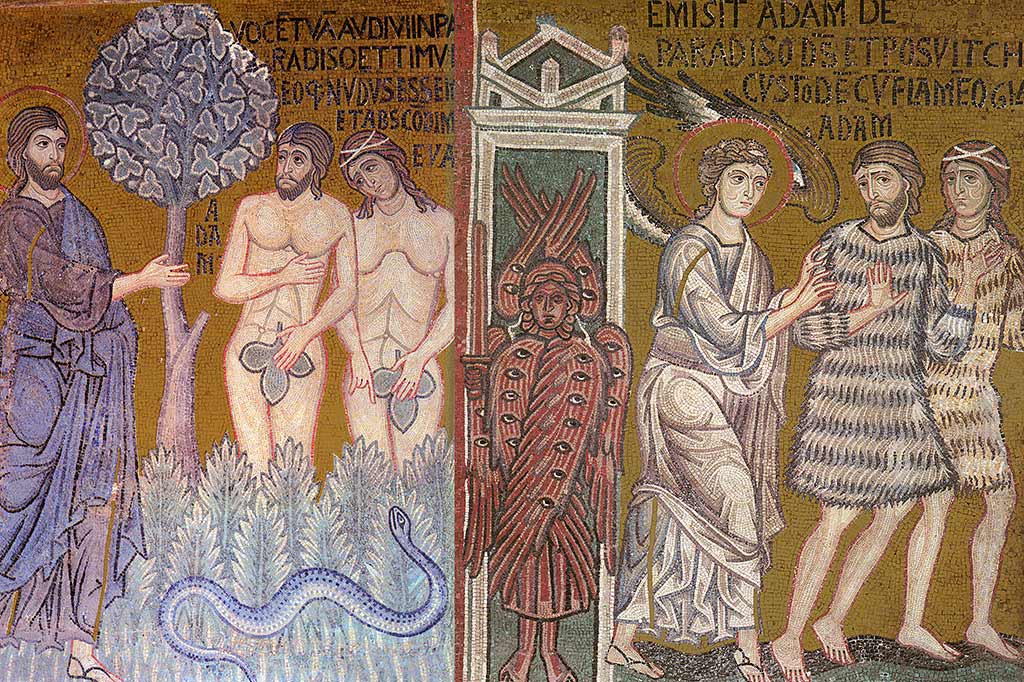
The Orthodox Church remembers the events described in this story on Forgiveness Sunday, the day before Great Lent begins. We include here the icon from that day, which shows God finding Adam and Eve, and then shows them being driven out of the Garden. Take a look at this icon and see what you notice about it.
Discussion questions:
1) Why did the man and the woman hide in the evening? (Because they heard God walking in the garden)
2) How do you think they were able to hear God walking in the Garden? Does God have feet? Who does the icon show with Adam and Eve in the Garden? (This is a question that encourages thought and speculation. However, within the Orthodox tradition, it is Jesus Christ Himself Who the icons show talking with Adam and Eve in the Garden, and when the Hymn of Kassiani talks about how the sinful woman washed the Lord’s feet, it makes the point that His feet were the same feet that Eve heard in the Garden, and hid herself.)
3) What did the man do when God asked if he had eaten the forbidden fruit? (He blamed the woman that God had given him…so pretty much he blamed God).
4) What did the woman do when God asked what she had done? (She blamed the snake).
5) What were the consequences for the snake? (The snake was cursed to go on its belly in the dust, and the fallen angel that had used the snake to tempt them was condemned to be the enemy of the woman and her descendants. The part about the snake’s head and the heel of Eve’s descendant was depicted in the picture last week)
6) What were the consequences for the woman? (Difficulty in childbirth, and submission to her husband. We need to note that both of these curses were lifted with Mary and her obedience. The Church has always taught that the Virgin Mary gave birth to Jesus Christ without the normal labor pains, specifically because with her, this curse is lifted. A lot of what we see about women in the Old Testament changes in the New Testament because of the Virgin Mary).
7) What were the consequences for the man? (He had to work to get food from the earth, as opposed to just picking fruit from the trees in the Garden, and he was condemned to die eventually and to go back to the earth from which he was taken. Both the man and the woman were kicked out of the Garden of Eden.)
8) What reason did God give for kicking them out of the Garden? (To make sure that they didn’t eat from the Tree of Life in their fallen condition. To live forever apart from God would be the worst thing imaginable, both for them, and for the universe at large).
Day 2 (Wednesday)
Hymns of Repentance from the Service of Confession
Since we talked on Monday about the consequences of the Fall, and how Adam and Eve lost their close relationship with God in the Garden of Eden because of their disobedience, today we’ll talk a little bit about Repentance, which is what we need to do to recover that relationship with God. We will specifically read three prayers/hymns of Repentance, which are used quite often in the life of the Church. The Priest prays these prayers every time he goes into the Church to do the Divine Liturgy, and we see them used in several other services of the Daily Cycle, and also in Paraklesis services and in the Sacrament of Confession.
“1 Have mercy on us, O Lord, have mercy on us: for at a loss for any plea, we sinners offer to You as Master this supplication: have mercy on us.
Glory to the Father and to the Son and to the Holy Spirit.
2 O Lord have mercy on us; for in You have we trusted: be not very angry with us, neither remember our iniquities. But as the Compassionate One, look down upon us even now, and deliver us from our enemies, for You are our God, and we are Your people, all being the works of Your hands, and we call upon Your name.
Both now and ever and to the ages of ages. Amen.
3 Open to us the doors of your lovingkindness, O blessed Theotokos, so that hoping in you we may not perish, but through you may be delivered from adversities; for you are the salvation of Christian people.”
There are a number of musical settings for these hymns – one beautiful version is linked below.
Discussion questions:
1) What do we ask God for in the first hymn? (For mercy)
2) What do you think it means when the hymn says “at a loss for any plea?” (It means that we don’t have any excuse or explanation to give to God for our sins – all we can give Him is our request that He have mercy on us)
3) In the 2nd hymn, what reason to we give to God to have mercy on us? (Because we have trusted in Him, because He is compassionate, and because we are His people, the work of His hands, and He is our God, and we call on His name).
4) Do you think that God is angry with us? What does the hymn say? (There may be many answers to this question – this is for discussion. I would point out that the hymn asks God NOT to be angry with us, which implies two things. The first is that God has every “right” to be angry with us; the second is that, when we ask Him for mercy, He will treat us with love, and not with anger.)
5) Who are we talking to in the 3rd Hymn? (To the Theotokos, the Virgin Mary – it may be worth reminding everyone that Theotokos means “Mother/Birthgiver of God,” and is the extra name with which we often address the Virgin Mary).
6) Why are we talking to the Virgin Mary in prayers of repentance? (When we sin, we turn away from the relationships and are selfish, acting as though we don’t need anyone else, and caring only for ourselves. Part of repentance is learning to ask for help, not only from God, but from other people, and especially from the Saints, who pray for us and by those prayers help us and support us. We especially ask the Virgin Mary for her prayers, because it was through her that salvation came into the world, in her Son, Jesus Christ our Lord and God. It is because of Him that she is the “salvation of the Christian people.”)
Day 3 (Friday)
Luke 4:14-30
Last week we saw Jesus in the desert for 40 days, being tempted by the Devil. After this, He went back to Galilee, back to His “home town” of Nazareth. There, in the synagogue, He proclaimed Himself to be the Messiah, the Christ, the Anointed One that the people were waiting for. Let’s see what happened…
“14 Then Jesus, filled with the power of the Spirit, returned to Galilee, and a report about him spread through all the surrounding country. 15 He began to teach in their synagogues and was praised by everyone.
16 When he came to Nazareth, where he had been brought up, he went to the synagogue on the sabbath day, as was his custom. He stood up to read, 17 and the scroll of the prophet Isaiah was given to him. He unrolled the scroll and found the place where it was written:
18 -19
“The Spirit of the Lord is upon me,
because he has anointed me
to bring good news to the poor.
He has sent me to proclaim release to the captives
and recovery of sight to the blind,
to let the oppressed go free,
to proclaim the year of the Lord’s favor.”
20 And he rolled up the scroll, gave it back to the attendant, and sat down. The eyes of all in the synagogue were fixed on him. 21 Then he began to say to them, “Today this scripture has been fulfilled in your hearing.” 22 All spoke well of him and were amazed at the gracious words that came from his mouth. They said, “Is not this Joseph’s son?” 23 He said to them, “Doubtless you will quote to me this proverb, ‘Doctor, cure yourself!’ And you will say, ‘Do here also in your hometown the things that we have heard you did at Capernaum.’” 24 And he said, “Truly I tell you, no prophet is accepted in the prophet’s hometown. 25 But the truth is, there were many widows in Israel in the time of Elijah, when the heaven was shut up three years and six months, and there was a severe famine over all the land; 26 yet Elijah was sent to none of them except to a widow at Zarephath in Sidon. 27 There were also many lepers[d] in Israel in the time of the prophet Elisha, and none of them was cleansed except Naaman the Syrian.” 28 When they heard this, all in the synagogue were filled with rage. 29 They got up, drove him out of the town, and led him to the brow of the hill on which their town was built, so that they might hurl him off the cliff. 30 But he passed through the midst of them and went on his way.
Discussion Questions
1) Where did Jesus go when He went back to Nazareth? (He went to the synagogue, the place where the people assembled on the Sabbath Day to read the Scripture)
2) What did He do there? (He read aloud from the prophecy of Isaiah, the prophecy of the Messiah, the Anointed One, God’s Chosen Christ – it is important to remind everyone that Messiah and Christ both mean “Anointed One.” One is the Hebrew word, the other is the Greek word, but both of them are talking about anointing, having oil poured on your head as a sign that God has chosen you to do an important job for him, like be a priest or a king or a savior.)
3) What did that prophecy say the Messiah was going to do? (To bring good news to the poor, to give sight to the blind, to give freedom to those who were enslaved or oppressed, and to announce the time of God’s favor on His people).
4) What did Jesus say when He had finished reading? (He told them that He was the fulfillment of the prophecy He had just read).
5) What did the people Jesus had grown up with say when they heard this? (First they said that He spoke very well, but then they started wondering what gave Him the right to say things like that, since He was just the son of the local carpenter, and a lot of them had known Him when He was just a child.)
6) What did Jesus say about this? (He quoted an old saying about how a prophet is never welcome in his own country, and then mentioned two stories from the Old Testament in which God’s blessings were given to strangers and foreigners, instead of to the Hebrew people. The point here, you might point out, is that Jesus is telling them that, as they question Him and try to put Him back in the box where they thought He fit, they are cutting themselves off from the blessings that He comes to give, and that those blessings will be given instead to foreigners and strangers).
7) What did the hometown crowd think of this? What did they do? (They were very angry, and tried to kill Him by throwing Him off a cliff).
8) How did Jesus escape? (He just walked through the crowd and left. We are to understand that this was a miracle, that He showed His power as God, that they were not able to hurt Him or even hold on to Him. This reminds us, as well, that Jesus could have escaped the Crucifixion at any time, had He decided to do so. That He did not escape then, as He does now, lets us see that He was there by choice, doing what He had come to do, in order to save us).